



 Chat with AI
Exam 23: Aggregate Demand and Aggregate Supply

Exam 1: Ten Principles of Economics438 Questions
Exam 2: Thinking Like an Economist620 Questions
Exam 3: Interdependence and the Gains From Trade527 Questions
Exam 4: The Market Forces of Supply and Demand700 Questions
Exam 5: Elasticity and Its Application598 Questions
Exam 6: Supply, Demand, and Government Policies648 Questions
Exam 7: Consumers, Producers, and the Efficiency of Markets550 Questions
Exam 8: Application: The Costs of Taxation514 Questions
Exam 9: Application: International Trade496 Questions
Exam 10: Externalities522 Questions
Exam 11: Public Goods and Common Resources434 Questions
Exam 12: The Costs of Production420 Questions
Exam 13: Firms in Competitive Markets543 Questions
Exam 14: Monopoly637 Questions
Exam 15: Measuring a Nations Income522 Questions
Exam 16: Measuring the Cost of Living545 Questions
Exam 17: Production and Growth507 Questions
Exam 18: Saving, Investment, and the Financial System567 Questions
Exam 19: The Basic Tools of Finance513 Questions
Exam 20: Unemployment699 Questions
Exam 21: The Monetary System518 Questions
Exam 22: Money Growth and Inflation487 Questions
Exam 23: Aggregate Demand and Aggregate Supply563 Questions
Exam 24: The Influence of Monetary and Fiscal Policy on Aggregate Demand512 Questions
Select questions type


The aggregate-demand curve shows the quantity of domestic goods and services that households, firms, the government, and customers abroad want to buy at each price level.
(True/False)
4.9/5  (78)
(78) Which of the following explains why production rises in most years?
(Multiple Choice)
4.8/5 (99)
(99) If businesses in general decide that they have overbuilt and so now have too much capital, their response to this would initially shift
(Multiple Choice)
4.7/5 (76)
(76) Which of the following is included in the aggregate demand for goods and services?
(Multiple Choice)
4.9/5 (89)
(89) Which of the following affected aggregate demand during the recession of 2008-2009?
(Multiple Choice)
5.0/5 (76)
(76) Imagine two economies that are identical except that for a long time, economy A has had a money supply of $1,000 billion while economy B has had a money supply of $500 billion. It follows that
(Multiple Choice)
4.9/5 (79)
(79) In which case can we be sure real GDP rises in the short run?
(Multiple Choice)
4.8/5 (81)
(81) Assuming that a is positive, theories of short-run aggregate supply are expressed mathematically as
(Multiple Choice)
5.0/5 (85)
(85) In the long-run, an increase in aggregate demand increases the price level, but not real GDP.
(True/False)
4.8/5 (74)
(74) Other things the same, the aggregate quantity of goods demanded in the U.S. increases if
(Multiple Choice)
4.7/5 (73)
(73) Policymakers who influence aggregate demand can potentially mitigate the severity of economic fluctuations.
(True/False)
4.8/5 (87)
(87) According to classical macroeconomic theory, changes in the money supply affect
(Multiple Choice)
4.7/5 (91)
(91) Figure 33-5.  -Refer to Figure 33-5. Starting from point B and assuming that aggregate demand is held constant, in the long run the economy is likely to experience
 (Multiple Choice)
4.9/5 (54)
(54) Figure 33-12. 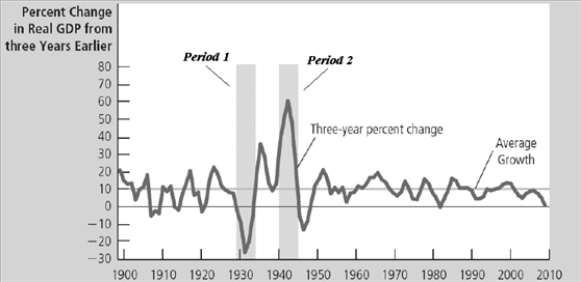 -Refer to Figure 33-12. Explain how the aggregate demand and aggregate supply model changed during periods 1 and 2.
 (Essay)
4.9/5 (74)
(74) According to classical macroeconomic theory, changes in the money supply affect
(Multiple Choice)
4.7/5 (90)
(90) In the first few years of the Great Depression, unemployment rose to about
(Multiple Choice)
4.8/5 (76)
(76) The recessions associated with the business cycle come at regular intervals.
(True/False)
5.0/5 (86)
(86) The exchange-rate effect is the idea that a higher U.S. price level causes the value of the dollar to increase in foreign exchange markets, and this effect contributes to the downward slope of the aggregate-demand curve.
(True/False)
4.8/5 (76)
(76) Which of the following would cause prices and real GDP to rise in the short run?
(Multiple Choice)
4.8/5 (83)
(83) 
Filters
- Essay(0)
- Multiple Choice(0)
- Short Answer(0)
- True False(0)
- Matching(0)