



 Chat with AI
Exam 25: Capital Budgeting and Managerial Decisions

Exam 1: Accounting in Business240 Questions
Exam 2: Analyzing and Recording Transactions197 Questions
Exam 3: Adjusting Accounts and Preparing Financial Statements224 Questions
Exam 4: Completing the Accounting Cycle176 Questions
Exam 5: Accounting for Merchandising Operations198 Questions
Exam 6: Inventories and Cost of Sales198 Questions
Exam 7: Accounting Information Systems176 Questions
Exam 8: Cash and Internal Controls196 Questions
Exam 9: Accounting for Receivables191 Questions
Exam 10: Plant Assets, Natural Resources, and Intangibles223 Questions
Exam 11: Current Liabilities and Payroll Accounting193 Questions
Exam 12: Accounting for Partnerships139 Questions
Exam 13: Accounting for Corporations246 Questions
Exam 14: Long-Term Liabilities198 Questions
Exam 15: Investments and International Operations192 Questions
Exam 16: Reporting the Statement of Cash Flows187 Questions
Exam 17: Analysis of Financial Statements187 Questions
Exam 18: Managerial Accounting Concepts and Principles197 Questions
Exam 19: Job Order Cost Accounting164 Questions
Exam 20: Process Cost Accounting174 Questions
Exam 21: Cost Allocation and Performance Measurement170 Questions
Exam 22: Cost-Volume-Profit Analysis186 Questions
Exam 23: Master Budgets and Planning162 Questions
Exam 24: Flexible Budgets and Standard Costs174 Questions
Exam 25: Capital Budgeting and Managerial Decisions150 Questions
Exam 26: Time Value of Money60 Questions
Select questions type


Beyer Corporation is considering buying a machine for $25,000. Its estimated useful life is 5 years, with no salvage value. Beyer anticipates annual net income after taxes of $1,500 from the new machine. What is the accounting rate of return assuming that Beyer uses straight-line depreciation and that income is earned uniformly throughout each year?
(Multiple Choice)
4.8/5  (83)
(83) A company is trying to decide which of two new product lines to introduce in the coming year. The predicted revenue and cost data for each product line follows: 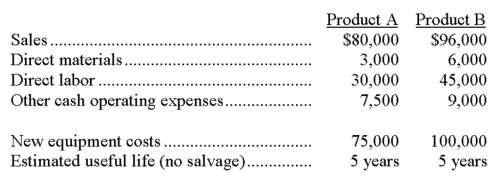 The company has a 30% tax rate, it uses the straight-line depreciation method, and it predicts that cash flows will be spread evenly throughout each year. Calculate each product's payback period. If the company requires a payback period of three years or less, which, if either, product should be chosen?
 (Not Answered)
This question doesn't have any answer yet
The concept of incremental cost is the same as the concept of differential cost.
(True/False)
4.8/5 (81)
(81) Briefly describe both the payback period method and the net present value method of comparing investment alternatives.
(Essay)
4.9/5 (91)
(91) A cost that requires a current and/or future outlay of cash, and is usually an incremental cost, is a(n):
(Multiple Choice)
5.0/5 (80)
(80) Identify at least three reasons for managers to favor the internal rate of return (IRR) over other capital budgeting approaches.
(Essay)
4.7/5 (80)
(80) Braybar Company is deciding between two projects. Each project requires an initial investment of $350,000. The projected net cash flows for the two projects are listed below. The revenue is to be received at the end of each year. Braybar requires a 10% return on its investments. The present value of an annuity of 1 and present value of an annuity factors for 10% are presented below. Use net present value to determine which project should be pursued and explain why. 
(Not Answered)
This question doesn't have any answer yet
For each of the capital budgeting methods listed below, place an X in the correct column, indicating the measurement basis of each, the ability to make comparison among projects, and whether each method reflects or ignores the time value of money. 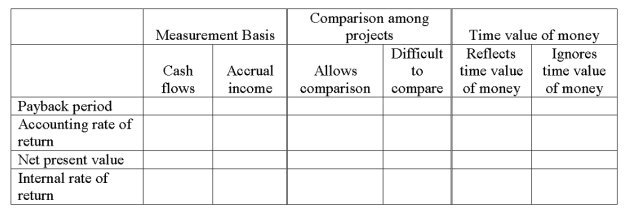
(Not Answered)
This question doesn't have any answer yet

Filters
- Essay(0)
- Multiple Choice(0)
- Short Answer(0)
- True False(0)
- Matching(0)