



 Chat with AI
Exam 25: Capital Budgeting and Managerial Decisions

Exam 1: Accounting in Business240 Questions
Exam 2: Analyzing and Recording Transactions197 Questions
Exam 3: Adjusting Accounts and Preparing Financial Statements224 Questions
Exam 4: Completing the Accounting Cycle176 Questions
Exam 5: Accounting for Merchandising Operations198 Questions
Exam 6: Inventories and Cost of Sales198 Questions
Exam 7: Accounting Information Systems176 Questions
Exam 8: Cash and Internal Controls196 Questions
Exam 9: Accounting for Receivables191 Questions
Exam 10: Plant Assets, Natural Resources, and Intangibles223 Questions
Exam 11: Current Liabilities and Payroll Accounting193 Questions
Exam 12: Accounting for Partnerships139 Questions
Exam 13: Accounting for Corporations246 Questions
Exam 14: Long-Term Liabilities198 Questions
Exam 15: Investments and International Operations192 Questions
Exam 16: Reporting the Statement of Cash Flows187 Questions
Exam 17: Analysis of Financial Statements187 Questions
Exam 18: Managerial Accounting Concepts and Principles197 Questions
Exam 19: Job Order Cost Accounting164 Questions
Exam 20: Process Cost Accounting174 Questions
Exam 21: Cost Allocation and Performance Measurement170 Questions
Exam 22: Cost-Volume-Profit Analysis186 Questions
Exam 23: Master Budgets and Planning162 Questions
Exam 24: Flexible Budgets and Standard Costs174 Questions
Exam 25: Capital Budgeting and Managerial Decisions150 Questions
Exam 26: Time Value of Money60 Questions
Select questions type


If a company has the capacity to produce either 10,000 units of Product X or 10,000 units of Product Y; assuming fixed costs remain constant, production restrictions are the same for both products, and the markets for both products are unlimited; the company should commit 100% of its capacity to the product that has the higher contribution margin.
(True/False)
4.8/5  (85)
(85) The payback method of evaluating an investment fails to consider how long the investment will generate cash inflows beyond the payback period.
(True/False)
4.7/5 (64)
(64) Use of the internal rate of return method cannot be used with uneven cash flows.
(True/False)
4.8/5 (86)
(86) A disadvantage of an investment with a short payback period is that it will produce revenue for only a short period of time.
(True/False)
4.8/5 (71)
(71) A capital budgeting method that considers how quickly a project recovers costs is known as _____________________. An enhancement to this method that considers the time value of money is called ________________.
(Short Answer)
4.8/5 (82)
(82) A company has the choice of either selling 1,000 defective units as scrap or rebuilding them. The company could sell the defective units as they are for $4.00 per unit. Alternatively, it could rebuild them with incremental costs of $1.00 per unit for materials, $2.00 per unit for labor, and $1.50 per unit for overhead, and then sell the rebuilt units for $8.00 each. What should the company do?
(Multiple Choice)
4.9/5 (83)
(83) A company inadvertently produced 6,000 defective portable CD players. The CD players cost $20 each to be manufactured. A salvage company will purchase the defective units as they are for $16 each. The production manager reports that the defects can be corrected for $9 per unit, enabling the company to sell them at the regular price of $30.00. The repair operations would not affect other production operations. Prepare an analysis that shows which action should be taken.
(Not Answered)
This question doesn't have any answer yet
A company puts four products through a common production process. This process costs $100,000 each year. The four products can be sold when they emerge from this process at the "split-off point", or processed further and then sold. Data about the four products for the coming period are: 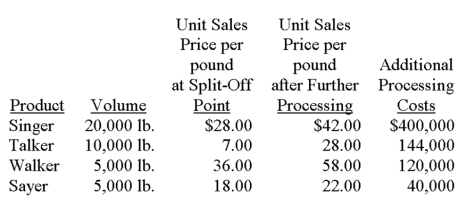 Determine which products should be sold at the split-off point and which should be processed further.
 (Not Answered)
This question doesn't have any answer yet
The process of restating future cash flows in today's dollars is known as:
(Multiple Choice)
4.9/5 (69)
(69) Part of the decision to accept additional business should be based on a comparison of the incremental (differential) costs of the added production with the additional revenues to be received.
(True/False)
4.8/5 (64)
(64) The process of analyzing alternative investments and deciding which assets to acquire or sell is known as:
(Multiple Choice)
4.8/5 (82)
(82) Capital budgeting is the process of analyzing alternative long-term investments and deciding which assets to acquire or sell.
(True/False)
4.8/5 (82)
(82) A company is evaluating the purchase of a machine for $900,000 with a six-year useful life and no salvage value. The company uses straight-line depreciation and it assumes that the annual net cash flow from using the machine will be received uniformly throughout each year. In calculating the accounting rate of return, what is the company's average investment?
(Not Answered)
This question doesn't have any answer yet
The __________________________ is the rate that yields a net present value of zero for an investment.
(Short Answer)
4.9/5 (85)
(85) When making capital budgeting decisions, companies usually prefer shorter payback periods. Explain why shorter payback periods are desirable.
(Essay)
4.9/5 (75)
(75) The net present value decision rule requires that when an asset's expected cash flows are discounted at the required rate and yield a positive net present value, the project should be ___________________.
(Short Answer)
4.7/5 (83)
(83) _____________________ is the process of analyzing alternative long-term investments and deciding which assets to acquire or sell.
(Short Answer)
4.8/5 (89)
(89) 
Filters
- Essay(0)
- Multiple Choice(0)
- Short Answer(0)
- True False(0)
- Matching(0)