



 Chat with AI
Exam 25: Capital Budgeting and Managerial Decisions

Exam 1: Accounting in Business240 Questions
Exam 2: Analyzing and Recording Transactions197 Questions
Exam 3: Adjusting Accounts and Preparing Financial Statements224 Questions
Exam 4: Completing the Accounting Cycle176 Questions
Exam 5: Accounting for Merchandising Operations198 Questions
Exam 6: Inventories and Cost of Sales198 Questions
Exam 7: Accounting Information Systems176 Questions
Exam 8: Cash and Internal Controls196 Questions
Exam 9: Accounting for Receivables191 Questions
Exam 10: Plant Assets, Natural Resources, and Intangibles223 Questions
Exam 11: Current Liabilities and Payroll Accounting193 Questions
Exam 12: Accounting for Partnerships139 Questions
Exam 13: Accounting for Corporations246 Questions
Exam 14: Long-Term Liabilities198 Questions
Exam 15: Investments and International Operations192 Questions
Exam 16: Reporting the Statement of Cash Flows187 Questions
Exam 17: Analysis of Financial Statements187 Questions
Exam 18: Managerial Accounting Concepts and Principles197 Questions
Exam 19: Job Order Cost Accounting164 Questions
Exam 20: Process Cost Accounting174 Questions
Exam 21: Cost Allocation and Performance Measurement170 Questions
Exam 22: Cost-Volume-Profit Analysis186 Questions
Exam 23: Master Budgets and Planning162 Questions
Exam 24: Flexible Budgets and Standard Costs174 Questions
Exam 25: Capital Budgeting and Managerial Decisions150 Questions
Exam 26: Time Value of Money60 Questions
Select questions type


A disadvantage of using the payback period to compare investment alternatives is that:
(Multiple Choice)
4.9/5  (67)
(67) The _______________________________ is computed by dividing a project's after-tax net income by the average amount invested in it.
(Short Answer)
4.8/5 (86)
(86) An estimate of an asset's value to the company, calculated by discounting the future cash flows from the investment at an appropriate rate and then subtracting the initial cost of the investment, is known as:
(Multiple Choice)
4.8/5 (83)
(83) Axle Company can produce a product that incurs the following costs per unit: direct materials, $10; direct labor, $24, and overhead, $16. An outside supplier has offered to sell the product to Axle for $45. If Axle buys from the supplier, it will still incur 45% of its overhead cost. Compute the net incremental cost or savings of buying.
(Multiple Choice)
4.8/5 (82)
(82) In this chapter, you examined several short-term managerial decision tasks. Identify (list) any three of these types of decision tasks:
___________________________
_________________________
_________________________
(Essay)
4.8/5 (85)
(85) Which one of the following methods considers the time value of money in evaluating alternative capital expenditures?
(Multiple Choice)
4.8/5 (77)
(77) The time expected to pass before the net cash flows from an investment would return its initial cost is called the:
(Multiple Choice)
4.9/5 (82)
(82) A company can buy a machine that is expected to have a three-year life and a $30,000 salvage value. The machine will cost $1,800,000 and is expected to produce a $200,000 after-tax net income to be received at the end of each year. If a table of present values of 1 at 12% shows values of 0.8929 for one year, 0.7972 for two years, and 0.7118 for three years, what is the net present value of the cash flows from the investment, discounted at 12%?
(Not Answered)
This question doesn't have any answer yet
The following data concerns a proposed equipment purchase: 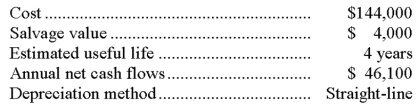 Assuming that net cash flows are received evenly throughout the year, the accounting rate of return is:
 (Multiple Choice)
4.9/5 (74)
(74) Relevant benefits refer to the additional or incremental revenue generated by selecting a particular course or action over another.
(True/False)
4.9/5 (77)
(77) The minimum acceptable rate of return on an investment is called the ________________.
(Short Answer)
4.7/5 (90)
(90) The rate that yields a net present value of zero for an investment is the:
(Multiple Choice)
4.9/5 (74)
(74) An ________________________ requires a future outlay of cash and is relevant for current and future decision making.
(Short Answer)
4.9/5 (78)
(78) The potential benefits of one alternative that are lost by choosing another is known as a(n):
(Multiple Choice)
4.7/5 (89)
(89) A new manufacturing machine is expected to cost $286,000, have an eight-year life, and a $30,000 salvage value. The machine will yield an annual incremental after-tax income of $35,000 after deducting the straight-line depreciation. Compute the payback period for the purchase.
(Multiple Choice)
4.8/5 (83)
(83) A company is considering the purchase of a new machine for $48,000. Management predicts that the machine can produce sales of $16,000 each year for the next 10 years. Expenses are expected to include direct materials, direct labor, and factory overhead totaling $8,000 per year plus depreciation of $4,000 per year. The company's tax rate is 40%. What is the payback period for the new machine?
(Multiple Choice)
4.8/5 (90)
(90) A _____________________ arises from a past decision and cannot be avoided or changed; it is irrelevant to future decisions.
(Short Answer)
4.9/5 (68)
(68) Eagle Company is considering the purchase of an asset for $100,000. It is expected to produce the following net cash flows. The cash flows occur evenly throughout each year. Compute the break-even time (BET) period for this investment. (Round to two decimal places.) 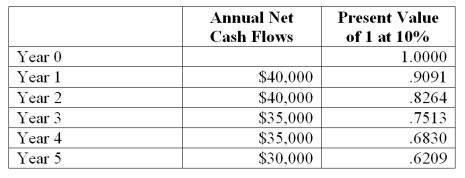
(Multiple Choice)
4.9/5 (80)
(80) Daniels Corporation is considering the purchase of new equipment costing $30,000. The projected annual after-tax net income from the equipment is $1,200, after deducting $10,000 for depreciation. The revenue is to be received at the end of each year. The machine has a useful life of 3 years and no salvage value. Daniels requires a 12% return on its investments. The present value of an annuity of 1 for different periods follows: 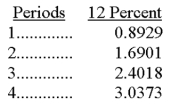 What is the net present value of the machine?
 (Multiple Choice)
4.8/5 (86)
(86) 
Filters
- Essay(0)
- Multiple Choice(0)
- Short Answer(0)
- True False(0)
- Matching(0)