



 Chat with AI
Exam 25: Capital Budgeting and Managerial Decisions

Exam 1: Accounting in Business240 Questions
Exam 2: Analyzing and Recording Transactions197 Questions
Exam 3: Adjusting Accounts and Preparing Financial Statements224 Questions
Exam 4: Completing the Accounting Cycle176 Questions
Exam 5: Accounting for Merchandising Operations198 Questions
Exam 6: Inventories and Cost of Sales198 Questions
Exam 7: Accounting Information Systems176 Questions
Exam 8: Cash and Internal Controls196 Questions
Exam 9: Accounting for Receivables191 Questions
Exam 10: Plant Assets, Natural Resources, and Intangibles223 Questions
Exam 11: Current Liabilities and Payroll Accounting193 Questions
Exam 12: Accounting for Partnerships139 Questions
Exam 13: Accounting for Corporations246 Questions
Exam 14: Long-Term Liabilities198 Questions
Exam 15: Investments and International Operations192 Questions
Exam 16: Reporting the Statement of Cash Flows187 Questions
Exam 17: Analysis of Financial Statements187 Questions
Exam 18: Managerial Accounting Concepts and Principles197 Questions
Exam 19: Job Order Cost Accounting164 Questions
Exam 20: Process Cost Accounting174 Questions
Exam 21: Cost Allocation and Performance Measurement170 Questions
Exam 22: Cost-Volume-Profit Analysis186 Questions
Exam 23: Master Budgets and Planning162 Questions
Exam 24: Flexible Budgets and Standard Costs174 Questions
Exam 25: Capital Budgeting and Managerial Decisions150 Questions
Exam 26: Time Value of Money60 Questions
Select questions type


A company is planning to introduce a new portable TV to its existing product line. Management must decide whether to make the TV case or buy it from an outside supplier. The lowest outside price is $100. If the case is produced internally, the company will have to purchase new equipment that will yield annual depreciation of $130,000. The company will also need to rent a new production facility at $200,000 a year. At 20,000 cases per year, a preliminary analysis of production costs shows the following: 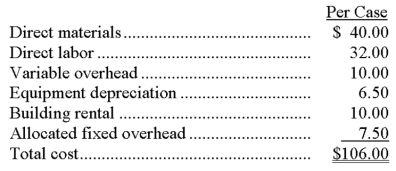 Required:
(1) Determine whether the company should make the cases or buy them from the outside supplier.
(2) What decision should be made if only 15,000 cases are needed?
(3) What other factors, besides cost, should the company consider?
Required:
(1) Determine whether the company should make the cases or buy them from the outside supplier.
(2) What decision should be made if only 15,000 cases are needed?
(3) What other factors, besides cost, should the company consider? (Not Answered)
This question doesn't have any answer yet
Jorgensen Department Store has three departments: Clothing, Toys, and Jewelry. The most recent income statement, showing the total operating profit and departmental results is shown below: 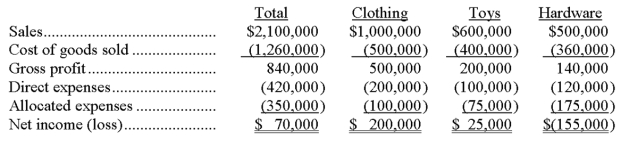 Based on this income statement, management is planning on eliminating the hardware department, as it is generating a net loss. If the hardware department is eliminated, the toy department will expand to fill the space, but sales will not change in total, nor will direct expenses. None of the allocated expenses will be avoided, but they will be reallocated. Clothing will be allocated $200,000 of these expenses, and Toys will be allocated $150,000 of these expenses.
Prepare a new income statement for Jorgensen Department Store, showing the results if the Hardware Department is eliminated. Should the Hardware Department be eliminated?
Based on this income statement, management is planning on eliminating the hardware department, as it is generating a net loss. If the hardware department is eliminated, the toy department will expand to fill the space, but sales will not change in total, nor will direct expenses. None of the allocated expenses will be avoided, but they will be reallocated. Clothing will be allocated $200,000 of these expenses, and Toys will be allocated $150,000 of these expenses.
Prepare a new income statement for Jorgensen Department Store, showing the results if the Hardware Department is eliminated. Should the Hardware Department be eliminated? (Not Answered)
This question doesn't have any answer yet
A cost that cannot be avoided or changed because it arises from a past decision, and is irrelevant to future decisions, is called a(n):
(Multiple Choice)
4.8/5  (76)
(76) Trescott Company had the following results of operations for the past year: 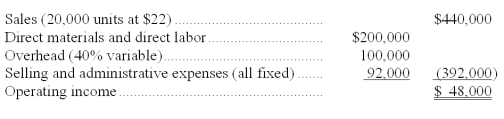 A foreign company (whose sales will not affect Trescott's market) offers to buy 3,000 units at $17.00 per unit. In addition to variable manufacturing costs, selling these units would increase fixed overhead by $500 and selling and administrative costs by $1,000. If Trescott accepts the offer, its profits will:
 (Multiple Choice)
4.7/5 (81)
(81) If two projects have the same risks, the same payback periods, and the same initial investments, they are equally attractive.
(True/False)
4.9/5 (77)
(77) In a make or buy decision, management should focus on costs that are constant under the two alternatives.
(True/False)
4.8/5 (85)
(85) Two investments with exactly the same payback periods are always equally valuable to an investor.
(True/False)
4.9/5 (89)
(89) A company produces three different products that all require processing on the same machines. There are only 27,000 machine hours available in each year. Production information for each product is:  Required:
(1) Determine the preferred sales mix if there are no market constraints on any of the products.
(2) Determine the preferred sales mix if the demand is limited to 5,000 units for each product.
(3) Determine the preferred sales mix if the demand is limited to 3,000 units for each product.
Required:
(1) Determine the preferred sales mix if there are no market constraints on any of the products.
(2) Determine the preferred sales mix if the demand is limited to 5,000 units for each product.
(3) Determine the preferred sales mix if the demand is limited to 3,000 units for each product. (Not Answered)
This question doesn't have any answer yet
A machine costs $180,000 and is expected to yield an after-tax net income of $10,800 each year. Management estimates the machine will have a ten-year life, a $20,000 salvage value, and straight-line depreciation is used. Compute the accounting rate of return for the investment.
(Multiple Choice)
4.9/5 (83)
(83) The calculation of the payback period for an investment when net cash flow is even (equal) is:
(Multiple Choice)
4.8/5 (63)
(63) Thompson Company had the following results of operations for the past year: 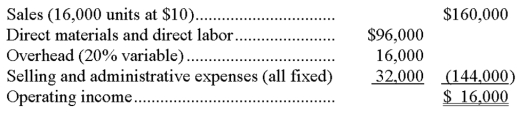 A foreign company (whose sales will not affect Thompson's market) offers to buy 4,000 units at $7.50 per unit. In addition to variable manufacturing costs, selling these units would increase fixed overhead by $600 and selling and administrative costs by $300. If Thompson accepts the offer, its profits will:
 (Multiple Choice)
4.9/5 (74)
(74) Marcus processes four different products that can either be sold as is or processed further. Listed below are sales and additional cost data: 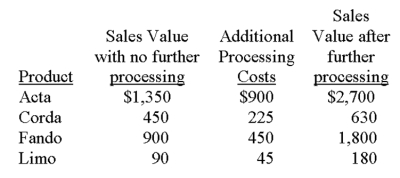 Which product(s) should not be processed further?
 (Multiple Choice)
4.9/5 (73)
(73) A company is considering a new project that will cost $19,000. This project would result in additional annual revenues of $6,000 for the next 5 years. The $19,000 cost is an example of a(n):
(Multiple Choice)
4.9/5 (65)
(65) Sherman Company can sell all of product A that it produces but only 160,000 units of Z and it has limited production capacity. It can produce 6 units of A per hour or 10 units of Z per hour, and it has 30,000 production hours available. Contribution margin per unit is $12 for A and $10 for Z. What is the most profitable sales mix for this company?
(Not Answered)
This question doesn't have any answer yet
A company is trying to decide which of two new product lines to introduce in the coming year. The company requires a 12% return on investment. The predicted revenue and cost data for each product line follows: 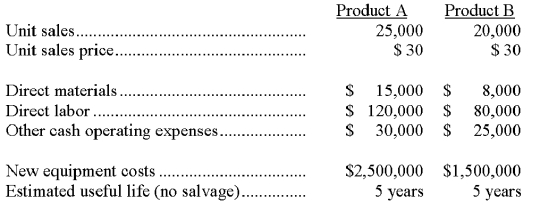 The company has a 30% tax rate and it uses the straight-line depreciation method. The present value of an annuity of 1 for 5 years at 12% is 3.6048. Compute the net present value for each piece of equipment under each of the two product lines. Which, if either of these two investments is acceptable?
 (Not Answered)
This question doesn't have any answer yet
A company manufactures two products. Each unit of product X requires 10 machine hours and each unit of product Y requires 4 machine hours. The company's productive capacity is limited to 180,000 machine hours. Each unit of product X sells for $15 and has variable costs of $7. Each unit of product Y sells for $8 and has variable costs of $3. If the company can sell all that it produces of both products, what should the sales mix be?
(Not Answered)
This question doesn't have any answer yet
After-tax net income divided by the annual average investment in an investment, is the:
(Multiple Choice)
4.9/5 (80)
(80) A company is considering the purchase of a new piece of equipment for $90,000. Predicted annual cash inflows from this investment are $36,000 (year 1), $30,000 (year 2), $18,000 (year 3), $12,000 (year 4) and $6,000 (year 5). The payback period is:
(Multiple Choice)
4.8/5 (72)
(72) The calculation of annual net cash flow from a particular investment project should include all of the following except:
(Multiple Choice)
4.9/5 (83)
(83) 
Filters
- Essay(0)
- Multiple Choice(0)
- Short Answer(0)
- True False(0)
- Matching(0)