



 Chat with AI
Exam 3: Planning and Scheduling

Exam 1: Urban Services107 Questions
Exam 2: Business Efficiency104 Questions
Exam 3: Planning and Scheduling108 Questions
Exam 4: Linear Programming111 Questions
Exam 5: Exploring Data: Distributions115 Questions
Exam 6: Exploring Data: Relationships104 Questions
Exam 7: Data for Decisions99 Questions
Exam 8: Probability: the Mathematics of Chance108 Questions
Exam 9: Social Choice: the Impossible Dream103 Questions
Exam 10: The Manipulability of Voting Systems106 Questions
Exam 11: Weighted Voting Systems111 Questions
Exam 12: Electing the President93 Questions
Exam 13: Fair Division121 Questions
Exam 14: Apportionment112 Questions
Exam 15: Game Theory: the Mathematics of Competition113 Questions
Exam 16: Identification Numbers110 Questions
Exam 17: Information Science94 Questions
Exam 18: Growth and Form111 Questions
Exam 19: Symmetry and Patterns115 Questions
Exam 20: Tilings112 Questions
Exam 21: Savings Models113 Questions
Exam 22: Borrowing Models113 Questions
Exam 23: The Economics of Resources119 Questions
Select questions type


Choose the packing that results from the use of the next-fit decreasing (NFD) bin-packing algorithm to pack the following weights into bins that can hold no more than 8 lbs. 5 lbs, 7 lbs, 1 lb, 2 lbs, 4 lbs, 5 lbs, 1 lb, 1 lb, 3 lbs, 6 lbs, 2 lbs, 3 lbs
(Multiple Choice)
4.8/5  (76)
(76) Choose the packing that results from the use of the worst-fit (WF) bin-packing algorithm to pack the following weights into bins that can hold no more than 8 lbs. 5 lbs, 7 lbs, 1 lb, 2 lbs, 4 lbs, 5 lbs, 1 lb, 1 lb, 3 lbs, 6 lbs, 2 lbs
(Multiple Choice)
4.7/5 (82)
(82) What is the minimum time required to complete 12 independent tasks on four processors when the sum of all the times of the 12 tasks is 120 minutes?
(Multiple Choice)
4.8/5 (74)
(74) Questions refer to this bin-packing task. Pack the following weights into bins holding no more than 5 lbs:
2 lbs, 1 lb, 4 lbs, 3 lbs, 4 lbs, 1 lb, 2 lbs, 3 lbs
-Find the number of bins required using the worst-fit (WF) algorithm.
(Multiple Choice)
4.9/5 (78)
(78) What is the minimum number of machines required to perform eight independent tasks in 12 minutes with a total task time of 48 minutes?
(Multiple Choice)
4.9/5 (83)
(83) When scheduling tasks using the list-processing algorithm, decreasing the time of each task always decreases the completion time.
(True/False)
4.9/5 (91)
(91) Questions refer to this bin-packing task. Pack the following weights into bins holding no more than 5 lbs:
2 lbs, 1 lb, 4 lbs, 3 lbs, 4 lbs, 1 lb, 2 lbs, 3 lbs
-Find the number of bins required using the next-fit (NF) algorithm.
(Multiple Choice)
5.0/5 (78)
(78) Use the order requirement digraph below (with time given in minutes) and the priority list T1, T2, T3, T4, T5, T6, T7, T8 to answer the following Questions 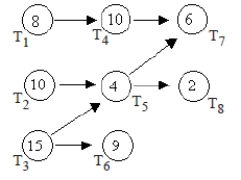 -Apply the critical-path scheduling algorithm to construct a schedule using two processors.
 (Essay)
4.9/5 (74)
(74) Give an example of an order-requirement digraph with six tasks T1, T2, T 3, T4, T5, T6 that requires 10 minutes when scheduled on two processors.
(Essay)
4.8/5 (76)
(76) Give an example of an order-requirement digraph with six tasks T1, T2, T 3, T4, T5, T6 for which the critical-path is T1, T3, T4.
(Essay)
4.8/5 (69)
(69) Use the order-requirement digraph below (with time given in minutes) and the priority list T1, T2, T 3, T4, T5, T6 to answer Questions 13-16. 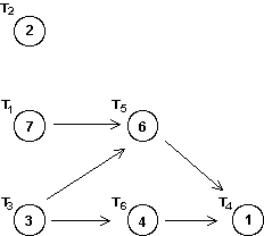 -Apply the critical-path scheduling algorithm to construct a schedule using three processors.
 (Essay)
4.7/5 (69)
(69)  -Use the next-fit (NF) bin-packing algorithm to pack the following weights into bins that can hold no more than 10 lbs.
1 lb, 2 lbs, 2 lbs, 7 lbs, 8 lbs, 5 lbs, 8 lbs, 4 lbs, 10 lbs, 6 lbs
-Use the next-fit (NF) bin-packing algorithm to pack the following weights into bins that can hold no more than 10 lbs.
1 lb, 2 lbs, 2 lbs, 7 lbs, 8 lbs, 5 lbs, 8 lbs, 4 lbs, 10 lbs, 6 lbs (Essay)
4.8/5 (86)
(86) Use the decreasing-time-list algorithm to schedule these tasks on two machines: How much time does the resulting schedule require?
(Multiple Choice)
4.7/5 (79)
(79) Use the following digraph to answer Questions
Suppose that a crew can currently complete a job (order-requirement digraph is shown below) in a minimum amount of time.  -If Task T2 is shortened from 9 minutes to 6 minutes, then what is the maximum amount of time by which the completion time of the entire job can be shortened?
 (Multiple Choice)
4.9/5 (90)
(90) The worst-fit decreasing (WFD) algorithm for bin-packing is guaranteed to always produce an optimal solution.
(True/False)
4.8/5 (86)
(86) The first-fit (FF) algorithm never uses more boxes than the next-fit (NF) algorithm.
(True/False)
4.8/5 (75)
(75) Give an example in which six independent tasks require 12 minutes when scheduled on three processors.
(Essay)
4.9/5 (78)
(78) Choose the packing that results from the use of the next-fit decreasing (NFD) bin-packing algorithm to pack data files with the following sizes onto compact discs that can hold no more than 700 MB. 100 MB, 500 MB, 250 MB, 350 MB, 400 MB, 250 MB, 450 MB, 200 MB, 50 MB
(Multiple Choice)
4.9/5 (82)
(82) Why are there several different algorithms for the bin-packing problem?
(Essay)
4.9/5 (69)
(69) Which of the algorithms-first fit (FF), next fit (NF), or worst fit (WF)-would be most preferable when packing cloth dolls? Why?
(Short Answer)
4.9/5 (74)
(74) 
Filters
- Essay(0)
- Multiple Choice(0)
- Short Answer(0)
- True False(0)
- Matching(0)