



 Chat with AI
Exam 3: Planning and Scheduling

Exam 1: Urban Services107 Questions
Exam 2: Business Efficiency104 Questions
Exam 3: Planning and Scheduling108 Questions
Exam 4: Linear Programming111 Questions
Exam 5: Exploring Data: Distributions115 Questions
Exam 6: Exploring Data: Relationships104 Questions
Exam 7: Data for Decisions99 Questions
Exam 8: Probability: the Mathematics of Chance108 Questions
Exam 9: Social Choice: the Impossible Dream103 Questions
Exam 10: The Manipulability of Voting Systems106 Questions
Exam 11: Weighted Voting Systems111 Questions
Exam 12: Electing the President93 Questions
Exam 13: Fair Division121 Questions
Exam 14: Apportionment112 Questions
Exam 15: Game Theory: the Mathematics of Competition113 Questions
Exam 16: Identification Numbers110 Questions
Exam 17: Information Science94 Questions
Exam 18: Growth and Form111 Questions
Exam 19: Symmetry and Patterns115 Questions
Exam 20: Tilings112 Questions
Exam 21: Savings Models113 Questions
Exam 22: Borrowing Models113 Questions
Exam 23: The Economics of Resources119 Questions
Select questions type


What is the chromatic number of a complete graph of 20 vertices?
(Multiple Choice)
5.0/5  (90)
(90) Choose the packing that results from the use of the next-fit decreasing (NFD) bin-packing algorithm to pack the following weights into bins that can hold no more than 9 lbs.
(Multiple Choice)
4.8/5 (80)
(80) Use the order-requirement digraph below (with time given in minutes) and the priority list T1, T2, T 3, T4, T5, T6 to answer Questions 13-16. 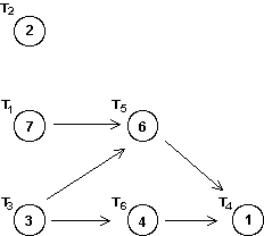 -Apply the list-processing algorithm to construct a schedule using two processors.
 (Essay)
4.8/5 (76)
(76) When scheduling independent tasks, why does the decreasing-time-list algorithm generally produce good schedules? Does it always produce an optimal schedule?
(Essay)
4.8/5 (83)
(83) Choose the packing that results from the use of the first-fit decreasing (FFD) bin-packing algorithm to pack the following weights into bins that can hold no more than 8 lbs. 5 lbs, 7 lbs, 1 lb, 2 lbs, 4 lbs, 5 lbs, 1 lb, 1 lb, 3 lbs, 6 lbs, 2 lbs, 3 lbs
(Multiple Choice)
4.8/5 (81)
(81) Given the order-requirement digraph below (with time given in minutes), apply the critical-path scheduling algorithm to construct a schedule using two processors. How much time does the resulting schedule require? 
(Multiple Choice)
4.8/5 (86)
(86) Choose the packing that results from the use of the next-fit (NF) bin-packing algorithm to pack the following weights into bins that can hold no more than 8 lbs. 5 lbs, 7 lbs, 1 lb, 2 lbs, 4 lbs, 5 lbs, 1 lb, 1 lb, 3 lbs, 6 lbs, 2 lbs
(Multiple Choice)
4.9/5 (89)
(89) Choose the packing that results from the use of the worst-fit (WF) bin-packing algorithm to pack the following weights into bins that can hold no more than 9 lbs.
(Multiple Choice)
4.9/5 (79)
(79) Given the order-requirement digraph below (with time given in minutes), apply the critical-path scheduling algorithm to construct a schedule using two processors. How much time does the resulting schedule require? 
(Multiple Choice)
4.8/5 (77)
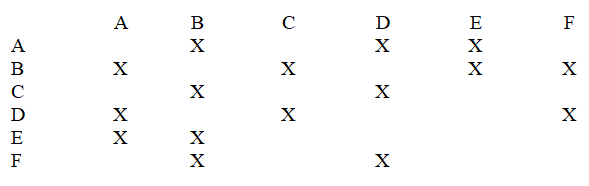
(77) The table below shows chemical compounds that cannot be mixed without causing dangerous reactions. If a graph were used to facilitate scheduling of disposal containers for the compounds, how many edges would it have?
(Multiple Choice)
5.0/5 (76)
(76) Assume a job consists of six independent tasks ranging in time from 3 to 12 minutes and totaling 36 minutes. Efficiently scheduled on four machines, how much time will the job require?
(Multiple Choice)
4.8/5 (83)
(83) Choose the packing that results from the use of the first-fit decreasing (FFD) bin-packing algorithm to pack data files with the following sizes onto compact discs that can hold no more than 700 MB. 100 MB, 500 MB, 250 MB, 350 MB, 400 MB, 250 MB, 450 MB, 200 MB, 50 MB
(Multiple Choice)
4.9/5 (66)
(66) Choose the packing that results from the use of the first-fit (FF) bin-packing algorithm to pack data files with the following sizes onto compact discs that can hold no more than 700 MB. 100 MB, 500 MB, 250 MB, 350 MB, 400 MB, 250 MB, 450 MB, 200 MB, 50 MB
(Multiple Choice)
4.7/5 (89)
(89) A talent show producer needs to fit 17 acts of varying lengths into three segments. The segments should be as short as possible and are to be separated by intermissions. How many acts will be placed in each segment?
(Multiple Choice)
4.7/5 (85)
(85) 
Questions refer to this bin-packing task. Pack the following weights into bins holding no more than 5 lbs:
2 lbs, 1 lb, 4 lbs, 3 lbs, 4 lbs, 1 lb, 2 lbs, 3 lbs
-Find the number of bins required using the first-fit decreasing (FFD) algorithm.
(Multiple Choice)
4.8/5 (63)
(63) Use the decreasing-time-list algorithm to schedule these tasks on two machines: How much time does the resulting schedule require?
(Multiple Choice)
4.9/5 (84)
(84) Choose the packing that results from the use of the first-fit (FF) bin-packing algorithm to pack the following weights into bins that can hold no more than 8 lbs. 5 lbs, 7 lbs, 1 lb, 2 lbs, 4 lbs, 5 lbs, 1 lb, 1 lb, 3 lbs, 6 lbs, 2 lbs
(Multiple Choice)
4.7/5 (76)
(76) What is the chromatic number of the complete graph on six vertices?
(Short Answer)
4.9/5 (81)
(81) Given the order-requirement digraph below (with time given in minutes) and the priority list T1, T2, T 3, T4, T5, T6, apply the list-processing algorithm to construct a schedule using two processors. How much time does the resulting schedule require? 
(Multiple Choice)
4.8/5 (88)
(88) 
Filters
- Essay(0)
- Multiple Choice(0)
- Short Answer(0)
- True False(0)
- Matching(0)