



 Chat with AI
Exam 3: Planning and Scheduling

Exam 1: Urban Services107 Questions
Exam 2: Business Efficiency104 Questions
Exam 3: Planning and Scheduling108 Questions
Exam 4: Linear Programming111 Questions
Exam 5: Exploring Data: Distributions115 Questions
Exam 6: Exploring Data: Relationships104 Questions
Exam 7: Data for Decisions99 Questions
Exam 8: Probability: the Mathematics of Chance108 Questions
Exam 9: Social Choice: the Impossible Dream103 Questions
Exam 10: The Manipulability of Voting Systems106 Questions
Exam 11: Weighted Voting Systems111 Questions
Exam 12: Electing the President93 Questions
Exam 13: Fair Division121 Questions
Exam 14: Apportionment112 Questions
Exam 15: Game Theory: the Mathematics of Competition113 Questions
Exam 16: Identification Numbers110 Questions
Exam 17: Information Science94 Questions
Exam 18: Growth and Form111 Questions
Exam 19: Symmetry and Patterns115 Questions
Exam 20: Tilings112 Questions
Exam 21: Savings Models113 Questions
Exam 22: Borrowing Models113 Questions
Exam 23: The Economics of Resources119 Questions
Select questions type


Use the order-requirement digraph below (with time given in minutes) and the priority list T1, T2, T 3, T4, T5, T6 to answer Questions 13-16. 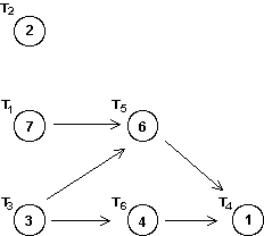 -Apply the list-processing algorithm to construct a schedule using three processors.
 (Essay)
4.8/5  (82)
(82) Given the order-requirement digraph below (with time given in minutes), apply the critical-path scheduling algorithm to construct a schedule using two processors. How much time does the resulting schedule require? 
(Multiple Choice)
4.9/5 (84)
(84) The order requirements for scheduling tasks depend on the priority list of tasks.
(True/False)
4.9/5 (81)
(81) Use the following digraph to answer Questions
Suppose that a crew can currently complete a job (order-requirement digraph is shown below) in a minimum amount of time.  -If Task T1 is shortened from 7 minutes to 4 minutes, then what is the maximum amount of time by which the completion time of the entire job can be shortened?
 (Multiple Choice)
4.9/5 (83)
(83) Which of the algorithms-first fit (FF), next fit (NF), or worst fit (WF)-would be most preferable when filling boxes on an assembly line? Why?
(Short Answer)
4.8/5 (74)
(74) When scheduling tasks using the list-processing algorithm, increasing the number of machines always reduces the completion time.
(True/False)
4.7/5 (74)
(74) 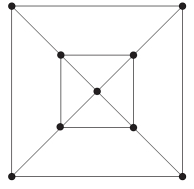
Use the following digraph to answer Questions
Suppose that a crew can currently complete a job (order-requirement digraph is shown below) in a minimum amount of time.
-If Task T4 is shortened from 8 minutes to 5 minutes, then what is the maximum amount of time by which the completion time of the entire job can be shortened?
-If Task T4 is shortened from 8 minutes to 5 minutes, then what is the maximum amount of time by which the completion time of the entire job can be shortened? (Multiple Choice)
4.9/5 (80)
(80) What is the minimum number of machines required to perform six independent tasks in 16 minutes with a total task time of 48 minutes?
(Multiple Choice)
4.9/5 (67)
(67) Use the order requirement digraph below (with time given in minutes) and the priority list T1, T2, T3, T4, T5, T6, T7, T8 to answer the following Questions 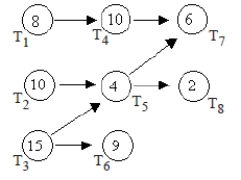 -Apply the list-processing algorithm to construct a schedule using two processors.
 (Essay)
4.9/5 (72)
(72) Use the following digraph to answer Questions
Suppose that a crew can currently complete a job (order-requirement digraph is shown below) in a minimum amount of time.
-Apply the critical-path scheduling algorithm to obtain a priority list.
-Apply the critical-path scheduling algorithm to obtain a priority list. (Multiple Choice)
4.8/5 (75)
(75) Given the order-requirement digraph below (with time given in minutes), apply the critical-path scheduling algorithm to construct a schedule using two processors. How much time does the resulting schedule require? 
(Multiple Choice)
4.8/5 (89)
(89) Given the order-requirement digraph below (with time given in minutes) and the priority list T1, T2, T 3, T4, T5, T6, T7, apply the list-processing algorithm to construct a schedule using two processors. How much time does the resulting schedule require? 
(Multiple Choice)
4.9/5 (83)
(83) Give an example in which the first-fit decreasing (FFD) and worst-fit decreasing (WFD) bin-packing algorithms produce the same packing.
(Essay)
4.9/5 (78)
(78) For a scheduling problem, list at least three possible goals to achieve.
(Essay)
4.8/5 (68)
(68) Choose the packing that results from the use of the first-fit (FF) bin-packing algorithm to pack the following weights into bins that can hold no more than 9 lbs.
(Multiple Choice)
4.9/5 (63)
(63) Choose the packing that results from the use of the first-fit decreasing (FFD) bin-packing algorithm to pack the following weights into bins that can hold no more than 8 lbs.
(Multiple Choice)
4.7/5 (85)
(85) Questions refer to this bin-packing task. Pack the following weights into bins holding no more than 5 lbs:
2 lbs, 1 lb, 4 lbs, 3 lbs, 4 lbs, 1 lb, 2 lbs, 3 lbs
-Find the number of bins required using the worst-fit decreasing (WFD) algorithm.
(Multiple Choice)
4.7/5 (80)
(80) Choose the packing that results from the use of the worst-fit decreasing (WFD) bin-packing algorithm to pack the following weights into bins that can hold no more than 8 lbs. 5 lbs, 7 lbs, 1 lb, 2 lbs, 4 lbs, 5 lbs, 1 lb, 1 lb, 3 lbs, 6 lbs, 2 lbs, 3 lbs
(Multiple Choice)
4.8/5 (70)
(70) Use the order requirement digraph below (with time given in minutes) and the priority list T1, T2, T3, T4, T5, T6, T7, T8 to answer the following Questions
-Apply the list-processing algorithm to construct a schedule using three processors.
-Apply the list-processing algorithm to construct a schedule using three processors. (Essay)
4.9/5 (90)
(90) 
Filters
- Essay(0)
- Multiple Choice(0)
- Short Answer(0)
- True False(0)
- Matching(0)