



 Chat with AI
Exam 3: Planning and Scheduling

Exam 1: Urban Services107 Questions
Exam 2: Business Efficiency104 Questions
Exam 3: Planning and Scheduling108 Questions
Exam 4: Linear Programming111 Questions
Exam 5: Exploring Data: Distributions115 Questions
Exam 6: Exploring Data: Relationships104 Questions
Exam 7: Data for Decisions99 Questions
Exam 8: Probability: the Mathematics of Chance108 Questions
Exam 9: Social Choice: the Impossible Dream103 Questions
Exam 10: The Manipulability of Voting Systems106 Questions
Exam 11: Weighted Voting Systems111 Questions
Exam 12: Electing the President93 Questions
Exam 13: Fair Division121 Questions
Exam 14: Apportionment112 Questions
Exam 15: Game Theory: the Mathematics of Competition113 Questions
Exam 16: Identification Numbers110 Questions
Exam 17: Information Science94 Questions
Exam 18: Growth and Form111 Questions
Exam 19: Symmetry and Patterns115 Questions
Exam 20: Tilings112 Questions
Exam 21: Savings Models113 Questions
Exam 22: Borrowing Models113 Questions
Exam 23: The Economics of Resources119 Questions
Select questions type


What is the minimum time required to complete the following tasks on two processors?
(Multiple Choice)
5.0/5  (74)
(74) Given the order-requirement digraph below (with time given in minutes) and the priority list T1, T2, T 3, T4, T5, T6, apply the list-processing algorithm to construct a schedule using two processors. How much time does the resulting schedule require? 
(Multiple Choice)
4.9/5 (79)
(79) A talent show producer needs to fit 17 acts of varying lengths into three segments. The segments should be as short as possible and are to be separated by intermissions. How can this problem be solved?
(Essay)
4.9/5 (76)
(76) Choose the packing that results from the use of the next-fit (NF) bin-packing algorithm to pack the following weights into bins that can hold no more than 9 lbs.
(Multiple Choice)
4.9/5 (81)
(81) 
Which of the algorithms-first fit (FF), next fit (NF), or worst fit (WF)-would be most preferable when cutting quilt pieces? Why?
(Short Answer)
4.8/5 (73)
(73) Assume an order-requirement digraph has a critical path with length 40 minutes. Based on this information, when the digraph is scheduled on four machines, how much time will be required?
(Multiple Choice)
4.8/5 (77)
(77) Which of the following is a correct vertex coloring of the given graph? (Capital letters indicate which color the vertex is colored.) 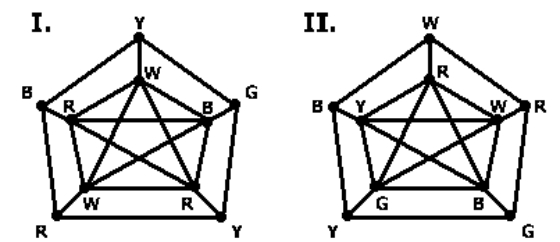
(Multiple Choice)
4.9/5 (88)
(88) What is the minimum time required to complete nine independent tasks on three processors when the sum of all the times of the nine tasks is 72 minutes?
(Multiple Choice)
4.8/5 (82)
(82) Questions refer to this bin-packing task. Pack the following weights into bins holding no more than 5 lbs:
2 lbs, 1 lb, 4 lbs, 3 lbs, 4 lbs, 1 lb, 2 lbs, 3 lbs
-Find the number of bins required using the next-fit decreasing (NFD) algorithm.
(Multiple Choice)
4.8/5 (70)
(70) Given the order-requirement digraph below (with time given in minutes) and the priority list T1, T4, T 5, T2, T3, T6, apply the list-processing algorithm to construct a schedule using two processors. How much time does the resulting schedule require? 
(Multiple Choice)
4.9/5 (69)
(69) Choose the packing that results from the use of the first-fit (FF) bin-packing algorithm to pack the following weights into bins that can hold no more than 8 lbs.
(Multiple Choice)
4.9/5 (80)
(80) Use the following digraph to answer Questions
Suppose that a crew can currently complete a job (order-requirement digraph is shown below) in a minimum amount of time.  -If Task T5 is shortened from 6 minutes to 3 minutes, then what is the maximum amount of time by which the completion time of the entire job can be shortened?
 (Multiple Choice)
4.8/5 (92)
(92) Give an example in which the first-fit (FF) and next-fit (NF) bin-packing algorithms produce the same packing.
(Essay)
4.8/5 (74)
(74) What is the minimum number of processors required to complete eight independent tasks in 40 minutes when the sum of the times of the eight tasks is 120 minutes?
(Short Answer)
5.0/5 (88)
(88) Choose the packing that results from the use of the next-fit decreasing (NFD) bin-packing algorithm to pack the following weights into bins that can hold no more than 8 lbs.
(Multiple Choice)
4.7/5 (91)
(91) Given the order-requirement digraph below (with time given in minutes), apply the critical-path scheduling algorithm to construct a schedule using two processors. How much time does the resulting schedule require? 
(Multiple Choice)
4.9/5 (82)
(82) Use the order-requirement digraph below (with time given in minutes) and the priority list T1, T2, T 3, T4, T5, T6 to answer Questions 13-16. 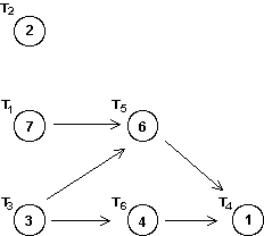 -Apply the critical-path scheduling algorithm to construct a schedule using two processors.
 (Essay)
4.7/5 (79)
(79) Use the decreasing-time-list algorithm to schedule these tasks on three machines:
7, 2, 5, 3, 9, 1, 6, 5, 3, 7 (time in minutes).
How much time does the resulting schedule require?
(Short Answer)
4.9/5 (81)
(81) Choose the packing that results from the use of the next-fit (NF) bin-packing algorithm to pack the following weights into bins that can hold no more than 8 lbs.
(Multiple Choice)
4.8/5 (84)
(84) 
Filters
- Essay(0)
- Multiple Choice(0)
- Short Answer(0)
- True False(0)
- Matching(0)