



 Chat with AI
Exam 2: Business Efficiency

Exam 1: Urban Services107 Questions
Exam 2: Business Efficiency104 Questions
Exam 3: Planning and Scheduling108 Questions
Exam 4: Linear Programming111 Questions
Exam 5: Exploring Data: Distributions115 Questions
Exam 6: Exploring Data: Relationships104 Questions
Exam 7: Data for Decisions99 Questions
Exam 8: Probability: the Mathematics of Chance108 Questions
Exam 9: Social Choice: the Impossible Dream103 Questions
Exam 10: The Manipulability of Voting Systems106 Questions
Exam 11: Weighted Voting Systems111 Questions
Exam 12: Electing the President93 Questions
Exam 13: Fair Division121 Questions
Exam 14: Apportionment112 Questions
Exam 15: Game Theory: the Mathematics of Competition113 Questions
Exam 16: Identification Numbers110 Questions
Exam 17: Information Science94 Questions
Exam 18: Growth and Form111 Questions
Exam 19: Symmetry and Patterns115 Questions
Exam 20: Tilings112 Questions
Exam 21: Savings Models113 Questions
Exam 22: Borrowing Models113 Questions
Exam 23: The Economics of Resources119 Questions
Select questions type


For the graph below, what is the cost of the Hamiltonian circuit obtained by using the sorted-edges algorithm? 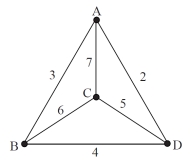
(Multiple Choice)
4.9/5  (78)
(78) In some states, license plates use a mixture of letters and numerals. How many possible plates could be constructed using three letters followed by three numerals?
(Short Answer)
4.8/5 (83)
(83) Suppose a maintenance worker needs to empty garbage dumpsters from five locations on the grounds of a park in the most efficient way possible. Which technique is most likely to be useful in solving this problem?
(Multiple Choice)
4.8/5 (79)
(79) The minimum-cost spanning tree produced by applying Kruskal's algorithm will always contain the lowest cost edge of the graph.
(True/False)
4.8/5 (79)
(79) 
Filters
- Essay(0)
- Multiple Choice(0)
- Short Answer(0)
- True False(0)
- Matching(0)