



 Chat with AI
Exam 2: Business Efficiency

Exam 1: Urban Services107 Questions
Exam 2: Business Efficiency104 Questions
Exam 3: Planning and Scheduling108 Questions
Exam 4: Linear Programming111 Questions
Exam 5: Exploring Data: Distributions115 Questions
Exam 6: Exploring Data: Relationships104 Questions
Exam 7: Data for Decisions99 Questions
Exam 8: Probability: the Mathematics of Chance108 Questions
Exam 9: Social Choice: the Impossible Dream103 Questions
Exam 10: The Manipulability of Voting Systems106 Questions
Exam 11: Weighted Voting Systems111 Questions
Exam 12: Electing the President93 Questions
Exam 13: Fair Division121 Questions
Exam 14: Apportionment112 Questions
Exam 15: Game Theory: the Mathematics of Competition113 Questions
Exam 16: Identification Numbers110 Questions
Exam 17: Information Science94 Questions
Exam 18: Growth and Form111 Questions
Exam 19: Symmetry and Patterns115 Questions
Exam 20: Tilings112 Questions
Exam 21: Savings Models113 Questions
Exam 22: Borrowing Models113 Questions
Exam 23: The Economics of Resources119 Questions
Select questions type


The route of a delivery truck generally follows a Hamiltonian circuit. Under what circumstances should it instead follow an Euler circuit?
(Essay)
4.8/5  (83)
(83) Use Kruskal's algorithm for minimum-cost spanning trees on the graph below. What is the cost of the tree found? 
(Multiple Choice)
4.8/5 (73)
(73) Suppose a pizza delivery person needs to take pizzas to 10 houses in different neighborhoods and then return to pick up the next set to be delivered. Which technique is most likely to be useful in solving this problem?
(Multiple Choice)
4.9/5 (85)
(85) For the graph below, which routing is produced by using the sorted-edges algorithm? 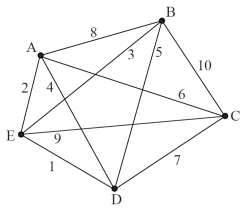
(Multiple Choice)
4.8/5 (77)
(77) Suppose an architect needs to design an intercom system for a large office building. Which technique is most likely to be useful in solving this problem?
(Multiple Choice)
4.8/5 (73)
(73) Which of the following describes a Hamiltonian circuit for the graph below? 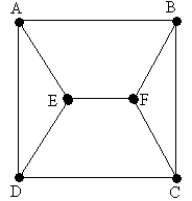
(Multiple Choice)
4.9/5 (79)
(79) The route of a neighborhood garbage truck generally follows an Euler circuit. Under what circumstances should it instead follow a Hamiltonian circuit?
(Essay)
4.7/5 (74)
(74) On the graph below, which algorithm has different routing from others to solve the traveling salesman problem? 
(Multiple Choice)
4.7/5 (73)
(73) For the graph below, what is the cost of the Hamiltonian circuit obtained by using the nearest-neighbor algorithm, starting at B? 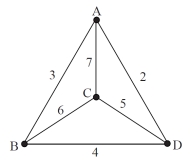
(Multiple Choice)
5.0/5 (68)
(68) Given the two graphs shown below, which one represents a tree? 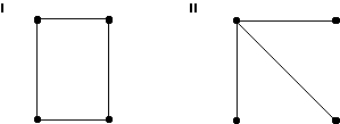
(Multiple Choice)
4.9/5 (75)
(75) Which of the following describes a Hamiltonian circuit for the graph below? 
(Multiple Choice)
4.7/5 (71)
(71) When the traveling salesman problem (Hamiltonian circuit) is applied to seven cities, how many distinct circuits are possible?
(Multiple Choice)
5.0/5 (83)
(83) How many distinct Hamiltonian circuits can you find on the following graph? 
(Short Answer)
4.9/5 (82)
(82) For the graph below, which routing is produced by using the nearest-neighbor algorithm starting at A? 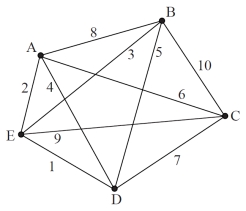
(Multiple Choice)
4.9/5 (87)
(87) Use Kruskal's algorithm for minimum-cost spanning trees on the graph below. What is the cost of the tree found? 
(Multiple Choice)
4.8/5 (73)
(73) Use the brute force algorithm to solve the traveling salesman problem for the graph of the four cities shown below. 
(Essay)
4.9/5 (80)
(80) If the order-requirement digraph for a collection of tasks is shown below, then what is the minimum completion time for the collection of tasks? 
(Multiple Choice)
5.0/5 (80)
(80) An online banking service requires its customers to select a password that is four characters long. The password is case-sensitive, so upper-case letters are considered to be different than lower-case letters. The first character of the password must be an upper-case letter and the second character must be a digit. The remaining two characters may each be a digit, an uppercase letter, or a lowercase letter. What is the number of possible passwords?
(Multiple Choice)
4.9/5 (74)
(74) 
Filters
- Essay(0)
- Multiple Choice(0)
- Short Answer(0)
- True False(0)
- Matching(0)