



 Chat with AI
Exam 2: Business Efficiency

Exam 1: Urban Services107 Questions
Exam 2: Business Efficiency104 Questions
Exam 3: Planning and Scheduling108 Questions
Exam 4: Linear Programming111 Questions
Exam 5: Exploring Data: Distributions115 Questions
Exam 6: Exploring Data: Relationships104 Questions
Exam 7: Data for Decisions99 Questions
Exam 8: Probability: the Mathematics of Chance108 Questions
Exam 9: Social Choice: the Impossible Dream103 Questions
Exam 10: The Manipulability of Voting Systems106 Questions
Exam 11: Weighted Voting Systems111 Questions
Exam 12: Electing the President93 Questions
Exam 13: Fair Division121 Questions
Exam 14: Apportionment112 Questions
Exam 15: Game Theory: the Mathematics of Competition113 Questions
Exam 16: Identification Numbers110 Questions
Exam 17: Information Science94 Questions
Exam 18: Growth and Form111 Questions
Exam 19: Symmetry and Patterns115 Questions
Exam 20: Tilings112 Questions
Exam 21: Savings Models113 Questions
Exam 22: Borrowing Models113 Questions
Exam 23: The Economics of Resources119 Questions
Select questions type


Construct an example of a connected graph that does not have a Hamiltonian circuit.
(Essay)
4.9/5  (70)
(70) Use Kruskal's algorithm for minimum-cost spanning trees on the graph below. What is the cost of the tree found? 
(Multiple Choice)
4.9/5 (82)
(82) The minimum-cost spanning tree produced by applying Kruskal's algorithm may contain the most expensive edge of the graph.
(True/False)
4.8/5 (90)
(90) For the graph below, what is the cost of the Hamiltonian circuit obtained by using the nearest-neighbor algorithm, starting at A? 
(Multiple Choice)
4.9/5 (81)
(81) When Kruskal's algorithm is used to find a minimum-cost spanning tree on a graph, which of the following is false?
(Multiple Choice)
4.8/5 (85)
(85) The graph below shows the cost (in hundreds of dollars) of installing telephone wires between the workspaces in an office complex. Use Kruskal's algorithm for minimum-cost spanning trees to find the cost for establishing this phone network. 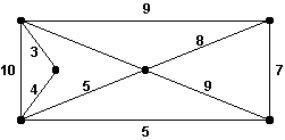
(Multiple Choice)
4.9/5 (85)
(85) When the traveling salesman problem (Hamiltonian circuit) is applied to four cities, how many distinct tours are possible?
(Multiple Choice)
5.0/5 (76)
(76) The nearest-neighbor algorithm for solving the traveling salesman problem always produces the same result as the sorted-edges algorithm.
(True/False)
5.0/5 (80)
(80) Kris has three pairs of pants of different colors, five shirts of different colors, and two pairs of shoes. How many different outfits can Kris create?
(Multiple Choice)
4.7/5 (72)
(72) For the graph below, which routing is produced by using the nearest-neighbor algorithm starting at D? 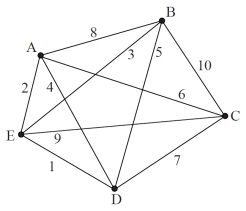
(Multiple Choice)
4.8/5 (62)
(62) The best-known guarantee for a heuristic algorithm for a traveling salesman problem yields a cost no worse than one and a half times the optimal cost.
(True/False)
4.9/5 (82)
(82) For the graph below, what is the cost of the Hamiltonian circuit obtained by using the nearest-neighbor algorithm, starting at A? 
(Multiple Choice)
4.9/5 (93)
(93) For the graph below, what is the cost of the Hamiltonian circuit obtained by using the sorted-edges algorithm? 
(Multiple Choice)
4.7/5 (96)
(96) How many distinct Hamiltonian circuits can you find on the following graph? (Do not count a circuit and the reverse of the same circuit as distinct.) 
(Short Answer)
5.0/5 (97)
(97) For the graph below, what is the cost of the Hamiltonian circuit obtained by using the sorted-edges algorithm? 
(Multiple Choice)
4.9/5 (69)
(69) What is the earliest possible completion time for a job whose order-requirement is shown below? 
(Multiple Choice)
4.8/5 (79)
(79) In which of the diagrams below do the wiggly edges represent spanning trees? 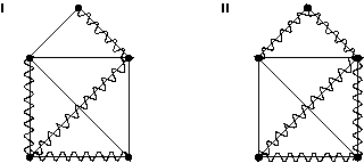
(Multiple Choice)
4.8/5 (66)
(66) You want to create a mileage grid showing the distance between every pair of the 50 U.S. state capitals. How many numbers will you have to compute?
(Short Answer)
4.9/5 (70)
(70) A college student has six pairs of pants, eight T-shirts, three sweatshirts, and two pairs of tennis shoes. If an outfit consists of pants, a T-shirt, a sweatshirt, and a pair of tennis shoes, how many different outfits can the student wear before repeating one?
(Multiple Choice)
4.9/5 (81)
(81) In which of the diagrams below do the wiggly edges represent spanning trees? 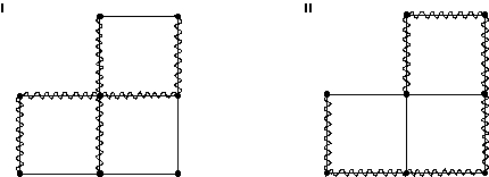
(Multiple Choice)
4.9/5 (74)
(74) 
Filters
- Essay(0)
- Multiple Choice(0)
- Short Answer(0)
- True False(0)
- Matching(0)