



 Chat with AI
Exam 2: Business Efficiency

Exam 1: Urban Services107 Questions
Exam 2: Business Efficiency104 Questions
Exam 3: Planning and Scheduling108 Questions
Exam 4: Linear Programming111 Questions
Exam 5: Exploring Data: Distributions115 Questions
Exam 6: Exploring Data: Relationships104 Questions
Exam 7: Data for Decisions99 Questions
Exam 8: Probability: the Mathematics of Chance108 Questions
Exam 9: Social Choice: the Impossible Dream103 Questions
Exam 10: The Manipulability of Voting Systems106 Questions
Exam 11: Weighted Voting Systems111 Questions
Exam 12: Electing the President93 Questions
Exam 13: Fair Division121 Questions
Exam 14: Apportionment112 Questions
Exam 15: Game Theory: the Mathematics of Competition113 Questions
Exam 16: Identification Numbers110 Questions
Exam 17: Information Science94 Questions
Exam 18: Growth and Form111 Questions
Exam 19: Symmetry and Patterns115 Questions
Exam 20: Tilings112 Questions
Exam 21: Savings Models113 Questions
Exam 22: Borrowing Models113 Questions
Exam 23: The Economics of Resources119 Questions
Select questions type


The local cafe offers three different entrees, 10 different vegetables, and four different salads. A "blue plate special" includes an entree, a vegetable, and a salad. How many different ways can a special be constructed?
(Short Answer)
4.9/5  (67)
(67) Which path listed forms a Hamiltonian circuit on the graph below? 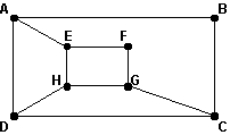
(Multiple Choice)
4.7/5 (76)
(76) When the traveling salesman problem (Hamiltonian circuit) is applied to six cities, how many tours are possible?
(Multiple Choice)
4.9/5 (82)
(82) The sorted-edges algorithm for solving the traveling salesman problem always gives optimal results.
(True/False)
4.7/5 (85)
(85) A connected graph H has a spanning tree with 50 edges. How many vertices does the spanning tree have? How many vertices does H have? What can one say about the number of edges H has?
(Essay)
4.8/5 (89)
(89) On the graph below, which routing is produced by using the nearest-neighbor algorithm to solve the traveling salesman problem, starting at A? 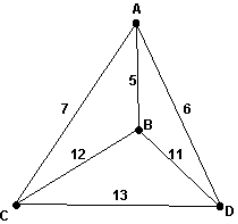
(Multiple Choice)
4.9/5 (75)
(75) Construct a complete graph whose vertices represent the six largest islands of Hawaii: Kauai, Oahu, Molokai, Lanai, Maui, and Hawaii.
(Essay)
4.8/5 (82)
(82) Construct a digraph for the following tasks necessary when building a house: get a building permit, install wiring, pour foundation, build walls, build doghouse, pass final inspection.
(Essay)
4.8/5 (84)
(84) When the traveling salesman problem (Hamiltonian circuit) is applied to six cities, how many distinct circuits are possible?
(Multiple Choice)
4.9/5 (84)
(84) A connected graph G has 32 vertices. How many vertices does a spanning tree of G have?
(Multiple Choice)
4.8/5 (93)
(93) If a graph of nine vertices is complete, how many edges are there?
(Short Answer)
4.8/5 (84)
(84) The path produced by the nearest-neighbor algorithm when solving the traveling salesman problem may be dependent on the starting city.
(True/False)
4.9/5 (90)
(90) There are 3, 4, and 3 distinct paths from the city A to B, B to C, and C to D, respectively. Starting from the city A, you are planning to travel those cities in the order B, C, and D. How many different travel routes are possible?
(Multiple Choice)
4.8/5 (75)
(75) Use Kruskal's algorithm for minimum-cost spanning trees on the graph below. What is the cost of the tree found? 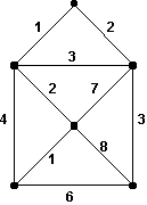
(Multiple Choice)
4.7/5 (71)
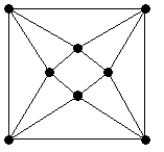
(71) 
A nearby ice cream shop offers 31 different flavors and three different types of cones. How many different single scoop cones can be ordered?
(Short Answer)
4.9/5 (90)
(90) Use the brute force algorithm to solve the traveling salesman problem for the graph of the four cities shown below. 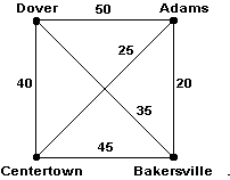
(Essay)
4.9/5 (88)
(88) For a connected graph of 18 vertices, every possible spanning tree has exactly 17 edges.
(True/False)
4.7/5 (80)
(80) Making the best choice at each stage for solving the traveling salesman problem always gives optimal results.
(True/False)
4.8/5 (84)
(84) 
Filters
- Essay(0)
- Multiple Choice(0)
- Short Answer(0)
- True False(0)
- Matching(0)