



 Chat with AI
Exam 11: Mendel and the Gene Idea

Exam 1: Introduction: Evolution and the Foundations of Biology36 Questions
Exam 2: The Chemical Context of Life137 Questions
Exam 3: Carbon and the Molecular Diversity of Life136 Questions
Exam 4: A Tour of the Cell75 Questions
Exam 5: Membrane Transport and Cell Signaling97 Questions
Exam 6: An Introduction to Metabolism79 Questions
Exam 7: Cellular Respiration and Fermentation100 Questions
Exam 8: Photosynthesis72 Questions
Exam 9: The Cell Cycle56 Questions
Exam 10: Meiosis and Sexual Life Cycles62 Questions
Exam 11: Mendel and the Gene Idea63 Questions
Exam 12: The Chromosomal Basis of Inheritance46 Questions
Exam 13: The Molecular Basis of Inheritance67 Questions
Exam 14: Gene Expression: From Gene to Protein80 Questions
Exam 15: Regulation of Gene Expression50 Questions
Exam 16: Development, Stem Cells, and Cancer34 Questions
Exam 17: Viruses35 Questions
Exam 18: Genomes and Their Evolution29 Questions
Exam 19: Descent With Modification55 Questions
Exam 20: Phylogeny60 Questions
Exam 21: The Evolution of Populations70 Questions
Exam 22: The Origin of Species67 Questions
Exam 23: Broad Patterns of Evolution45 Questions
Exam 24: Early Life and the Diversification of Prokaryotes88 Questions
Exam 25: The Origin and Diversification of Eukaryotes71 Questions
Exam 26: The Colonization of Land by Plants and Fungi126 Questions
Exam 27: The Rise of Animal Diversity88 Questions
Exam 28: Plant Structure and Growth59 Questions
Exam 29: Resource Acquisition, Nutrition, and Transport in Vascular Plants110 Questions
Exam 30: Reproduction and Domestication of Flowering Plants67 Questions
Exam 31: Plant Responses to Internal and External Signals75 Questions
Exam 32: Homeostasis and Endocrine Signaling120 Questions
Exam 33: Animal Nutrition67 Questions
Exam 34: Circulation and Gas Exchange88 Questions
Exam 35: The Immune System91 Questions
Exam 36: Reproduction and Development118 Questions
Exam 37: Neurons, Synapses, and Signaling76 Questions
Exam 38: Nervous and Sensory Systems99 Questions
Exam 39: Motor Mechanisms and Behavior79 Questions
Exam 40: Population Ecology and the Distribution of Organisms93 Questions
Exam 41: Species Interactions60 Questions
Exam 42: Ecosystems and Energy90 Questions
Exam 43: Global Ecology and Conservation Biology72 Questions
Select questions type


Please use the following information to answer the question(s) below.
Drosophila (fruit flies) usually have long wings (+), but mutations in two different genes can result in bent wings (bt) or vestigial wings (vg).
-If flies that are heterozygous for both the bent wing gene and the vestigial wing gene are mated, what is the probability of offspring with bent wings only?
(Multiple Choice)
4.8/5  (78)
(78) Please use the following information to answer the question(s) below.
A man who is an achondroplastic dwarf with normal vision marries a color-blind woman of normal height. The man's father was 6 feet tall, and both the woman's parents were of average height. Achondroplastic dwarfism is autosomal dominant, and red-green color blindness is X-linked recessive.
-What do we mean when we use the term monohybrid cross?
(Multiple Choice)
4.8/5 (88)
(88) Please use the following information to answer the question(s) below.
A man who is an achondroplastic dwarf with normal vision marries a color-blind woman of normal height. The man's father was 6 feet tall, and both the woman's parents were of average height. Achondroplastic dwarfism is autosomal dominant, and red-green color blindness is X-linked recessive.
-Which of the following describes the ability of a single gene to have multiple phenotypic effects?
(Multiple Choice)
4.7/5 (67)
(67) Please use the following information to answer the question(s) below.
Radish flowers may be red, purple, or white. A cross between a red-flowered plant and a white-flowered plant yields all-purple offspring. The part of the radish we eat may be oval or long, with long being the dominant trait.
-The flower color trait in radishes is an example of which of the following?
(Multiple Choice)
4.8/5 (77)
(77) Please use the following information to answer the question(s) below.
A woman who has blood type A positive has a daughter who is type O positive and a son who is type B negative. Rh positive is a trait that shows simple dominance over Rh negative and is designated by the alleles R and r, respectively. A third gene for the MN blood group has codominant alleles M and N.
-If both children are of blood type M, which of the following is possible?
(Multiple Choice)
4.8/5 (83)
(83) Use the following pedigree (Figure 11.3) for a family in which dark-shaded symbols represent individuals with one of the two major types of colon cancer. Numbers under the symbols are the individual's age at the time of diagnosis. A slash through the symbol indicates that the individual is deceased. 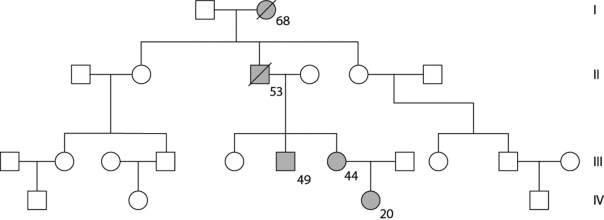 Figure 11.3
-The affected woman in generation IV is thinking about her future and asks her oncologist (cancer specialist) whether she can know whether any or all of her children will have a high risk of the same cancer. The doctor would be expected to advise which of the following: (I) genetic counseling; (II) prenatal diagnosis when/if she becomes pregnant; (III) testing to see whether she has the allele; (IV) testing to see whether her future spouse or partner has the allele?
Figure 11.3
-The affected woman in generation IV is thinking about her future and asks her oncologist (cancer specialist) whether she can know whether any or all of her children will have a high risk of the same cancer. The doctor would be expected to advise which of the following: (I) genetic counseling; (II) prenatal diagnosis when/if she becomes pregnant; (III) testing to see whether she has the allele; (IV) testing to see whether her future spouse or partner has the allele? (Multiple Choice)
5.0/5 (80)
(80) Please use the following information to answer the question(s) below.
Feather color in budgies is determined by two different genes, Y and B, one for pigment on the outside of the feather and one for the inside. YYBB, YyBB, or YYBb is green; yyBB or yyBb is blue; YYbb or Yybb is yellow; and yybb is white.
-A blue budgie is crossed with a white budgie. Which of the following results is possible?
(Multiple Choice)
4.8/5 (83)
(83) Please use the following information to answer the question(s) below.
A man who is an achondroplastic dwarf with normal vision marries a color-blind woman of normal height. The man's father was 6 feet tall, and both the woman's parents were of average height. Achondroplastic dwarfism is autosomal dominant, and red-green color blindness is X-linked recessive.
-Hydrangea plants of the same genotype are planted in a large flower garden. Some of the plants produce blue flowers and others produce pink flowers. This can be best explained by which of the following statements?
(Multiple Choice)
4.9/5 (78)
(78) Please use the following information to answer the question(s) below.
A man who is an achondroplastic dwarf with normal vision marries a color-blind woman of normal height. The man's father was 6 feet tall, and both the woman's parents were of average height. Achondroplastic dwarfism is autosomal dominant, and red-green color blindness is X-linked recessive.
-Which of the following traits is an example of polygenic inheritance?
(Multiple Choice)
4.7/5 (77)
(77) Please use the following information to answer the question(s) below.
A man who is an achondroplastic dwarf with normal vision marries a color-blind woman of normal height. The man's father was 6 feet tall, and both the woman's parents were of average height. Achondroplastic dwarfism is autosomal dominant, and red-green color blindness is X-linked recessive.
-Why did Mendel continue some of his experiments to the F2 generation?
(Multiple Choice)
4.9/5 (80)
(80) Please use the following information to answer the question(s) below.
A man who is an achondroplastic dwarf with normal vision marries a color-blind woman of normal height. The man's father was 6 feet tall, and both the woman's parents were of average height. Achondroplastic dwarfism is autosomal dominant, and red-green color blindness is X-linked recessive.
-Cystic fibrosis affects the lungs, the pancreas, the digestive system, and other organs, resulting in symptoms ranging from breathing difficulties to recurrent infections. Which of the following terms best describes this expression of phenotypes?
(Multiple Choice)
4.9/5 (75)
(75) Please use the following information to answer the question(s) below.
A woman who has blood type A positive has a daughter who is type O positive and a son who is type B negative. Rh positive is a trait that shows simple dominance over Rh negative and is designated by the alleles R and r, respectively. A third gene for the MN blood group has codominant alleles M and N.
-Which of the following is a possible partial genotype for the son?
(Multiple Choice)
4.9/5 (72)
(72) Please use the following information to answer the question(s) below.
A man who is an achondroplastic dwarf with normal vision marries a color-blind woman of normal height. The man's father was 6 feet tall, and both the woman's parents were of average height. Achondroplastic dwarfism is autosomal dominant, and red-green color blindness is X-linked recessive.
-Mendel's second law of independent assortment has its basis in which of the following events of meiosis I?
(Multiple Choice)
4.8/5 (91)
(91) Please use the following information to answer the question(s) below.
Tallness (T) in snapdragons is dominant to dwarfness (t), and red (CR) flower color is not dominant to white (Cr). The heterozygous condition results in pink (CRCr) flower color.
-A dwarf red snapdragon is crossed with a plant homozygous for tallness and white flowers. What are the genotype and phenotype of the F1 individuals?
(Multiple Choice)
4.8/5 (81)
(81) Please use the following information to answer the question(s) below.
A man who is an achondroplastic dwarf with normal vision marries a color-blind woman of normal height. The man's father was 6 feet tall, and both the woman's parents were of average height. Achondroplastic dwarfism is autosomal dominant, and red-green color blindness is X-linked recessive.
-Which of the following statements describes one difference between the law of independent assortment and the law of segregation?
(Multiple Choice)
4.8/5 (85)
(85) Please use the following information to answer the question(s) below.
A man who is an achondroplastic dwarf with normal vision marries a color-blind woman of normal height. The man's father was 6 feet tall, and both the woman's parents were of average height. Achondroplastic dwarfism is autosomal dominant, and red-green color blindness is X-linked recessive.
-What was the most significant conclusion that Gregor Mendel drew from his experiments with pea plants?
(Multiple Choice)
4.8/5 (70)
(70) Please use the following information to answer the question(s) below.
Skin color in a certain species of fish is inherited via a single gene with four different alleles.
-One fish of this type has alleles 1 and 3 (S1S3) and its mate has alleles 2 and 4 (S2S4). If each allele confers a unit of color darkness such that S1 has one unit, S2 has two units, and so on, then what proportion of their offspring would be expected to have five units of color?
(Multiple Choice)
4.9/5 (85)
(85) Please use the following information to answer the question(s) below.
A man who is an achondroplastic dwarf with normal vision marries a color-blind woman of normal height. The man's father was 6 feet tall, and both the woman's parents were of average height. Achondroplastic dwarfism is autosomal dominant, and red-green color blindness is X-linked recessive.
-What do we mean when we use the term dihybrid cross?
(Multiple Choice)
4.9/5 (81)
(81) Please use the following information to answer the question(s) below.
Figure 11.2 shows a pedigree chart for a family, some of whose members exhibit the dominant trait, W. Affected individuals are indicated by a dark square or circle. 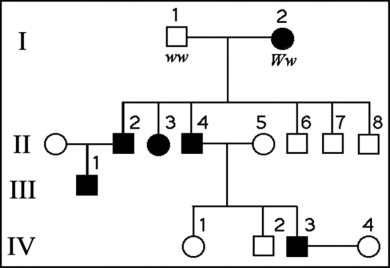 Figure 11.2
-What is the genotype of individual II-5?
Figure 11.2
-What is the genotype of individual II-5? (Multiple Choice)
4.9/5 (83)
(83) Please use the following information to answer the question(s) below.
In a particular plant, leaf color is controlled by gene locus D. Plants with at least one D allele have dark green leaves, and plants with the homozygous recessive dd genotype have light green leaves. A true-breeding dark-leaved plant is crossed with a light-leaved one, and the F1 offspring is allowed to self-pollinate. The predicted outcome of the F2 is diagrammed in the Punnett square shown in Figure 11.1, where 1, 2, 3, and 4 represent the genotypes corresponding to each box within the square. 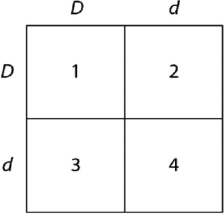 Figure 11.1
-Which of the boxes correspond(s) to plants with a heterozygous genotype?
Figure 11.1
-Which of the boxes correspond(s) to plants with a heterozygous genotype? (Multiple Choice)
4.9/5 (75)
(75) 
Filters
- Essay(0)
- Multiple Choice(0)
- Short Answer(0)
- True False(0)
- Matching(0)