



 Chat with AI
Exam 20: Phylogeny

Exam 1: Introduction: Evolution and the Foundations of Biology36 Questions
Exam 2: The Chemical Context of Life137 Questions
Exam 3: Carbon and the Molecular Diversity of Life136 Questions
Exam 4: A Tour of the Cell75 Questions
Exam 5: Membrane Transport and Cell Signaling97 Questions
Exam 6: An Introduction to Metabolism79 Questions
Exam 7: Cellular Respiration and Fermentation100 Questions
Exam 8: Photosynthesis72 Questions
Exam 9: The Cell Cycle56 Questions
Exam 10: Meiosis and Sexual Life Cycles62 Questions
Exam 11: Mendel and the Gene Idea63 Questions
Exam 12: The Chromosomal Basis of Inheritance46 Questions
Exam 13: The Molecular Basis of Inheritance67 Questions
Exam 14: Gene Expression: From Gene to Protein80 Questions
Exam 15: Regulation of Gene Expression50 Questions
Exam 16: Development, Stem Cells, and Cancer34 Questions
Exam 17: Viruses35 Questions
Exam 18: Genomes and Their Evolution29 Questions
Exam 19: Descent With Modification55 Questions
Exam 20: Phylogeny60 Questions
Exam 21: The Evolution of Populations70 Questions
Exam 22: The Origin of Species67 Questions
Exam 23: Broad Patterns of Evolution45 Questions
Exam 24: Early Life and the Diversification of Prokaryotes88 Questions
Exam 25: The Origin and Diversification of Eukaryotes71 Questions
Exam 26: The Colonization of Land by Plants and Fungi126 Questions
Exam 27: The Rise of Animal Diversity88 Questions
Exam 28: Plant Structure and Growth59 Questions
Exam 29: Resource Acquisition, Nutrition, and Transport in Vascular Plants110 Questions
Exam 30: Reproduction and Domestication of Flowering Plants67 Questions
Exam 31: Plant Responses to Internal and External Signals75 Questions
Exam 32: Homeostasis and Endocrine Signaling120 Questions
Exam 33: Animal Nutrition67 Questions
Exam 34: Circulation and Gas Exchange88 Questions
Exam 35: The Immune System91 Questions
Exam 36: Reproduction and Development118 Questions
Exam 37: Neurons, Synapses, and Signaling76 Questions
Exam 38: Nervous and Sensory Systems99 Questions
Exam 39: Motor Mechanisms and Behavior79 Questions
Exam 40: Population Ecology and the Distribution of Organisms93 Questions
Exam 41: Species Interactions60 Questions
Exam 42: Ecosystems and Energy90 Questions
Exam 43: Global Ecology and Conservation Biology72 Questions
Select questions type


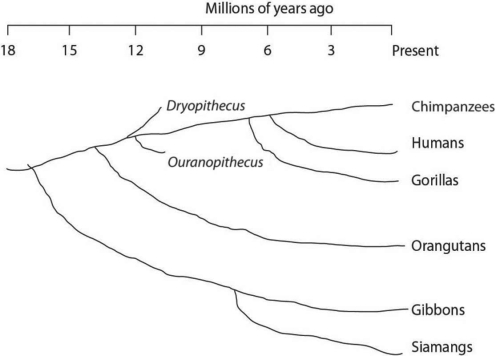 Figure 20.2
-
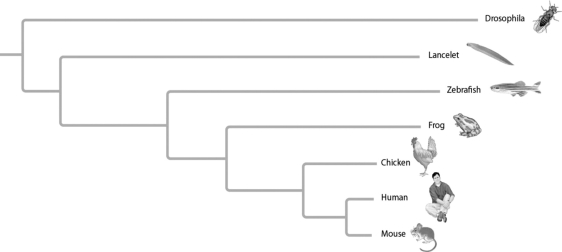 Figure 20.3
In Figure 20.3, phylogeny branch lengths represent genetic changes. Which organism on the tree has undergone the most genetic changes since divergence from common ancestor?
Figure 20.2
- Figure 20.3
In Figure 20.3, phylogeny branch lengths represent genetic changes. Which organism on the tree has undergone the most genetic changes since divergence from common ancestor? (Multiple Choice)
4.8/5  (71)
(71) Which of the following are the best examples of homologous structures?
(Multiple Choice)
4.8/5 (84)
(84) A phylogenetic tree shows that birds and crocodiles share many features. A hypothesis based on this tree predicts that these features are present in a common ancestor. Which of these predicted traits is supported by fossil evidence?
(Multiple Choice)
4.9/5 (86)
(86) Which of the following is true of all horizontally oriented phylogenetic trees, in which time advances to the right?
(Multiple Choice)
4.9/5 (81)
(81) Which of the following are problematic when the goal is to construct phylogenies that accurately reflect evolutionary history?
(Multiple Choice)
4.9/5 (79)
(79) The term homoplasy is most applicable to which of the following features?
(Multiple Choice)
4.9/5 (86)
(86) What evidence suggests that limbless bodies are the result of convergent evolution of snakes and lizards?
(Multiple Choice)
4.9/5 (91)
(91) In addition to naming species, Linnaeus also grouped species into a hierarchy of increasingly inclusive categories. The largest category that would include closely related species is
(Multiple Choice)
4.8/5 (73)
(73) Please use the following information to answer the question(s) below.
Traditionally, whales and hippopotamuses have been classified in different orders, the Cetacea and the Artiodactyla, respectively. Recent molecular evidence, however, indicates that the whales' closest living relatives are the hippos. This has caused some zoologists to lump the two orders together into a single clade, the Cetartiodactyla. There is no consensus on whether the Cetartiodactyla should be accorded order status or superorder status. This is because it remains unclear whether the whale lineage diverged from the lineage leading to the hippos before or after the other members of the order Artiodactyla (pigs, camels, etc.) diverged (see Figure 20.5). 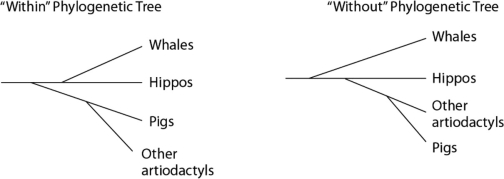 Figure 20.5
-One morphological feature of modern cetaceans is a vestigial pelvic girdle. If it is determined that cetacean lineage diverged from the artiodactyls' lineage after the divergence of pigs and other artiodactyla, then what should be true of the vestigial pelvic girdle of cetaceans?
Figure 20.5
-One morphological feature of modern cetaceans is a vestigial pelvic girdle. If it is determined that cetacean lineage diverged from the artiodactyls' lineage after the divergence of pigs and other artiodactyla, then what should be true of the vestigial pelvic girdle of cetaceans? (Multiple Choice)
4.8/5 (80)
(80) The common ancestors of birds and mammals were very early (stem) reptiles, which almost certainly possessed three-chambered hearts (two atria, one ventricle). Birds and mammals, however, are alike in having four-chambered hearts (two atria, two ventricles). The four-chambered hearts of birds and mammals are best described as
(Multiple Choice)
4.8/5 (80)
(80) A potential source of confusion in constructing a phylogeny tree is similarity between organisms that is due to
(Multiple Choice)
4.8/5 (74)
(74) The relative lengths of the frog and mouse branches in the phylogenetic tree in the figure given below indicate that 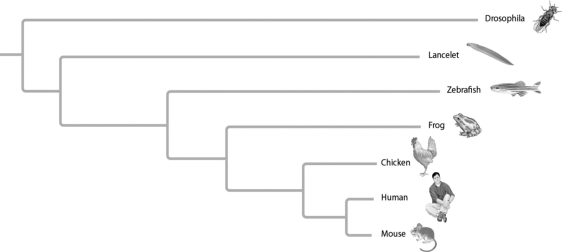 Figure 20.7
 (Multiple Choice)
4.8/5 (78)
(78) Please use the following information to answer the question(s) below.
Traditionally, whales and hippopotamuses have been classified in different orders, the Cetacea and the Artiodactyla, respectively. Recent molecular evidence, however, indicates that the whales' closest living relatives are the hippos. This has caused some zoologists to lump the two orders together into a single clade, the Cetartiodactyla. There is no consensus on whether the Cetartiodactyla should be accorded order status or superorder status. This is because it remains unclear whether the whale lineage diverged from the lineage leading to the hippos before or after the other members of the order Artiodactyla (pigs, camels, etc.) diverged (see Figure 20.5). Figure 20.5
-What can be properly inferred from Figure 20.5?
Figure 20.5
-What can be properly inferred from Figure 20.5? (Multiple Choice)
5.0/5 (73)
(73) The importance of computers and of computer software to modern cladistics is most closely linked to advances in
(Multiple Choice)
4.7/5 (73)
(73) The next question(s) refer to Table 20.1, which compares the % sequence homology of four different parts (two introns and two exons) of a gene that is found in five different eukaryotic species. Each part is numbered to indicate its distance from the promoter (for example, intron I is the one closest to the promoter). The data reported for species A were obtained by comparing DNA from one member of species A to the DNA of another member of species A. 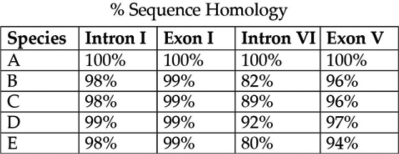 Table 20.1
-Based on the tabular data, and assuming that time advances vertically, which cladogram (a type of phylogenetic tree) is the most likely depiction of the evolutionary relationships among these five species?
Table 20.1
-Based on the tabular data, and assuming that time advances vertically, which cladogram (a type of phylogenetic tree) is the most likely depiction of the evolutionary relationships among these five species? (Multiple Choice)
4.9/5 (77)
(77) Please use the following information to answer the question(s) below.
Traditionally, whales and hippopotamuses have been classified in different orders, the Cetacea and the Artiodactyla, respectively. Recent molecular evidence, however, indicates that the whales' closest living relatives are the hippos. This has caused some zoologists to lump the two orders together into a single clade, the Cetartiodactyla. There is no consensus on whether the Cetartiodactyla should be accorded order status or superorder status. This is because it remains unclear whether the whale lineage diverged from the lineage leading to the hippos before or after the other members of the order Artiodactyla (pigs, camels, etc.) diverged (see Figure 20.5). Figure 20.5
-It was once thought that cetaceans had evolved from an extinct group of mammals called the mesonychids. If, in the future, it is determined that some organisms currently classified as cetaceans did actually evolve from mesonychids, whereas other cetaceans evolved from artiodactyl stock, then what will be true of the order Cetacea?
Figure 20.5
-It was once thought that cetaceans had evolved from an extinct group of mammals called the mesonychids. If, in the future, it is determined that some organisms currently classified as cetaceans did actually evolve from mesonychids, whereas other cetaceans evolved from artiodactyl stock, then what will be true of the order Cetacea? (Multiple Choice)
4.8/5 (82)
(82) Cladograms (a type of phylogenetic tree) constructed from evidence from molecular systematics are based on similarities in
(Multiple Choice)
4.7/5 (86)
(86) 
Filters
- Essay(0)
- Multiple Choice(0)
- Short Answer(0)
- True False(0)
- Matching(0)