



 Chat with AI
Exam 21: The Evolution of Populations

Exam 1: Introduction: Evolution and the Foundations of Biology36 Questions
Exam 2: The Chemical Context of Life137 Questions
Exam 3: Carbon and the Molecular Diversity of Life136 Questions
Exam 4: A Tour of the Cell75 Questions
Exam 5: Membrane Transport and Cell Signaling97 Questions
Exam 6: An Introduction to Metabolism79 Questions
Exam 7: Cellular Respiration and Fermentation100 Questions
Exam 8: Photosynthesis72 Questions
Exam 9: The Cell Cycle56 Questions
Exam 10: Meiosis and Sexual Life Cycles62 Questions
Exam 11: Mendel and the Gene Idea63 Questions
Exam 12: The Chromosomal Basis of Inheritance46 Questions
Exam 13: The Molecular Basis of Inheritance67 Questions
Exam 14: Gene Expression: From Gene to Protein80 Questions
Exam 15: Regulation of Gene Expression50 Questions
Exam 16: Development, Stem Cells, and Cancer34 Questions
Exam 17: Viruses35 Questions
Exam 18: Genomes and Their Evolution29 Questions
Exam 19: Descent With Modification55 Questions
Exam 20: Phylogeny60 Questions
Exam 21: The Evolution of Populations70 Questions
Exam 22: The Origin of Species67 Questions
Exam 23: Broad Patterns of Evolution45 Questions
Exam 24: Early Life and the Diversification of Prokaryotes88 Questions
Exam 25: The Origin and Diversification of Eukaryotes71 Questions
Exam 26: The Colonization of Land by Plants and Fungi126 Questions
Exam 27: The Rise of Animal Diversity88 Questions
Exam 28: Plant Structure and Growth59 Questions
Exam 29: Resource Acquisition, Nutrition, and Transport in Vascular Plants110 Questions
Exam 30: Reproduction and Domestication of Flowering Plants67 Questions
Exam 31: Plant Responses to Internal and External Signals75 Questions
Exam 32: Homeostasis and Endocrine Signaling120 Questions
Exam 33: Animal Nutrition67 Questions
Exam 34: Circulation and Gas Exchange88 Questions
Exam 35: The Immune System91 Questions
Exam 36: Reproduction and Development118 Questions
Exam 37: Neurons, Synapses, and Signaling76 Questions
Exam 38: Nervous and Sensory Systems99 Questions
Exam 39: Motor Mechanisms and Behavior79 Questions
Exam 40: Population Ecology and the Distribution of Organisms93 Questions
Exam 41: Species Interactions60 Questions
Exam 42: Ecosystems and Energy90 Questions
Exam 43: Global Ecology and Conservation Biology72 Questions
Select questions type


If the nucleotide variability of a locus equals 0%, what is the gene variability and number of alleles at that locus?
(Multiple Choice)
4.8/5  (72)
(72) Please use the following information to answer the question(s) below.
HIV's genome of RNA includes the code for reverse transcriptase (RT), an enzyme that acts early in infection to synthesize a DNA genome off of an RNA template. The HIV genome also codes for protease (PR), an enzyme that acts later in infection by cutting long viral polyproteins into smaller, functional proteins. Both RT and PR represent potential targets for antiretroviral drugs. Drugs called nucleoside analogs (NA) act against RT, whereas drugs called protease inhibitors (PI) act against PR.
-Which of the following represents the treatment option most likely to avoid the production of drug-resistant HIV (assuming no drug interactions or side effects)?
(Multiple Choice)
4.8/5 (84)
(84) Please use the following information to answer the question(s) below. 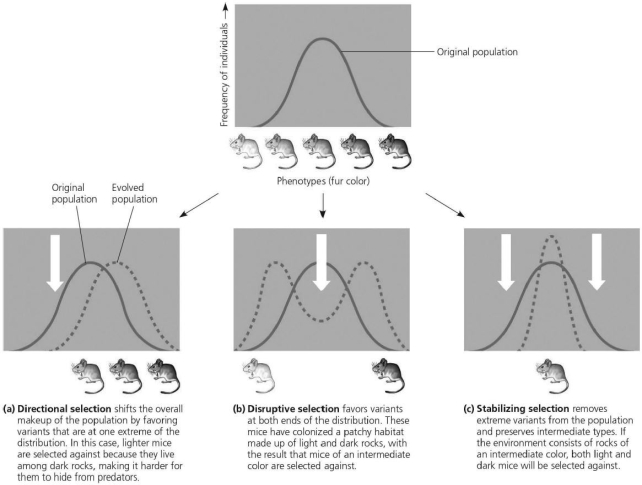 -Examining the figure, which type of selection eliminates extreme frequency of individuals' phenotype?
 (Multiple Choice)
4.8/5 (71)
(71) Please use the following information to answer the question(s) below.
In the year 2500, five male space colonists and five female space colonists (all unrelated to each other) settle on an uninhabited Earthlike planet in the Andromeda galaxy. The colonists and their offspring randomly mate for generations. All 10 of the original colonists had free earlobes, and 2 were heterozygous for that trait. The allele for free earlobes is dominant to the allele for attached earlobes.
-If four of the original colonists died before they produced offspring, the ratios of genotypes could be quite different in the subsequent generations. This would be an example of
(Multiple Choice)
4.9/5 (70)
(70) Which of the following attributes has the least effect on the contribution an individual makes to the gene pool of the next generation?
(Multiple Choice)
4.8/5 (90)
(90) If the original finches that had been blown over to the Galápagos Islands from South America had already been genetically different from the parental population of South American finches, even before adapting to the Galápagos, this would have been an example of
(Multiple Choice)
4.8/5 (84)
(84) Why don't similar genotypes always produce the same phenotype?
(Multiple Choice)
4.9/5 (83)
(83) Anopheles mosquitoes, which carry the malaria parasite, cannot live above elevations of 5,900 feet. In addition, oxygen availability decreases with higher altitude. Consider a hypothetical human population that is adapted to life on the slopes of Mt. Kilimanjaro in Tanzania, a country in equatorial Africa. Mt. Kilimanjaro's base is about 2,600 feet above sea level and its peak is 19,341 feet above sea level. If the incidence of the sickle-cell allele in the population is plotted against altitude (feet above sea level), which of the following distributions is most likely, assuming little migration of people up or down the mountain?
(Multiple Choice)
4.9/5 (79)
(79) Please use the following information to answer the question(s) below.
In those parts of equatorial Africa where the malaria parasite is most common, the sickle-cell allele constitutes 20% of the β hemoglobin alleles in the human gene pool.
-Considering the overall human population of the U.S. mainland at the time when the slave trade brought large numbers of people from equatorial Africa, what was primarily acting to change the frequency of the sickle-cell allele in the overall U.S. population?
(Multiple Choice)
4.8/5 (69)
(69) 
Filters
- Essay(0)
- Multiple Choice(0)
- Short Answer(0)
- True False(0)
- Matching(0)