



 Chat with AI
Exam 4: A Tour of the Cell

Exam 1: Introduction: Evolution and the Foundations of Biology36 Questions
Exam 2: The Chemical Context of Life137 Questions
Exam 3: Carbon and the Molecular Diversity of Life136 Questions
Exam 4: A Tour of the Cell75 Questions
Exam 5: Membrane Transport and Cell Signaling97 Questions
Exam 6: An Introduction to Metabolism79 Questions
Exam 7: Cellular Respiration and Fermentation100 Questions
Exam 8: Photosynthesis72 Questions
Exam 9: The Cell Cycle56 Questions
Exam 10: Meiosis and Sexual Life Cycles62 Questions
Exam 11: Mendel and the Gene Idea63 Questions
Exam 12: The Chromosomal Basis of Inheritance46 Questions
Exam 13: The Molecular Basis of Inheritance67 Questions
Exam 14: Gene Expression: From Gene to Protein80 Questions
Exam 15: Regulation of Gene Expression50 Questions
Exam 16: Development, Stem Cells, and Cancer34 Questions
Exam 17: Viruses35 Questions
Exam 18: Genomes and Their Evolution29 Questions
Exam 19: Descent With Modification55 Questions
Exam 20: Phylogeny60 Questions
Exam 21: The Evolution of Populations70 Questions
Exam 22: The Origin of Species67 Questions
Exam 23: Broad Patterns of Evolution45 Questions
Exam 24: Early Life and the Diversification of Prokaryotes88 Questions
Exam 25: The Origin and Diversification of Eukaryotes71 Questions
Exam 26: The Colonization of Land by Plants and Fungi126 Questions
Exam 27: The Rise of Animal Diversity88 Questions
Exam 28: Plant Structure and Growth59 Questions
Exam 29: Resource Acquisition, Nutrition, and Transport in Vascular Plants110 Questions
Exam 30: Reproduction and Domestication of Flowering Plants67 Questions
Exam 31: Plant Responses to Internal and External Signals75 Questions
Exam 32: Homeostasis and Endocrine Signaling120 Questions
Exam 33: Animal Nutrition67 Questions
Exam 34: Circulation and Gas Exchange88 Questions
Exam 35: The Immune System91 Questions
Exam 36: Reproduction and Development118 Questions
Exam 37: Neurons, Synapses, and Signaling76 Questions
Exam 38: Nervous and Sensory Systems99 Questions
Exam 39: Motor Mechanisms and Behavior79 Questions
Exam 40: Population Ecology and the Distribution of Organisms93 Questions
Exam 41: Species Interactions60 Questions
Exam 42: Ecosystems and Energy90 Questions
Exam 43: Global Ecology and Conservation Biology72 Questions
Select questions type


The volume enclosed by the plasma membrane of plant cells is often much larger than the corresponding volume in animal cells. The most reasonable explanation for this observation is that
(Multiple Choice)
4.9/5  (76)
(76) Which structure is the site of the synthesis of proteins destined for export from the cell?
(Multiple Choice)
4.9/5 (69)
(69) Why isn't the mitochondrion classified as part of the endomembrane system?
(Multiple Choice)
4.8/5 (63)
(63) Cytochalasin D is a drug that prevents actin polymerization. A cell treated with cytochalasin D will still be able to
(Multiple Choice)
4.9/5 (71)
(71) A cell has the following molecules and structures: enzymes, DNA, ribosomes, plasma membrane, and mitochondria. It could be a cell from
(Multiple Choice)
4.9/5 (75)
(75) Which of the following makes it necessary for animal cells, although they have no cell walls, to have intercellular junctions?
(Multiple Choice)
4.7/5 (67)
(67) 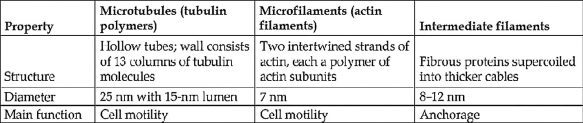 Table 4.1The differences among the three categories of cytoskeletal elements outlined in Table 4.1 suggest that each has a specialized role. Which of the following is a correct match between a cytoskeletal element and its function? (All three elements are involved in the maintenance of cell shape.)
 (Multiple Choice)
4.9/5 (80)
(80) Which of the following organelles is found exclusively in plant cells?
(Multiple Choice)
4.8/5 (73)
(73) What types of proteins are synthesized somewhere other than the rough ER?
(Multiple Choice)
4.8/5 (78)
(78) Vinblastine, a drug that inhibits microtubule polymerization, is used to treat some forms of cancer. Cancer cells given vinblastine would be unable to
(Multiple Choice)
4.7/5 (73)
(73) Which of the following correctly describes the pathway taken by a protein destined for secretion from an animal cell?
(Multiple Choice)
4.9/5 (88)
(88) When biologists wish to study the internal ultrastructure of cells, they can achieve the finest resolution by using a
(Multiple Choice)
4.8/5 (88)
(88) Passive movement of fluids and bacteria from the interior of the small intestine through the space between cells of the intestinal wall can cause serious infection and medical complications. Defects in which of the following would be associated with such a condition?
(Multiple Choice)
4.8/5 (79)
(79) Comparison of samples from the liver of an alcoholic with samples from the liver of a non-drinker when examined by transmission electron microscopy would likely reveal that
(Multiple Choice)
4.7/5 (76)
(76) Which type of organelle or structure is primarily involved in the synthesis of oils, phospholipids, and steroids?
(Multiple Choice)
4.8/5 (76)
(76) Plasmodesmata in plant cells are most similar in function to which of the following structures in animal cells?
(Multiple Choice)
4.8/5 (81)
(81) 
Filters
- Essay(0)
- Multiple Choice(0)
- Short Answer(0)
- True False(0)
- Matching(0)