



 Chat with AI
Exam 9: The Cell Cycle

Exam 1: Introduction: Evolution and the Foundations of Biology36 Questions
Exam 2: The Chemical Context of Life137 Questions
Exam 3: Carbon and the Molecular Diversity of Life136 Questions
Exam 4: A Tour of the Cell75 Questions
Exam 5: Membrane Transport and Cell Signaling97 Questions
Exam 6: An Introduction to Metabolism79 Questions
Exam 7: Cellular Respiration and Fermentation100 Questions
Exam 8: Photosynthesis72 Questions
Exam 9: The Cell Cycle56 Questions
Exam 10: Meiosis and Sexual Life Cycles62 Questions
Exam 11: Mendel and the Gene Idea63 Questions
Exam 12: The Chromosomal Basis of Inheritance46 Questions
Exam 13: The Molecular Basis of Inheritance67 Questions
Exam 14: Gene Expression: From Gene to Protein80 Questions
Exam 15: Regulation of Gene Expression50 Questions
Exam 16: Development, Stem Cells, and Cancer34 Questions
Exam 17: Viruses35 Questions
Exam 18: Genomes and Their Evolution29 Questions
Exam 19: Descent With Modification55 Questions
Exam 20: Phylogeny60 Questions
Exam 21: The Evolution of Populations70 Questions
Exam 22: The Origin of Species67 Questions
Exam 23: Broad Patterns of Evolution45 Questions
Exam 24: Early Life and the Diversification of Prokaryotes88 Questions
Exam 25: The Origin and Diversification of Eukaryotes71 Questions
Exam 26: The Colonization of Land by Plants and Fungi126 Questions
Exam 27: The Rise of Animal Diversity88 Questions
Exam 28: Plant Structure and Growth59 Questions
Exam 29: Resource Acquisition, Nutrition, and Transport in Vascular Plants110 Questions
Exam 30: Reproduction and Domestication of Flowering Plants67 Questions
Exam 31: Plant Responses to Internal and External Signals75 Questions
Exam 32: Homeostasis and Endocrine Signaling120 Questions
Exam 33: Animal Nutrition67 Questions
Exam 34: Circulation and Gas Exchange88 Questions
Exam 35: The Immune System91 Questions
Exam 36: Reproduction and Development118 Questions
Exam 37: Neurons, Synapses, and Signaling76 Questions
Exam 38: Nervous and Sensory Systems99 Questions
Exam 39: Motor Mechanisms and Behavior79 Questions
Exam 40: Population Ecology and the Distribution of Organisms93 Questions
Exam 41: Species Interactions60 Questions
Exam 42: Ecosystems and Energy90 Questions
Exam 43: Global Ecology and Conservation Biology72 Questions
Select questions type


Please use the following information to answer the question(s) below.
Nucleotides can be radiolabeled before they are incorporated into newly forming DNA and can therefore be assayed to track their incorporation. In a set of experiments, a student-faculty research team introduced labeled T nucleotides into the culture of dividing human cells at specific times.
-Which of the following questions might be answered by such a method?
(Multiple Choice)
4.8/5  (86)
(86) 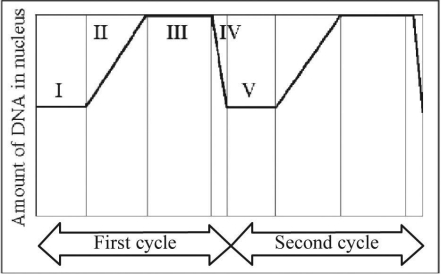 Figure 9.3
-In Figure 9.3, mitosis is represented by which numbered parts of the cycle?
Figure 9.3
-In Figure 9.3, mitosis is represented by which numbered parts of the cycle? (Multiple Choice)
4.9/5 (72)
(72) The protein complex that activates progress through the M phase checkpoint will allow which of the following to occur?
(Multiple Choice)
4.8/5 (79)
(79) Through a microscope, you can see a cell plate beginning to develop across the middle of a cell and nuclei forming on either side of the cell plate. This cell is most likely
(Multiple Choice)
4.8/5 (82)
(82) Why do neurons and some other specialized cells divide infrequently?
(Multiple Choice)
4.8/5 (91)
(91) Please use the following information to answer the question(s) below.
The unlettered circle at the top of Figure 9.1 shows a diploid nucleus with four chromosomes that have not yet replicated. There are two pairs of homologous chromosomes, one long and the other short. One haploid set is black, and the other is gray. The circles labeled A-E show various combinations of these chromosomes. 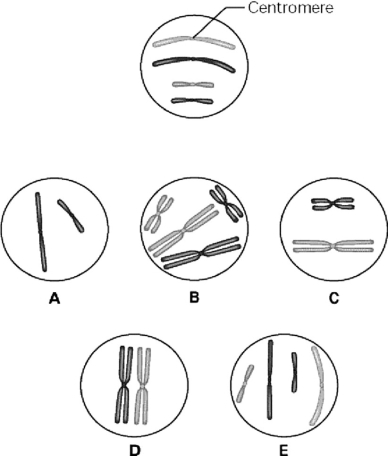 Figure 9.1
-What is the correct chromosomal condition for a nucleus in G1 of the cell division cycle?
Figure 9.1
-What is the correct chromosomal condition for a nucleus in G1 of the cell division cycle? (Multiple Choice)
5.0/5 (84)
(84) Taxol is an anticancer drug extracted from the Pacific yew tree that binds to microtubules and prevents their depolymerization. Actively dividing cells treated with Taxol become blocked in which phase of mitosis?
(Multiple Choice)
4.8/5 (81)
(81) At which phase of mitosis do the sister chromatids become daughter chromosomes?
(Multiple Choice)
4.8/5 (73)
(73) Where do the microtubules of the spindle originate during mitosis in animal cells?
(Multiple Choice)
4.8/5 (71)
(71) When a cell is in late anaphase of mitosis, which of the following may be seen?
(Multiple Choice)
4.9/5 (84)
(84) Movement of the chromosomes during anaphase would be most affected by a drug that prevents
(Multiple Choice)
4.7/5 (90)
(90) Which of the following is released by platelets in the vicinity of an injury?
(Multiple Choice)
4.7/5 (89)
(89) What is produced if a cell completes mitosis but does not undergo cytokinesis?
(Multiple Choice)
4.8/5 (93)
(93) For a chemotherapeutic drug to be useful for treating cancer cells, which of the following is most desirable?
(Multiple Choice)
4.8/5 (93)
(93) In the cells of some organisms, mitosis occurs without cytokinesis. This will result in
(Multiple Choice)
4.8/5 (90)
(90) Beginning with a fertilized egg (zygote), a series of five cell divisions would produce an early embryo with how many cells?
(Multiple Choice)
4.9/5 (77)
(77) 
Filters
- Essay(0)
- Multiple Choice(0)
- Short Answer(0)
- True False(0)
- Matching(0)