



 Chat with AI
Exam 27: The Rise of Animal Diversity

Exam 1: Introduction: Evolution and the Foundations of Biology36 Questions
Exam 2: The Chemical Context of Life135 Questions
Exam 3: Carbon and the Molecular Diversity of Life121 Questions
Exam 4: A Tour of the Cell72 Questions
Exam 5: Membrane Transport and Cell Signaling89 Questions
Exam 6: An Introduction to Metabolism74 Questions
Exam 7: Cellular Respiration and Fermentation90 Questions
Exam 8: Photosynthesis71 Questions
Exam 9: The Cell Cycle63 Questions
Exam 10: Meiosis and Sexual Life Cycles65 Questions
Exam 11: Mendel and the Gene Idea65 Questions
Exam 12: The Chromosomal Basis of Inheritance46 Questions
Exam 13: The Molecular Basis of Inheritance68 Questions
Exam 14: Gene Expression: From Gene to Protein83 Questions
Exam 15: Regulation of Gene Expression53 Questions
Exam 16: Development, Stem Cells, and Cancer34 Questions
Exam 17: Viruses35 Questions
Exam 18: Genomes and Their Evolution31 Questions
Exam 19: Descent With Modification54 Questions
Exam 20: Phylogeny53 Questions
Exam 21: The Evolution of Populations69 Questions
Exam 22: The Origin of Species60 Questions
Exam 23: Broad Patterns of Evolution38 Questions
Exam 24: Early Life and the Diversification of Prokaryotes89 Questions
Exam 25: The Origin and Diversification of Eukaryotes71 Questions
Exam 26: The Colonization of Land by Plants and Fungi153 Questions
Exam 27: The Rise of Animal Diversity107 Questions
Exam 28: Plant Structure and Growth50 Questions
Exam 29: Resource Acquisition, Nutrition, and Transport in Vascular Plants130 Questions
Exam 30: Reproduction and Domestication of Flowering Plants68 Questions
Exam 31: Plant Responses to Internal and External Signals71 Questions
Exam 32: Homeostasis and Endocrine Signaling122 Questions
Exam 33: Animal Nutrition61 Questions
Exam 34: Circulation and Gas Exchange77 Questions
Exam 35: The Immune System84 Questions
Exam 36: Reproduction and Development109 Questions
Exam 37: Neurons, Synapses, and Signaling68 Questions
Exam 38: Nervous and Sensory Systems89 Questions
Exam 39: Motor Mechanisms and Behavior74 Questions
Exam 40: Population Ecology and the Distribution of Organisms92 Questions
Exam 41: Species Interactions55 Questions
Exam 42: Ecosystems and Energy79 Questions
Exam 43: Global Ecology and Conservation Biology70 Questions
Select questions type


Which of these, if true, would support the claim that the ancestral cnidarians had bilateral symmetry? 1. Cnidarian larvae possess anterior-posterior, left-right, and dorsal-ventral aspects.
2) Cnidarians have fewer Hox genes than bilaterians.
3) All extant cnidarians, including Nematostella, are diploblastic.
4) β-catenin turns out to be essential for gastrulation in all animals in which it occurs.
5) All cnidarians are acoelomate.
(Multiple Choice)
4.7/5  (83)
(83) An elementary school science teacher decided to liven up the classroom with a saltwater aquarium. Knowing that saltwater aquaria can be quite a hassle, the teacher proceeded stepwise. First, the teacher conditioned the water. Next, the teacher decided to stock the tank with various marine invertebrates, including a polychaete, a siliceous sponge, several bivalves, a shrimp, several sea anemones of different types, a colonial hydra, a few coral species, an ectoproct, a sea star, and several herbivorous gastropod varieties. Last, she added some vertebrates-a parrotfish and a clownfish. She arranged for daily feedings of copepods and feeder fish.
-One day, little Tommy (a student in an undersupervised class of 40 fifth graders) got the urge to pet Nemo (the clownfish), who was swimming among the waving petals of a pretty underwater "flower" that had a big hole in the midst of the petals. Tommy giggled upon finding that these petals felt sticky. A few hours later, Tommy was in the nurse's office with nausea and cramps. Microscopic examination of his fingers would probably have revealed the presence of
(Multiple Choice)
4.8/5 (97)
(97) Both animals and fungi are heterotrophic. What distinguishes animal heterotrophy from fungal heterotrophy is that only animals derive their nutrition by
(Multiple Choice)
4.8/5 (81)
(81) Which shark structure is most analogous to a swim bladder full of gas?
(Multiple Choice)
4.8/5 (76)
(76) In the traditional phylogeny (A), the phylum Platyhelminthes is depicted as a sister taxon to the rest of the protostome phyla, and as having diverged earlier from the lineage that led to the rest of the protostomes. In the molecular phylogeny (B), Platyhelminthes is depicted as a lophotrochozoan phylum. What probably led to this change?
(Multiple Choice)
4.8/5 (64)
(64) A new species of aquatic chordate is discovered that closely resembles an ancient form. It has the following characteristics: external armor of bony plates, no paired lateral fins, and a suspension-feeding mode of nutrition. In addition to these, it will probably have which of the following characteristics?
(Multiple Choice)
4.8/5 (70)
(70) Evidence of which structure or characteristic would be most surprising to find among fossils of the Ediacaran fauna?
(Multiple Choice)
4.9/5 (87)
(87) Fossil evidence indicates that the following events occurred in what sequence, from earliest to most recent? 1. Protostomes invade terrestrial environments.
2) Cambrian explosion occurs.
3) Deuterostomes invade terrestrial environments.
4) Vertebrates become top predators in the seas.
(Multiple Choice)
4.8/5 (82)
(82) How many of the following statements about craniates is (are) correct? 1. Craniates are more highly cephalized than are noncraniate chordates.
2) Craniates' genomic evolution includes duplication of clusters of genes that code for transcription factors.
3) The craniate clade is synonymous with the vertebrate clade.
4) Pharyngeal slits that play a major role in gas exchange originated in craniates.
5) The two-chambered heart originated with the early craniates.
(Multiple Choice)
4.9/5 (79)
(79) Using similarities in embryonic development, body symmetry, and other anatomical features to assign an organism to a clade involves 1. cladistics based on body plan.
2) molecular-based phylogeny.
3) morphology-based phylogeny.
(Multiple Choice)
4.9/5 (72)
(72) Chordate pharyngeal slits appear to have functioned first as
(Multiple Choice)
4.9/5 (64)
(64) Which of these, if discovered among cycliophorans, would cause the most confusion concerning our current understanding of cycliophoran taxonomy?
(Multiple Choice)
4.9/5 (74)
(74) Which of the following could be considered the most recent common ancestor of living tetrapods?
(Multiple Choice)
4.9/5 (74)
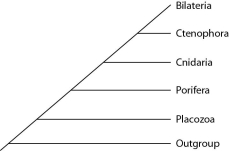
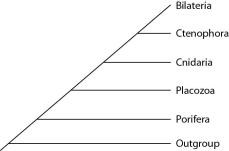
(74) Placozoan evolutionary relationships to other animals are currently unclear, and different phylogenies can be created, depending on the character used to infer relatedness. Sponges have no tissues, but about 20 cell types. Tp (Trichoplax adhaerens) produces a neuropeptide almost identical to one found in cnidarians. The genome of Tp, although the smallest of any known animal, shares many features of complex eumetazoan (even human!) genomes. The next three questions refer to the phylogenetic trees that follow.
I.
 II.
 III.
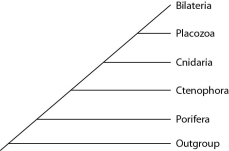 -Which phylogeny has been created by emphasizing genomic features of placozoans?
II.
III.
-Which phylogeny has been created by emphasizing genomic features of placozoans? (Multiple Choice)
4.9/5 (79)
(79) At least one of these has been found in all species of eumetazoan animals studied thus far.
(Multiple Choice)
5.0/5 (79)
(79) Organisms at which of the following trophic levels increased the most because of the movement of animals onto land?
(Multiple Choice)
4.8/5 (92)
(92) Basing your inferences on information in the previous paragraph, to which clade(s) should cycliophorans belong? 1. Eumetazoa
2) Deuterostomia
3) Bilateria
4) Ecdysozoa
5) Lophotrochozoa
(Multiple Choice)
4.7/5 (68)
(68) Arthropods invaded land about 100 million years before vertebrates did so. This most clearly implies that
(Multiple Choice)
4.8/5 (77)
(77) 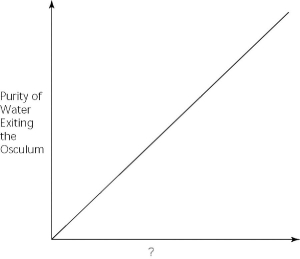 Figure 27.1
-Which of the following factors, when used to label the horizontal axis of the graph in Figure 27.1, would account most directly for the shape of the plot?
Figure 27.1
-Which of the following factors, when used to label the horizontal axis of the graph in Figure 27.1, would account most directly for the shape of the plot? (Multiple Choice)
4.7/5 (86)
(86) 
Filters
- Essay(0)
- Multiple Choice(0)
- Short Answer(0)
- True False(0)
- Matching(0)