



 Chat with AI
Exam 27: The Rise of Animal Diversity

Exam 1: Introduction: Evolution and the Foundations of Biology36 Questions
Exam 2: The Chemical Context of Life135 Questions
Exam 3: Carbon and the Molecular Diversity of Life121 Questions
Exam 4: A Tour of the Cell72 Questions
Exam 5: Membrane Transport and Cell Signaling89 Questions
Exam 6: An Introduction to Metabolism74 Questions
Exam 7: Cellular Respiration and Fermentation90 Questions
Exam 8: Photosynthesis71 Questions
Exam 9: The Cell Cycle63 Questions
Exam 10: Meiosis and Sexual Life Cycles65 Questions
Exam 11: Mendel and the Gene Idea65 Questions
Exam 12: The Chromosomal Basis of Inheritance46 Questions
Exam 13: The Molecular Basis of Inheritance68 Questions
Exam 14: Gene Expression: From Gene to Protein83 Questions
Exam 15: Regulation of Gene Expression53 Questions
Exam 16: Development, Stem Cells, and Cancer34 Questions
Exam 17: Viruses35 Questions
Exam 18: Genomes and Their Evolution31 Questions
Exam 19: Descent With Modification54 Questions
Exam 20: Phylogeny53 Questions
Exam 21: The Evolution of Populations69 Questions
Exam 22: The Origin of Species60 Questions
Exam 23: Broad Patterns of Evolution38 Questions
Exam 24: Early Life and the Diversification of Prokaryotes89 Questions
Exam 25: The Origin and Diversification of Eukaryotes71 Questions
Exam 26: The Colonization of Land by Plants and Fungi153 Questions
Exam 27: The Rise of Animal Diversity107 Questions
Exam 28: Plant Structure and Growth50 Questions
Exam 29: Resource Acquisition, Nutrition, and Transport in Vascular Plants130 Questions
Exam 30: Reproduction and Domestication of Flowering Plants68 Questions
Exam 31: Plant Responses to Internal and External Signals71 Questions
Exam 32: Homeostasis and Endocrine Signaling122 Questions
Exam 33: Animal Nutrition61 Questions
Exam 34: Circulation and Gas Exchange77 Questions
Exam 35: The Immune System84 Questions
Exam 36: Reproduction and Development109 Questions
Exam 37: Neurons, Synapses, and Signaling68 Questions
Exam 38: Nervous and Sensory Systems89 Questions
Exam 39: Motor Mechanisms and Behavior74 Questions
Exam 40: Population Ecology and the Distribution of Organisms92 Questions
Exam 41: Species Interactions55 Questions
Exam 42: Ecosystems and Energy79 Questions
Exam 43: Global Ecology and Conservation Biology70 Questions
Select questions type


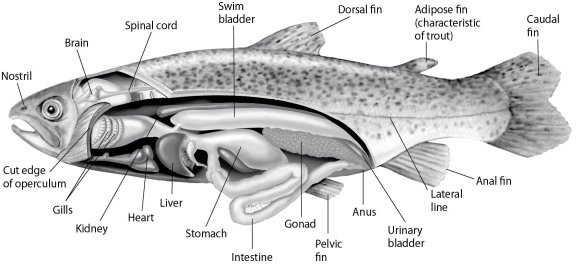 Figure 27.2
Fishes that have swim bladders can regulate their density and thus their buoyancy. There are two types of swim bladder: physostomus and physoclistus. The ancestral version is the physostomus version, in which the swim bladder is connected to the esophagus via a short tube (Figure 27.2). The fish fills this version by swimming to the surface, taking gulps of air, and directing them into the swim bladder. Air is removed from this version by "belching." The physoclistus version is more derived, and has lost its connection to the esophagus. Instead, gas enters and leaves the swim bladder via special circulatory mechanisms within the wall of the swim bladder.
-Rank the following fish, from most to least, in terms of the amount of energy each must use to maintain its position (depth) in the water column over the long term. 1. physoclistus fish
2) physostomus fish
3) chondrichthyan fish
Figure 27.2
Fishes that have swim bladders can regulate their density and thus their buoyancy. There are two types of swim bladder: physostomus and physoclistus. The ancestral version is the physostomus version, in which the swim bladder is connected to the esophagus via a short tube (Figure 27.2). The fish fills this version by swimming to the surface, taking gulps of air, and directing them into the swim bladder. Air is removed from this version by "belching." The physoclistus version is more derived, and has lost its connection to the esophagus. Instead, gas enters and leaves the swim bladder via special circulatory mechanisms within the wall of the swim bladder.
-Rank the following fish, from most to least, in terms of the amount of energy each must use to maintain its position (depth) in the water column over the long term. 1. physoclistus fish
2) physostomus fish
3) chondrichthyan fish (Multiple Choice)
4.9/5  (76)
(76) Which extant chordates are postulated to be most like the earliest chordates in appearance?
(Multiple Choice)
4.9/5 (73)
(73) If nudibranch rhinophores are located at the anteriors of these sea slugs, then they contribute to the sea slugs'
(Multiple Choice)
4.7/5 (73)
(73) The last common ancestor of all bilaterians is thought to have had four Hox genes. Most extant cnidarians have two Hox genes, except Nematostella (of β-catenin fame), which has three Hox genes. On the basis of these observations, some have proposed that the ancestral cnidarians were originally bilateral and, in stages, lost Hox genes from their genomes. If true, this would mean that
(Multiple Choice)
4.9/5 (79)
(79) During chordate evolution, what is the sequence (from earliest to most recent) in which the following structures arose? 1. amniotic egg
2) paired fins
3) jaws
4) swim bladder
5) four-chambered heart
(Multiple Choice)
4.8/5 (65)
(65) An adult animal that possesses bilateral symmetry is most certainly also
(Multiple Choice)
5.0/5 (77)
(77) The Hox genes came to regulate each of the following in what sequence, from earliest to most recent? 1. identity and position of paired appendages in protostome embryos
2) anterior-posterior orientation of segments in protostome embryos
3) positioning of tentacles in cnidarians
4) anterior-posterior orientation in vertebrate embryos
(Multiple Choice)
4.9/5 (83)
(83) Some researchers claim that sponge genomes have homeotic genes, but no Hox genes. If true, this finding would
(Multiple Choice)
4.9/5 (88)
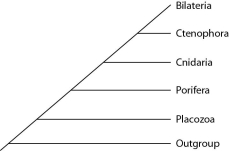
(88) Placozoan evolutionary relationships to other animals are currently unclear, and different phylogenies can be created, depending on the character used to infer relatedness. Sponges have no tissues, but about 20 cell types. Tp (Trichoplax adhaerens) produces a neuropeptide almost identical to one found in cnidarians. The genome of Tp, although the smallest of any known animal, shares many features of complex eumetazoan (even human!) genomes. The next three questions refer to the phylogenetic trees that follow.
I.
 II.
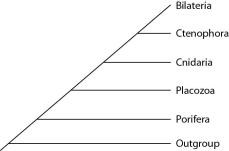 III.
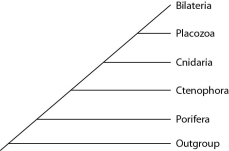 -Which phylogeny has been created by emphasizing the structural simplicity of placozoans?
II.
III.
-Which phylogeny has been created by emphasizing the structural simplicity of placozoans? (Multiple Choice)
4.8/5 (80)
(80) Which characteristic(s) is (are) shared by both cnidarians and flatworms?
(Multiple Choice)
4.9/5 (79)
(79) If a multicellular animal lacks true tissues, then it can properly be included among the
(Multiple Choice)
4.8/5 (87)
(87) What is true of the feeding stage of cycliophorans? 1. It is chemoheterotrophic.
2) It is sessile.
3) It captures food in a manner similar to that of animals with lophophores.
4) It has radial symmetry.
(Multiple Choice)
4.9/5 (72)
(72) The members of which clade in the phylum Cnidaria occur only as polyps?
(Multiple Choice)
4.7/5 (85)
(85) Which graph properly depicts the relationship between the amount of gas in the swim bladder and the density of the fish?
(Multiple Choice)
4.9/5 (73)
(73) Which of the following was probably the least important factor in bringing about the Cambrian explosion?
(Multiple Choice)
4.9/5 (90)
(90) If all of the animals died in a large region of an ocean, we would expect an increase in the
(Multiple Choice)
4.8/5 (82)
(82) Which group's members have had both lungs and gills during their adult lives?
(Multiple Choice)
4.9/5 (83)
(83) 
Filters
- Essay(0)
- Multiple Choice(0)
- Short Answer(0)
- True False(0)
- Matching(0)