



 Chat with AI
Exam 27: The Rise of Animal Diversity

Exam 1: Introduction: Evolution and the Foundations of Biology36 Questions
Exam 2: The Chemical Context of Life135 Questions
Exam 3: Carbon and the Molecular Diversity of Life121 Questions
Exam 4: A Tour of the Cell72 Questions
Exam 5: Membrane Transport and Cell Signaling89 Questions
Exam 6: An Introduction to Metabolism74 Questions
Exam 7: Cellular Respiration and Fermentation90 Questions
Exam 8: Photosynthesis71 Questions
Exam 9: The Cell Cycle63 Questions
Exam 10: Meiosis and Sexual Life Cycles65 Questions
Exam 11: Mendel and the Gene Idea65 Questions
Exam 12: The Chromosomal Basis of Inheritance46 Questions
Exam 13: The Molecular Basis of Inheritance68 Questions
Exam 14: Gene Expression: From Gene to Protein83 Questions
Exam 15: Regulation of Gene Expression53 Questions
Exam 16: Development, Stem Cells, and Cancer34 Questions
Exam 17: Viruses35 Questions
Exam 18: Genomes and Their Evolution31 Questions
Exam 19: Descent With Modification54 Questions
Exam 20: Phylogeny53 Questions
Exam 21: The Evolution of Populations69 Questions
Exam 22: The Origin of Species60 Questions
Exam 23: Broad Patterns of Evolution38 Questions
Exam 24: Early Life and the Diversification of Prokaryotes89 Questions
Exam 25: The Origin and Diversification of Eukaryotes71 Questions
Exam 26: The Colonization of Land by Plants and Fungi153 Questions
Exam 27: The Rise of Animal Diversity107 Questions
Exam 28: Plant Structure and Growth50 Questions
Exam 29: Resource Acquisition, Nutrition, and Transport in Vascular Plants130 Questions
Exam 30: Reproduction and Domestication of Flowering Plants68 Questions
Exam 31: Plant Responses to Internal and External Signals71 Questions
Exam 32: Homeostasis and Endocrine Signaling122 Questions
Exam 33: Animal Nutrition61 Questions
Exam 34: Circulation and Gas Exchange77 Questions
Exam 35: The Immune System84 Questions
Exam 36: Reproduction and Development109 Questions
Exam 37: Neurons, Synapses, and Signaling68 Questions
Exam 38: Nervous and Sensory Systems89 Questions
Exam 39: Motor Mechanisms and Behavior74 Questions
Exam 40: Population Ecology and the Distribution of Organisms92 Questions
Exam 41: Species Interactions55 Questions
Exam 42: Ecosystems and Energy79 Questions
Exam 43: Global Ecology and Conservation Biology70 Questions
Select questions type


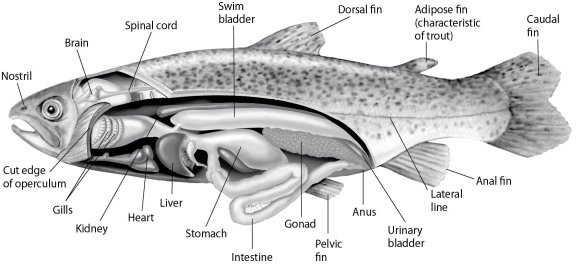 Figure 27.2
Fishes that have swim bladders can regulate their density and thus their buoyancy. There are two types of swim bladder: physostomus and physoclistus. The ancestral version is the physostomus version, in which the swim bladder is connected to the esophagus via a short tube (Figure 27.2). The fish fills this version by swimming to the surface, taking gulps of air, and directing them into the swim bladder. Air is removed from this version by "belching." The physoclistus version is more derived, and has lost its connection to the esophagus. Instead, gas enters and leaves the swim bladder via special circulatory mechanisms within the wall of the swim bladder.
-The presence of a swim bladder allows the typical ray-finned fish to stop swimming and still
Figure 27.2
Fishes that have swim bladders can regulate their density and thus their buoyancy. There are two types of swim bladder: physostomus and physoclistus. The ancestral version is the physostomus version, in which the swim bladder is connected to the esophagus via a short tube (Figure 27.2). The fish fills this version by swimming to the surface, taking gulps of air, and directing them into the swim bladder. Air is removed from this version by "belching." The physoclistus version is more derived, and has lost its connection to the esophagus. Instead, gas enters and leaves the swim bladder via special circulatory mechanisms within the wall of the swim bladder.
-The presence of a swim bladder allows the typical ray-finned fish to stop swimming and still (Multiple Choice)
4.9/5  (87)
(87) Among the invertebrate phyla, phylum Arthropoda is unique in possessing members that have
(Multiple Choice)
4.8/5 (76)
(76) In coelacanths, a swim bladder is present, but the swim bladder is full of adipose tissue (fat), which is there on a fairly permanent basis. If such a swim bladder is used by coelacanths to affect buoyancy, then it does so in much the same way as does the
(Multiple Choice)
4.9/5 (70)
(70) Which of the following are the only extant animals that descended directly from dinosaurs?
(Multiple Choice)
4.8/5 (83)
(83) Regarding its position in the water column, the same thing that happens to a shark when it stops swimming also happens to a
(Multiple Choice)
4.7/5 (72)
(72) Which of these characteristics added most to vertebrate success in relatively dry environments?
(Multiple Choice)
4.8/5 (73)
(73)  Table 27.1. Proposed Number of Hox Genes in Various Extant and Extinct Animals
-What conclusion is apparent from the data in Table 27.1?
Table 27.1. Proposed Number of Hox Genes in Various Extant and Extinct Animals
-What conclusion is apparent from the data in Table 27.1? (Multiple Choice)
4.9/5 (89)
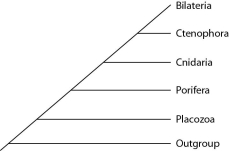
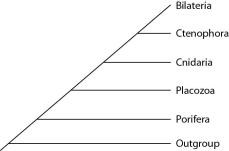
(89) Placozoan evolutionary relationships to other animals are currently unclear, and different phylogenies can be created, depending on the character used to infer relatedness. Sponges have no tissues, but about 20 cell types. Tp (Trichoplax adhaerens) produces a neuropeptide almost identical to one found in cnidarians. The genome of Tp, although the smallest of any known animal, shares many features of complex eumetazoan (even human!) genomes. The next three questions refer to the phylogenetic trees that follow.
I.
 II.
 III.
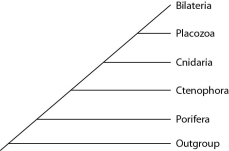 -Which phylogeny has been created by emphasizing a protein found in placozoans?
II.
III.
-Which phylogeny has been created by emphasizing a protein found in placozoans? (Multiple Choice)
4.9/5 (86)
(86) When a shark stops swimming, it does which of the following? 1. sinks
2) quickly dies
3) oxygenates its blood less effectively
(Multiple Choice)
4.8/5 (92)
(92) Which of the following characterize at least some members of the phylum Cnidaria? 1. a gastrovascular cavity
2) a polyp stage
3) a medusa stage
4) cnidocytes
5) a pseudocoelom
(Multiple Choice)
4.9/5 (81)
(81) Which of the following genetic processes may be most helpful in accounting for the Cambrian explosion?
(Multiple Choice)
4.8/5 (81)
(81) A new, sixth global mass-extinction event appears to be occurring on Earth today. The most likely explanation for the dramatic loss of species is
(Multiple Choice)
4.8/5 (83)
(83) Which of the following clades contains the greatest number of animal species?
(Multiple Choice)
5.0/5 (72)
(72) To which of the following are the scales of chondrichthyans most closely related in a structural sense?
(Multiple Choice)
4.8/5 (85)
(85) According to the evidence collected so far, the animal kingdom is
(Multiple Choice)
4.8/5 (76)
(76) What is the probable sequence in which the following clades of animals originated, from earliest to most recent? 1. tetrapods
2) vertebrates
3) deuterostomes
4) amniotes
5) bilaterians
(Multiple Choice)
4.8/5 (79)
(79) 
Filters
- Essay(0)
- Multiple Choice(0)
- Short Answer(0)
- True False(0)
- Matching(0)