



 Chat with AI
Exam 35: The Immune System

Exam 1: Introduction: Evolution and the Foundations of Biology36 Questions
Exam 2: The Chemical Context of Life135 Questions
Exam 3: Carbon and the Molecular Diversity of Life121 Questions
Exam 4: A Tour of the Cell72 Questions
Exam 5: Membrane Transport and Cell Signaling89 Questions
Exam 6: An Introduction to Metabolism74 Questions
Exam 7: Cellular Respiration and Fermentation90 Questions
Exam 8: Photosynthesis71 Questions
Exam 9: The Cell Cycle63 Questions
Exam 10: Meiosis and Sexual Life Cycles65 Questions
Exam 11: Mendel and the Gene Idea65 Questions
Exam 12: The Chromosomal Basis of Inheritance46 Questions
Exam 13: The Molecular Basis of Inheritance68 Questions
Exam 14: Gene Expression: From Gene to Protein83 Questions
Exam 15: Regulation of Gene Expression53 Questions
Exam 16: Development, Stem Cells, and Cancer34 Questions
Exam 17: Viruses35 Questions
Exam 18: Genomes and Their Evolution31 Questions
Exam 19: Descent With Modification54 Questions
Exam 20: Phylogeny53 Questions
Exam 21: The Evolution of Populations69 Questions
Exam 22: The Origin of Species60 Questions
Exam 23: Broad Patterns of Evolution38 Questions
Exam 24: Early Life and the Diversification of Prokaryotes89 Questions
Exam 25: The Origin and Diversification of Eukaryotes71 Questions
Exam 26: The Colonization of Land by Plants and Fungi153 Questions
Exam 27: The Rise of Animal Diversity107 Questions
Exam 28: Plant Structure and Growth50 Questions
Exam 29: Resource Acquisition, Nutrition, and Transport in Vascular Plants130 Questions
Exam 30: Reproduction and Domestication of Flowering Plants68 Questions
Exam 31: Plant Responses to Internal and External Signals71 Questions
Exam 32: Homeostasis and Endocrine Signaling122 Questions
Exam 33: Animal Nutrition61 Questions
Exam 34: Circulation and Gas Exchange77 Questions
Exam 35: The Immune System84 Questions
Exam 36: Reproduction and Development109 Questions
Exam 37: Neurons, Synapses, and Signaling68 Questions
Exam 38: Nervous and Sensory Systems89 Questions
Exam 39: Motor Mechanisms and Behavior74 Questions
Exam 40: Population Ecology and the Distribution of Organisms92 Questions
Exam 41: Species Interactions55 Questions
Exam 42: Ecosystems and Energy79 Questions
Exam 43: Global Ecology and Conservation Biology70 Questions
Select questions type


Mutant fruit flies that make only one antimicrobial peptide were tested for survival after infection with Neurospora crassa fungi or with Micrococcus luteus bacteria, and the results are shown in Figures 35.1 and 35.2.
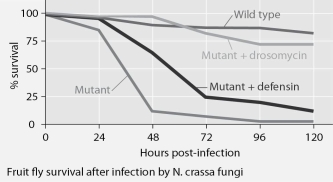
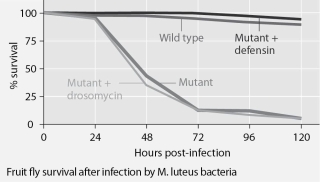 Figure 35.1 Figure 35.2
-The results shown in the graphs in Figures 35.1 and 35.2 support the hypothesis that
Figure 35.1 Figure 35.2
-The results shown in the graphs in Figures 35.1 and 35.2 support the hypothesis that (Multiple Choice)
4.8/5  (68)
(68) The cells and signaling molecules that initiate inflammatory responses are
(Multiple Choice)
4.9/5 (80)
(80) A systemic inflammatory response that is often life threatening is
(Multiple Choice)
4.8/5 (72)
(72) A patient who can produce antibodies against some bacterial pathogens, but not against viral infections, probably has a disorder in his
(Multiple Choice)
5.0/5 (78)
(78) An individual who has been bitten by a poisonous snake that has a fast-acting toxin would likely benefit from
(Multiple Choice)
4.9/5 (82)
(82) Normal immune responses can be described as polyclonal because
(Multiple Choice)
4.7/5 (87)
(87) Jenner's successful use of cowpox virus as a vaccine against the smallpox virus is due to the fact that
(Multiple Choice)
4.9/5 (75)
(75) An example of a pathogen that undergoes rapid changes resulting in antigenic variation is
(Multiple Choice)
4.7/5 (79)
(79) A newborn who is accidentally given a drug that destroys the thymus would most likely
(Multiple Choice)
5.0/5 (94)
(94) Clonal selection of B cells activated by antigen exposure leads to production of
(Multiple Choice)
4.9/5 (82)
(82) Arrange these components of the mammalian immune system as it first responds to a pathogen in the correct sequence. I. Pathogen is destroyed.
II. Lymphocytes secrete antibodies.
III. Antigenic determinants from pathogen bind to antigen receptors on lymphocytes.
IV. Lymphocytes specific to antigenic determinants from pathogen become numerous.
V. Only memory cells remain.
(Multiple Choice)
4.8/5 (80)
(80) A patient who undergoes a high level of mast cell degranulation, dilation of blood vessels, and an acute drop in blood pressure is likely suffering from
(Multiple Choice)
4.9/5 (81)
(81) The eyes and the respiratory tract are both protected against infections by
(Multiple Choice)
4.9/5 (71)
(71) Secondary immune responses upon a second exposure to a pathogen are due to the activation of
(Multiple Choice)
4.9/5 (75)
(75) Use the following information to answer the next few questions.
An otherwise healthy student in your class is infected with EBV, the virus that causes infectious mononucleosis. The same student had already been infected when she was a child, at which time she had merely experienced a mild sore throat and swollen lymph nodes in her neck. This time, although infected, she does not get sick.
-Which of the following statements is not true?
(Multiple Choice)
4.9/5 (80)
(80) Bacterial infection in a previously uninfected house cat would most quickly activate its
(Multiple Choice)
4.7/5 (75)
(75) 
Filters
- Essay(0)
- Multiple Choice(0)
- Short Answer(0)
- True False(0)
- Matching(0)