



 Chat with AI
Exam 35: The Immune System

Exam 1: Introduction: Evolution and the Foundations of Biology36 Questions
Exam 2: The Chemical Context of Life135 Questions
Exam 3: Carbon and the Molecular Diversity of Life121 Questions
Exam 4: A Tour of the Cell72 Questions
Exam 5: Membrane Transport and Cell Signaling89 Questions
Exam 6: An Introduction to Metabolism74 Questions
Exam 7: Cellular Respiration and Fermentation90 Questions
Exam 8: Photosynthesis71 Questions
Exam 9: The Cell Cycle63 Questions
Exam 10: Meiosis and Sexual Life Cycles65 Questions
Exam 11: Mendel and the Gene Idea65 Questions
Exam 12: The Chromosomal Basis of Inheritance46 Questions
Exam 13: The Molecular Basis of Inheritance68 Questions
Exam 14: Gene Expression: From Gene to Protein83 Questions
Exam 15: Regulation of Gene Expression53 Questions
Exam 16: Development, Stem Cells, and Cancer34 Questions
Exam 17: Viruses35 Questions
Exam 18: Genomes and Their Evolution31 Questions
Exam 19: Descent With Modification54 Questions
Exam 20: Phylogeny53 Questions
Exam 21: The Evolution of Populations69 Questions
Exam 22: The Origin of Species60 Questions
Exam 23: Broad Patterns of Evolution38 Questions
Exam 24: Early Life and the Diversification of Prokaryotes89 Questions
Exam 25: The Origin and Diversification of Eukaryotes71 Questions
Exam 26: The Colonization of Land by Plants and Fungi153 Questions
Exam 27: The Rise of Animal Diversity107 Questions
Exam 28: Plant Structure and Growth50 Questions
Exam 29: Resource Acquisition, Nutrition, and Transport in Vascular Plants130 Questions
Exam 30: Reproduction and Domestication of Flowering Plants68 Questions
Exam 31: Plant Responses to Internal and External Signals71 Questions
Exam 32: Homeostasis and Endocrine Signaling122 Questions
Exam 33: Animal Nutrition61 Questions
Exam 34: Circulation and Gas Exchange77 Questions
Exam 35: The Immune System84 Questions
Exam 36: Reproduction and Development109 Questions
Exam 37: Neurons, Synapses, and Signaling68 Questions
Exam 38: Nervous and Sensory Systems89 Questions
Exam 39: Motor Mechanisms and Behavior74 Questions
Exam 40: Population Ecology and the Distribution of Organisms92 Questions
Exam 41: Species Interactions55 Questions
Exam 42: Ecosystems and Energy79 Questions
Exam 43: Global Ecology and Conservation Biology70 Questions
Select questions type


Preventing the appearance of the symptoms of an allergy attack would be the likely result of
(Multiple Choice)
4.8/5  (69)
(69) Engulfing-phagocytic cells of innate immunity include all of the following except
(Multiple Choice)
4.9/5 (70)
(70) In the human disease known as lupus, there is an immune reaction against a patient's own DNA from broken or dying cells, which categorizes lupus as
(Multiple Choice)
4.8/5 (82)
(82) Mammals have Toll-like receptors (TLRs) that can recognize a kind of macromolecule that is absent from vertebrates but present in/on certain groups of pathogens, including viral
(Multiple Choice)
4.8/5 (88)
(88) An invertebrate, such as an insect, has innate immunity activity in its intestine that likely includes
(Multiple Choice)
4.7/5 (71)
(71) All cells have protein markers on their membranes, and the Rh antigen is found in the membranes of red blood cells. If a person possesses the Rh antigen on his or her red blood cells, it is indicated with a + sign. If a person does not possess the Rh antigen, it is indicated with a - sign. A, B, and O refer to the ABO blood groups.
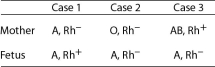 Figure 35.3
-Study the table in Figure 35.3. The mother could exhibit an anti-Rh factor reaction to the developing fetus in
Figure 35.3
-Study the table in Figure 35.3. The mother could exhibit an anti-Rh factor reaction to the developing fetus in (Multiple Choice)
4.8/5 (71)
(71) The cell-mediated immunity that destroys virally infected cells involves
(Multiple Choice)
4.8/5 (76)
(76) This type of immunity is present only when a newborn infant is being fed by actively nursing its mother and ends when nursing ends.
(Multiple Choice)
4.8/5 (66)
(66) A cell type that interacts with both the humoral and cell-mediated immune pathways is a
(Multiple Choice)
4.9/5 (88)
(88) Infection by a bacterium that has elements on its surface that enhance its resistance to lysozyme will likely result in
(Multiple Choice)
4.9/5 (82)
(82) When antibodies bind antigens, the clumping of antigens results from
(Multiple Choice)
4.8/5 (87)
(87) The ability of one person to produce over a million different antibody molecules does not require over a million different genes; rather, this wide range of antibody production is due to
(Multiple Choice)
4.8/5 (84)
(84) The ability of some viruses to remain inactive (latent) for a period of time is exemplified by
(Multiple Choice)
4.9/5 (75)
(75) 
Filters
- Essay(0)
- Multiple Choice(0)
- Short Answer(0)
- True False(0)
- Matching(0)