



 Chat with AI
Exam 17: The Evolution of Plant and Fungal Diversity

Exam 1: Biology: Exploring Life47 Questions
Exam 2: The Chemical Basis of Life73 Questions
Exam 3: The Molecules of Cells89 Questions
Exam 4: A Tour of the Cell93 Questions
Exam 5: The Working Cell81 Questions
Exam 6: How Cells Harvest Chemical Energy82 Questions
Exam 7: Photosynthesis: Using Light to Make Food83 Questions
Exam 8: The Cellular Basis of Reproduction and Inheritance81 Questions
Exam 9: Patterns of Inheritance76 Questions
Exam 10: Molecular Biology of the Gene85 Questions
Exam 11: How Genes Are Controlled84 Questions
Exam 12: DNA Technology and Genomics80 Questions
Exam 13: How Populations Evolve67 Questions
Exam 14: The Origin of Species59 Questions
Exam 15: Tracing Evolutionary History88 Questions
Exam 16: Microbial Life: Prokaryotes and Protists80 Questions
Exam 17: The Evolution of Plant and Fungal Diversity85 Questions
Exam 18: The Evolution of Invertebrate Diversity81 Questions
Exam 19: The Evolution of Vertebrate Diversity77 Questions
Exam 20: Unifying Concepts of Animal Structure and Function68 Questions
Exam 21: Nutrition and Digestion96 Questions
Exam 22: Gas Exchange68 Questions
Exam 23: Circulation81 Questions
Exam 24: The Immune System76 Questions
Exam 25: Control of Body Temperature and Water Balance67 Questions
Exam 26: Hormones and the Endocrine System66 Questions
Exam 27: Reproduction and Embryonic Development88 Questions
Exam 28: Nervous Systems75 Questions
Exam 29: The Senses62 Questions
Exam 30: How Animals Move72 Questions
Exam 31: Plant Structure, Growth, and Reproduction81 Questions
Exam 32: Plant Nutrition and Transport69 Questions
Exam 33: Control Systems in Plants61 Questions
Exam 34: The Biosphere: an Introduction to Earths Diverse Environments61 Questions
Exam 35: Behavioral Adaptations to the Environment54 Questions
Exam 36: Population Ecology57 Questions
Exam 37: Communities and Ecosystems62 Questions
Exam 38: Conservation Biology61 Questions
Select questions type


As fungi play important roles in ecosystem processes as decomposers and symbiont partners, scientists are interested in understanding how global climate change may affect fungal diversity. In 2007-2008, scientists visited the maritime Antarctic, an area of the Southern Hemisphere that is noted to be warming the fastest, to conduct a survey of fungal diversity along a climatic gradient (the most prevalent weather conditions of a region along an incline). Twenty-nine soil samples were taken along the gradient. Fungal diversity was measured in operational taxonomic units (OTUs); one OTU = one cluster, or group, of organisms. Here is a portion of the data collected:
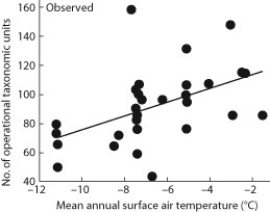 Source: Newsham, K. K., Hopkins, D. W., Carvalhais, L. C., Fretwell, P. T., Rushton, S. P., O'Donnell, A. G., & Dennis, P. G. (n.d.). Relationship between soil fungal diversity and temperature in the maritime Antarctic. Nature Climate Change, 6, 182-186.
-What might scientists also predict to find in warmer environments based on the data in the figure?
Source: Newsham, K. K., Hopkins, D. W., Carvalhais, L. C., Fretwell, P. T., Rushton, S. P., O'Donnell, A. G., & Dennis, P. G. (n.d.). Relationship between soil fungal diversity and temperature in the maritime Antarctic. Nature Climate Change, 6, 182-186.
-What might scientists also predict to find in warmer environments based on the data in the figure? (Multiple Choice)
5.0/5  (92)
(92) One of the factors that helps animal-pollinated flowering plants transfer pollen to plants of the same species is that
(Multiple Choice)
4.8/5 (77)
(77) Which of the following occurs in the sexual reproduction phase of the fungus life cycle?
(Multiple Choice)
4.7/5 (82)
(82) Most familiar types of fungi including mushrooms, puffballs, and shelf fungi are examples of
(Multiple Choice)
4.8/5 (82)
(82) The incomplete decay of dead plants during the Carboniferous period led to
(Multiple Choice)
4.9/5 (77)
(77) Suppose you have two small plants. You cut the roots off of one and then place both plants in a jar of red dye. After 20 minutes, the roots, stem, and leaves of the plant with roots have turned pink. The plant without roots has not changed color at all. Why has the plant without roots remained a normal, green color?
(Multiple Choice)
4.8/5 (74)
(74) During the Carboniferous period, photosynthesis in immense swamp forests removed ________ from the atmosphere, which produced a drier, cooler global climate and promoted the success of ________.
(Multiple Choice)
4.9/5 (87)
(87) Red maples and other wind-pollinated plants invest relatively little in producing ________ but must invest a great deal in producing ________ to achieve good pollination rates.
(Multiple Choice)
4.9/5 (79)
(79) To cross-fertilize flowers A and B, one would first remove flower A's immature ________ and later transfer pollen from flower B to flower A's ________.
(Multiple Choice)
4.7/5 (82)
(82) Two characteristics shared by gymnosperms and angiosperms that are absent from earlier plant groups and represent key adaptations to life on dry land are
(Multiple Choice)
4.9/5 (74)
(74) The last common ancestor of animals and fungi was probably ________, like the spores of ________ fungi.
(Multiple Choice)
4.8/5 (93)
(93) As fungi play important roles in ecosystem processes as decomposers and symbiont partners, scientists are interested in understanding how global climate change may affect fungal diversity. In 2007-2008, scientists visited the maritime Antarctic, an area of the Southern Hemisphere that is noted to be warming the fastest, to conduct a survey of fungal diversity along a climatic gradient (the most prevalent weather conditions of a region along an incline). Twenty-nine soil samples were taken along the gradient. Fungal diversity was measured in operational taxonomic units (OTUs); one OTU = one cluster, or group, of organisms. Here is a portion of the data collected:
Source: Newsham, K. K., Hopkins, D. W., Carvalhais, L. C., Fretwell, P. T., Rushton, S. P., O'Donnell, A. G., & Dennis, P. G. (n.d.). Relationship between soil fungal diversity and temperature in the maritime Antarctic. Nature Climate Change, 6, 182-186.
-Each dot on the figure represents a soil sample. Which of the following is an accurate conclusion about the data presented?
Source: Newsham, K. K., Hopkins, D. W., Carvalhais, L. C., Fretwell, P. T., Rushton, S. P., O'Donnell, A. G., & Dennis, P. G. (n.d.). Relationship between soil fungal diversity and temperature in the maritime Antarctic. Nature Climate Change, 6, 182-186.
-Each dot on the figure represents a soil sample. Which of the following is an accurate conclusion about the data presented? (Multiple Choice)
4.7/5 (79)
(79) The plant genus Pinus reaches optimal growth when it grows with the fungal genus Suillusis. The ________ of the fungus give Pinus water and mineral nutrients, while Pinus gives the fungus sugars and organic macromolecules. Pinus and Suillusis have a ________ relationship.
(Multiple Choice)
4.9/5 (77)
(77) A leaf with a higher density of stomata can take up more CO2 and release more water than a leaf with a lower density of stomata.
-Consider two plant types: 1. Plants that grow in arid (dry) environments
2) Plants that grow in moist (e.g., wetland) environments
Which plant would you expect to have fewer stomata, and why?
(Multiple Choice)
4.9/5 (80)
(80) Tomato seeds are often consumed by birds or other organisms and then deposited through feces. However, when tomatoes rot on the vine, organisms may not consume them. How would tomato seeds likely disperse in this situation?
(Multiple Choice)
4.8/5 (66)
(66) Fungal diseases common in ________ include ________ and ________.
(Multiple Choice)
4.8/5 (75)
(75) Fungi contact and absorb food through the ________, a branching network of ________.
(Multiple Choice)
4.7/5 (83)
(83) Some of the unique adaptations of angiosperms include their beneficial relationships with ________ and their relatively ________.
(Multiple Choice)
4.9/5 (86)
(86) 
Filters
- Essay(0)
- Multiple Choice(0)
- Short Answer(0)
- True False(0)
- Matching(0)