



 Chat with AI
Exam 17: The Evolution of Plant and Fungal Diversity

Exam 1: Biology: Exploring Life47 Questions
Exam 2: The Chemical Basis of Life73 Questions
Exam 3: The Molecules of Cells89 Questions
Exam 4: A Tour of the Cell93 Questions
Exam 5: The Working Cell81 Questions
Exam 6: How Cells Harvest Chemical Energy82 Questions
Exam 7: Photosynthesis: Using Light to Make Food83 Questions
Exam 8: The Cellular Basis of Reproduction and Inheritance81 Questions
Exam 9: Patterns of Inheritance76 Questions
Exam 10: Molecular Biology of the Gene85 Questions
Exam 11: How Genes Are Controlled84 Questions
Exam 12: DNA Technology and Genomics80 Questions
Exam 13: How Populations Evolve67 Questions
Exam 14: The Origin of Species59 Questions
Exam 15: Tracing Evolutionary History88 Questions
Exam 16: Microbial Life: Prokaryotes and Protists80 Questions
Exam 17: The Evolution of Plant and Fungal Diversity85 Questions
Exam 18: The Evolution of Invertebrate Diversity81 Questions
Exam 19: The Evolution of Vertebrate Diversity77 Questions
Exam 20: Unifying Concepts of Animal Structure and Function68 Questions
Exam 21: Nutrition and Digestion96 Questions
Exam 22: Gas Exchange68 Questions
Exam 23: Circulation81 Questions
Exam 24: The Immune System76 Questions
Exam 25: Control of Body Temperature and Water Balance67 Questions
Exam 26: Hormones and the Endocrine System66 Questions
Exam 27: Reproduction and Embryonic Development88 Questions
Exam 28: Nervous Systems75 Questions
Exam 29: The Senses62 Questions
Exam 30: How Animals Move72 Questions
Exam 31: Plant Structure, Growth, and Reproduction81 Questions
Exam 32: Plant Nutrition and Transport69 Questions
Exam 33: Control Systems in Plants61 Questions
Exam 34: The Biosphere: an Introduction to Earths Diverse Environments61 Questions
Exam 35: Behavioral Adaptations to the Environment54 Questions
Exam 36: Population Ecology57 Questions
Exam 37: Communities and Ecosystems62 Questions
Exam 38: Conservation Biology61 Questions
Select questions type


According to this figure, at what time in the evolutionary history of plants did vascular systems likely first evolve? 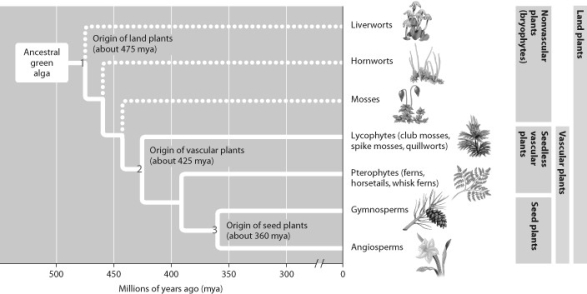
(Multiple Choice)
4.8/5  (78)
(78) Old cemeteries (pre-1900) often have gravestones that often host many types of lichens. However, it is not impossible to find old cemeteries where lichens are entirely absent. Given what is known about lichens, an old cemetery without lichens probably
(Multiple Choice)
5.0/5 (86)
(86) Corn, rice, wheat, fleshy fruits such as apples and berries, and many spices are all produced by
(Multiple Choice)
4.8/5 (90)
(90) Plants dependent on night-flying (nocturnal) pollinators typically have flowers that
(Multiple Choice)
4.9/5 (79)
(79) A growth-producing region of cell division, known as a/an ________, is found near the tips of stems and roots.
(Multiple Choice)
5.0/5 (69)
(69) In ferns, the ________ produces spores by ________ in ________.
(Multiple Choice)
4.8/5 (63)
(63) The angiosperm plant we see represents the ________ generation, and the flower produces ________.
(Multiple Choice)
5.0/5 (81)
(81) Which of the following organisms has a dominant sporophyte generation and a free-living gametophyte generation?
(Multiple Choice)
4.9/5 (93)
(93) Many flower traits are specifically attractive to a certain type of pollinator. For example, the scent of rotting flesh is attractive to certain flies and beetles but not to most other pollinators. What adaptive purpose is served by this kind of "niche marketing" of flowers to specific pollinators?
(Multiple Choice)
4.8/5 (91)
(91) Which of the following represents the male gametophyte of a conifer?
(Multiple Choice)
4.8/5 (77)
(77) As fungi play important roles in ecosystem processes as decomposers and symbiont partners, scientists are interested in understanding how global climate change may affect fungal diversity. In 2007-2008, scientists visited the maritime Antarctic, an area of the Southern Hemisphere that is noted to be warming the fastest, to conduct a survey of fungal diversity along a climatic gradient (the most prevalent weather conditions of a region along an incline). Twenty-nine soil samples were taken along the gradient. Fungal diversity was measured in operational taxonomic units (OTUs); one OTU = one cluster, or group, of organisms. Here is a portion of the data collected:
 Source: Newsham, K. K., Hopkins, D. W., Carvalhais, L. C., Fretwell, P. T., Rushton, S. P., O'Donnell, A. G., & Dennis, P. G. (n.d.). Relationship between soil fungal diversity and temperature in the maritime Antarctic. Nature Climate Change, 6, 182-186.
-In this frigid Antarctic region, there is a thin soil layer that defrosts during the year. However, the rest of the soil in the region, called permafrost, stays frozen. Which of the following characteristics would best help plants to survive in this soil-poor climate?
Source: Newsham, K. K., Hopkins, D. W., Carvalhais, L. C., Fretwell, P. T., Rushton, S. P., O'Donnell, A. G., & Dennis, P. G. (n.d.). Relationship between soil fungal diversity and temperature in the maritime Antarctic. Nature Climate Change, 6, 182-186.
-In this frigid Antarctic region, there is a thin soil layer that defrosts during the year. However, the rest of the soil in the region, called permafrost, stays frozen. Which of the following characteristics would best help plants to survive in this soil-poor climate? (Multiple Choice)
4.9/5 (87)
(87) In angiosperms, pollen grains develop in the ________ and land on the ________.
(Multiple Choice)
4.9/5 (82)
(82) Heterotrophic eukaryotes that digest their food externally and absorb the small molecules are referred to as
(Multiple Choice)
5.0/5 (80)
(80) The ancestors of land plants were probably ________ that lived in ________.
(Multiple Choice)
4.7/5 (70)
(70) In a moss, most of the plants that we see are ________; in a fern, the most dominant stage is the ________.
(Multiple Choice)
4.8/5 (87)
(87) Fungi are found associated with the earliest plant fossils. Fungi may have helped plants become terrestrial by
(Multiple Choice)
4.8/5 (87)
(87) As fungi play important roles in ecosystem processes as decomposers and symbiont partners, scientists are interested in understanding how global climate change may affect fungal diversity. In 2007-2008, scientists visited the maritime Antarctic, an area of the Southern Hemisphere that is noted to be warming the fastest, to conduct a survey of fungal diversity along a climatic gradient (the most prevalent weather conditions of a region along an incline). Twenty-nine soil samples were taken along the gradient. Fungal diversity was measured in operational taxonomic units (OTUs); one OTU = one cluster, or group, of organisms. Here is a portion of the data collected:
Source: Newsham, K. K., Hopkins, D. W., Carvalhais, L. C., Fretwell, P. T., Rushton, S. P., O'Donnell, A. G., & Dennis, P. G. (n.d.). Relationship between soil fungal diversity and temperature in the maritime Antarctic. Nature Climate Change, 6, 182-186.
-Usable (liquid) water sources in the maritime Antarctic are directly related to air temperatures: the warmer the temperature, the more water becomes available for use by plants, fungi, and other living species. How would you predict this phenomenon would influence fungal biodiversity?
Source: Newsham, K. K., Hopkins, D. W., Carvalhais, L. C., Fretwell, P. T., Rushton, S. P., O'Donnell, A. G., & Dennis, P. G. (n.d.). Relationship between soil fungal diversity and temperature in the maritime Antarctic. Nature Climate Change, 6, 182-186.
-Usable (liquid) water sources in the maritime Antarctic are directly related to air temperatures: the warmer the temperature, the more water becomes available for use by plants, fungi, and other living species. How would you predict this phenomenon would influence fungal biodiversity? (Multiple Choice)
4.8/5 (85)
(85) An experimental forest ecosystem is enclosed in a sealed greenhouse. The entire ecosystem, including the air and soil, is treated with an extremely potent fungicide that kills all fungal life stages including spores. What will probably happen next?
(Multiple Choice)
4.9/5 (68)
(68) 
Filters
- Essay(0)
- Multiple Choice(0)
- Short Answer(0)
- True False(0)
- Matching(0)