



 Chat with AI
Exam 18: The Evolution of Invertebrate Diversity

Exam 1: Biology: Exploring Life47 Questions
Exam 2: The Chemical Basis of Life73 Questions
Exam 3: The Molecules of Cells89 Questions
Exam 4: A Tour of the Cell93 Questions
Exam 5: The Working Cell81 Questions
Exam 6: How Cells Harvest Chemical Energy82 Questions
Exam 7: Photosynthesis: Using Light to Make Food83 Questions
Exam 8: The Cellular Basis of Reproduction and Inheritance81 Questions
Exam 9: Patterns of Inheritance76 Questions
Exam 10: Molecular Biology of the Gene85 Questions
Exam 11: How Genes Are Controlled84 Questions
Exam 12: DNA Technology and Genomics80 Questions
Exam 13: How Populations Evolve67 Questions
Exam 14: The Origin of Species59 Questions
Exam 15: Tracing Evolutionary History88 Questions
Exam 16: Microbial Life: Prokaryotes and Protists80 Questions
Exam 17: The Evolution of Plant and Fungal Diversity85 Questions
Exam 18: The Evolution of Invertebrate Diversity81 Questions
Exam 19: The Evolution of Vertebrate Diversity77 Questions
Exam 20: Unifying Concepts of Animal Structure and Function68 Questions
Exam 21: Nutrition and Digestion96 Questions
Exam 22: Gas Exchange68 Questions
Exam 23: Circulation81 Questions
Exam 24: The Immune System76 Questions
Exam 25: Control of Body Temperature and Water Balance67 Questions
Exam 26: Hormones and the Endocrine System66 Questions
Exam 27: Reproduction and Embryonic Development88 Questions
Exam 28: Nervous Systems75 Questions
Exam 29: The Senses62 Questions
Exam 30: How Animals Move72 Questions
Exam 31: Plant Structure, Growth, and Reproduction81 Questions
Exam 32: Plant Nutrition and Transport69 Questions
Exam 33: Control Systems in Plants61 Questions
Exam 34: The Biosphere: an Introduction to Earths Diverse Environments61 Questions
Exam 35: Behavioral Adaptations to the Environment54 Questions
Exam 36: Population Ecology57 Questions
Exam 37: Communities and Ecosystems62 Questions
Exam 38: Conservation Biology61 Questions
Select questions type


Which of the following statements about deuterostomes is true?
(Multiple Choice)
4.8/5  (82)
(82) Which of the following phyla is most closely related to echinoderms?
(Multiple Choice)
4.9/5 (87)
(87) The graph below is of an index of diversity of arthropods in three different plots of a cornfield. In one of the three plots an insecticide was sprayed. Answer the questions below about this situation.
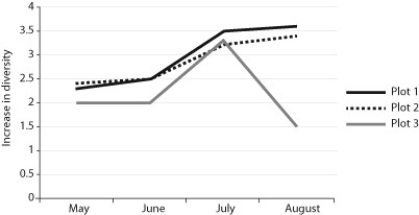 Arthropod diversity in three cornfield plots.
-Which of the following conclusions is supported by the data shown in the graph?
Arthropod diversity in three cornfield plots.
-Which of the following conclusions is supported by the data shown in the graph? (Multiple Choice)
4.9/5 (83)
(83) A bilaterally symmetrical, wormlike animal that has a complete digestive tract and a cuticle could be a member of which of the following phyla?
(Multiple Choice)
5.0/5 (81)
(81) Which of the following are not included among the eumetazoans that have true tissues?
(Multiple Choice)
4.8/5 (67)
(67) An organism that can fly and has an exoskeleton must be a(n)
(Multiple Choice)
4.8/5 (68)
(68) ________ are soil dwellers; ________ are mostly marine; and ________ mostly inhabit fresh water.
(Multiple Choice)
4.9/5 (84)
(84) Corals belong to phylum Cnidaria. The reefs themselves are made up of millions of polyps, each of which secretes a calcium carbonate skeleton that becomes part of the reef structure. Corals, which are attached to the reef as adults, have free-swimming larvae that develop into new polyps.
Corals are actually colorless. The brilliant colors that are visible on the reef come from the zooxanthellae (microscopic algae) that live within their body tissues. The zooxanthellae and corals have a symbiotic relationship in which corals provide carbon dioxide and mineral nutrients (released as wastes from coral digestion) to the zooxanthellae. The zooxanthellae perform photosynthesis. Photosynthesis produces nutrients (in the form of sugars) for the coral and also releases oxygen. This relationship supplements energy from predation and allows corals to survive in clear tropical water, even though these areas have very low nutrient levels.
-What advantage do free-swimming larvae confer on reef-building corals?
(Multiple Choice)
5.0/5 (85)
(85) 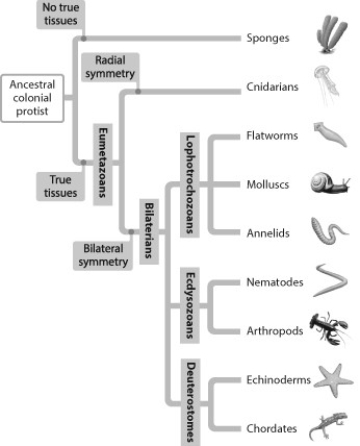 -Which phyla of animals are most closely related?
While wading in the ocean, you look down into the water and notice an umbrella-shaped, translucent animal. It swims by pulsing its body, and long tentacles trail behind it. One of them brushes your leg. Ouch! You feel a burning sensation where it touched you. To what phylum does this creature probably belong?
(Multiple Choice)
4.8/5 (82)
(82) During the Cambrian explosion approximately 535 to 525 million years ago,
(Multiple Choice)
4.9/5 (84)
(84) 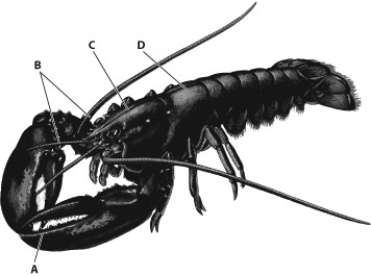 -The most obvious feature that this animal shares with annelids is
 (Multiple Choice)
4.8/5 (71)
(71) The insect body plan includes many groups of serially repeated units. For example, there are typically three pairs of legs, one on each of the three segments of the thorax. Which of the following options best describes how these pairs of legs develop and evolve?
(Multiple Choice)
4.7/5 (70)
(70) You find a wormlike, soft-bodied adult animal in a mudflat. It is bilaterally symmetrical, is segmented, has a true coelom, and has a complete digestive tract. Based on these characteristics, what phylum does the animal represent?
(Multiple Choice)
4.8/5 (78)
(78) Which of the following is a typical characteristic of molluscs?
(Multiple Choice)
4.8/5 (65)
(65) 
Filters
- Essay(0)
- Multiple Choice(0)
- Short Answer(0)
- True False(0)
- Matching(0)