



 Chat with AI
Exam 18: The Evolution of Invertebrate Diversity

Exam 1: Biology: Exploring Life47 Questions
Exam 2: The Chemical Basis of Life73 Questions
Exam 3: The Molecules of Cells89 Questions
Exam 4: A Tour of the Cell93 Questions
Exam 5: The Working Cell81 Questions
Exam 6: How Cells Harvest Chemical Energy82 Questions
Exam 7: Photosynthesis: Using Light to Make Food83 Questions
Exam 8: The Cellular Basis of Reproduction and Inheritance81 Questions
Exam 9: Patterns of Inheritance76 Questions
Exam 10: Molecular Biology of the Gene85 Questions
Exam 11: How Genes Are Controlled84 Questions
Exam 12: DNA Technology and Genomics80 Questions
Exam 13: How Populations Evolve67 Questions
Exam 14: The Origin of Species59 Questions
Exam 15: Tracing Evolutionary History88 Questions
Exam 16: Microbial Life: Prokaryotes and Protists80 Questions
Exam 17: The Evolution of Plant and Fungal Diversity85 Questions
Exam 18: The Evolution of Invertebrate Diversity81 Questions
Exam 19: The Evolution of Vertebrate Diversity77 Questions
Exam 20: Unifying Concepts of Animal Structure and Function68 Questions
Exam 21: Nutrition and Digestion96 Questions
Exam 22: Gas Exchange68 Questions
Exam 23: Circulation81 Questions
Exam 24: The Immune System76 Questions
Exam 25: Control of Body Temperature and Water Balance67 Questions
Exam 26: Hormones and the Endocrine System66 Questions
Exam 27: Reproduction and Embryonic Development88 Questions
Exam 28: Nervous Systems75 Questions
Exam 29: The Senses62 Questions
Exam 30: How Animals Move72 Questions
Exam 31: Plant Structure, Growth, and Reproduction81 Questions
Exam 32: Plant Nutrition and Transport69 Questions
Exam 33: Control Systems in Plants61 Questions
Exam 34: The Biosphere: an Introduction to Earths Diverse Environments61 Questions
Exam 35: Behavioral Adaptations to the Environment54 Questions
Exam 36: Population Ecology57 Questions
Exam 37: Communities and Ecosystems62 Questions
Exam 38: Conservation Biology61 Questions
Select questions type


The graph below is of an index of diversity of arthropods in three different plots of a cornfield. In one of the three plots an insecticide was sprayed. Answer the questions below about this situation.
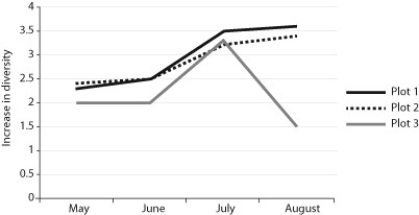 Arthropod diversity in three cornfield plots.
-The fact that the lines generally rise from left to right indicates
Arthropod diversity in three cornfield plots.
-The fact that the lines generally rise from left to right indicates (Multiple Choice)
4.9/5  (73)
(73) The digestive tract of a nematode is most like which of the following?
(Multiple Choice)
4.8/5 (75)
(75) For the following questions consider these characteristics:
I. radial symmetry
II. bilateral symmetry
III. true tissues
IV. complete digestive tract
-One of the most venomous organisms on earth is an Australian marine invertebrate that kills its prey using cnidocytes. These animals would be expected to have
(Multiple Choice)
4.8/5 (89)
(89) Which of the following statements about tunicates indicates that these animals are chordates?
(Multiple Choice)
4.9/5 (85)
(85) Cassiopeia is a marine organism with a medusa body that has an unusual orientation: It floats upside-down. It also has a distinct coloration that is due to algae that live between the epidermis (outer) layer and gastrodermis (inner layer that lines the digestive cavity) of the Cassiopeia. The algae provide food for the Cassiopeia, and the Cassiopeia's orientation provides sunlight to the algae for photosynthesis. Cassiopeia is a/an ________, and the Cassiopeia and the algae have a ________ relationship.
(Multiple Choice)
4.9/5 (74)
(74) Suppose you use a dissecting microscope to observe organisms that have colonized discs of densely packed, fibrous wood (Masonite plates) that have been submerged in 6 inches of lake water for 8 weeks. You see insect cases (protective shelters), insect larvae, and newly emerged insects with wings. You determine that you are looking at an insect species
(Multiple Choice)
4.8/5 (95)
(95) Which of these molluscs sometimes do not have an exterior shell?
(Multiple Choice)
4.8/5 (73)
(73) 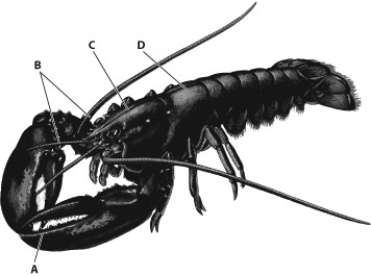 -Which part of this figure shows the thorax segment of the lobster?
 (Multiple Choice)
4.8/5 (74)
(74) Invertebrate diversity contributes to all of the following except
(Multiple Choice)
4.9/5 (83)
(83) Which of the following statements regarding cnidarians is true?
(Multiple Choice)
4.8/5 (78)
(78) You find a small, elongated animal embedded in the sand with one end sticking out. Among other things, it has segmental musculature, a coelom, a notochord, and a complete digestive tract with an anus located partway down the body. This animal is
(Multiple Choice)
4.7/5 (75)
(75) Complete metamorphosis is considered to occur in a species if
(Multiple Choice)
4.8/5 (85)
(85)
-Which part of this figure shows the tube feet of the starfish? 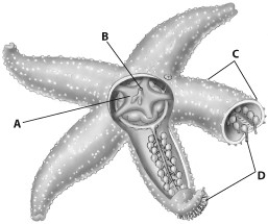
-Which part of this figure shows the tube feet of the starfish? (Multiple Choice)
4.9/5 (77)
(77) According to the "new" revised phylogeny based on genetic analyses, annelids are a member of the Lophotrochozoa and are most closely related to which of the following groups?
(Multiple Choice)
4.8/5 (91)
(91) 
Filters
- Essay(0)
- Multiple Choice(0)
- Short Answer(0)
- True False(0)
- Matching(0)