



 Chat with AI
Exam 2: The Chemical Basis of Life

Exam 1: Biology: Exploring Life47 Questions
Exam 2: The Chemical Basis of Life73 Questions
Exam 3: The Molecules of Cells89 Questions
Exam 4: A Tour of the Cell93 Questions
Exam 5: The Working Cell81 Questions
Exam 6: How Cells Harvest Chemical Energy82 Questions
Exam 7: Photosynthesis: Using Light to Make Food83 Questions
Exam 8: The Cellular Basis of Reproduction and Inheritance81 Questions
Exam 9: Patterns of Inheritance76 Questions
Exam 10: Molecular Biology of the Gene85 Questions
Exam 11: How Genes Are Controlled84 Questions
Exam 12: DNA Technology and Genomics80 Questions
Exam 13: How Populations Evolve67 Questions
Exam 14: The Origin of Species59 Questions
Exam 15: Tracing Evolutionary History88 Questions
Exam 16: Microbial Life: Prokaryotes and Protists80 Questions
Exam 17: The Evolution of Plant and Fungal Diversity85 Questions
Exam 18: The Evolution of Invertebrate Diversity81 Questions
Exam 19: The Evolution of Vertebrate Diversity77 Questions
Exam 20: Unifying Concepts of Animal Structure and Function68 Questions
Exam 21: Nutrition and Digestion96 Questions
Exam 22: Gas Exchange68 Questions
Exam 23: Circulation81 Questions
Exam 24: The Immune System76 Questions
Exam 25: Control of Body Temperature and Water Balance67 Questions
Exam 26: Hormones and the Endocrine System66 Questions
Exam 27: Reproduction and Embryonic Development88 Questions
Exam 28: Nervous Systems75 Questions
Exam 29: The Senses62 Questions
Exam 30: How Animals Move72 Questions
Exam 31: Plant Structure, Growth, and Reproduction81 Questions
Exam 32: Plant Nutrition and Transport69 Questions
Exam 33: Control Systems in Plants61 Questions
Exam 34: The Biosphere: an Introduction to Earths Diverse Environments61 Questions
Exam 35: Behavioral Adaptations to the Environment54 Questions
Exam 36: Population Ecology57 Questions
Exam 37: Communities and Ecosystems62 Questions
Exam 38: Conservation Biology61 Questions
Select questions type


What is the atomic mass of an atom that has 6 protons, 6 neutrons, and 6 electrons?
(Multiple Choice)
4.8/5  (80)
(80) What happens to an atom if the electrons in the outer shell are altered?
(Multiple Choice)
4.9/5 (99)
(99) If you found a fossilized dinosaur bone, what could be done to accurately determine the age of the fossil?
(Multiple Choice)
4.9/5 (69)
(69) Which of the following particles are found in the nucleus of an atom?
(Multiple Choice)
4.9/5 (83)
(83) Household ammonia, or ammonium hydroxide, is a mixture of ammonia (NH3) and water. What types of bonding interactions will occur between molecules of ammonia and water in a bottle of household ammonia?
(Multiple Choice)
4.8/5 (78)
(78) When full, the innermost electron shell of argon contains ________ electrons, and the outermost shell contains ________ electrons.
(Multiple Choice)
5.0/5 (76)
(76) Below is the structure of leucine, an amino acid. What type of bond is the arrow pointing to? 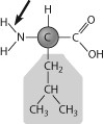
(Multiple Choice)
4.9/5 (67)
(67) Consider the following situations: (1) a magnesium atom and two chlorine atoms join together to form a molecule of magnesium chloride; (2) water molecules interact with each other in a beaker; and (3) two carbon atoms and six hydrogen atoms join together to form ethane. Rank the strength of the bonding interactions taking place in each situation, from the weakest bonds to the strongest bonds.
(Multiple Choice)
4.7/5 (80)
(80) You want to design a controlled experiment to determine which tablet, PEPCID AC or Alka-Seltzer, neutralizes stomach acid the quickest. Which of the following experiments would be the best to perform?
(Multiple Choice)
4.8/5 (74)
(74) 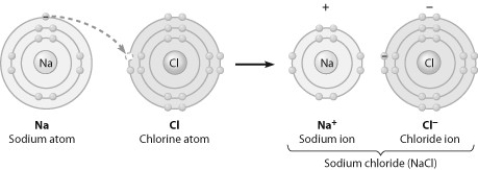
If you were able to chemically analyze your stomach fluids 30 minutes after taking two tablets, you would find
(Multiple Choice)
4.8/5 (78)
(78) You've made a hot drink by dissolving a teaspoon of instant coffee and a teaspoon of sugar in a cup of hot water. Which of the following statements is true?
(Multiple Choice)
4.9/5 (78)
(78) 
Filters
- Essay(0)
- Multiple Choice(0)
- Short Answer(0)
- True False(0)
- Matching(0)