



 Chat with AI
Exam 2: The Chemical Basis of Life

Exam 1: Biology: Exploring Life47 Questions
Exam 2: The Chemical Basis of Life73 Questions
Exam 3: The Molecules of Cells89 Questions
Exam 4: A Tour of the Cell93 Questions
Exam 5: The Working Cell81 Questions
Exam 6: How Cells Harvest Chemical Energy82 Questions
Exam 7: Photosynthesis: Using Light to Make Food83 Questions
Exam 8: The Cellular Basis of Reproduction and Inheritance81 Questions
Exam 9: Patterns of Inheritance76 Questions
Exam 10: Molecular Biology of the Gene85 Questions
Exam 11: How Genes Are Controlled84 Questions
Exam 12: DNA Technology and Genomics80 Questions
Exam 13: How Populations Evolve67 Questions
Exam 14: The Origin of Species59 Questions
Exam 15: Tracing Evolutionary History88 Questions
Exam 16: Microbial Life: Prokaryotes and Protists80 Questions
Exam 17: The Evolution of Plant and Fungal Diversity85 Questions
Exam 18: The Evolution of Invertebrate Diversity81 Questions
Exam 19: The Evolution of Vertebrate Diversity77 Questions
Exam 20: Unifying Concepts of Animal Structure and Function68 Questions
Exam 21: Nutrition and Digestion96 Questions
Exam 22: Gas Exchange68 Questions
Exam 23: Circulation81 Questions
Exam 24: The Immune System76 Questions
Exam 25: Control of Body Temperature and Water Balance67 Questions
Exam 26: Hormones and the Endocrine System66 Questions
Exam 27: Reproduction and Embryonic Development88 Questions
Exam 28: Nervous Systems75 Questions
Exam 29: The Senses62 Questions
Exam 30: How Animals Move72 Questions
Exam 31: Plant Structure, Growth, and Reproduction81 Questions
Exam 32: Plant Nutrition and Transport69 Questions
Exam 33: Control Systems in Plants61 Questions
Exam 34: The Biosphere: an Introduction to Earths Diverse Environments61 Questions
Exam 35: Behavioral Adaptations to the Environment54 Questions
Exam 36: Population Ecology57 Questions
Exam 37: Communities and Ecosystems62 Questions
Exam 38: Conservation Biology61 Questions
Select questions type


Which of the following is dependent on the ability of water molecules to form hydrogen bonds with other molecules besides water?
(Multiple Choice)
4.8/5  (85)
(85) Typically, nitrogen atoms are composed of electrons, protons, and neutrons. An isotope of nitrogen could
(Multiple Choice)
4.9/5 (92)
(92) A nutrition facts label from a fortified cereal states that in a single serving of cereal there is 8% of the percent daily value of the element phosphorous. The label also says that a single serving of cereal plus one-half cup of skim milk has 20% of the percent daily value of phosphorus. Which of the following statements is false?
(Multiple Choice)
4.9/5 (82)
(82) Medicines are often administered in pill form. In many cases, the active ingredient of the pill (the drug) is joined to another substance by ________. This forms a(n) ________, which is stable in the dry environment of a pill bottle but dissociates under the wet conditions of the digestive system to release the drug to the body.
(Multiple Choice)
4.7/5 (82)
(82) Which of the following best describes the atomic number of an atom?
(Multiple Choice)
5.0/5 (76)
(76) Which of the following trace elements needed by humans is commonly added to table salt?
(Multiple Choice)
4.9/5 (81)
(81) In plants, the process of photosynthesis produces glucose (C6H12O6) and oxygen from carbon dioxide and water. Which of the following options about photosynthesis is consistent with this statement?
(Multiple Choice)
4.8/5 (78)
(78) Uranium is a metallic element that is used in nuclear reactors and nuclear weapons. The vast majority of uranium found on Earth is in the form of uranium-238, an isotope with a mass number of 238, while the uranium that is used for nuclear reactors and weapons is uranium-235, an isotope with a mass number of 235.
-What is the atomic difference between uranium-235 and uranium-238?
(Multiple Choice)
4.8/5 (90)
(90) Silicon is an element that is found directly underneath carbon in the periodic table and thus has similar properties to carbon, including electron orbitals. How many electrons are in the valence shell of a silicon atom?
(Multiple Choice)
4.8/5 (90)
(90) You want to design an experiment to compare the effectiveness of Pepcid AC tablets and Alka-Seltzer tablets. Which of the following facts would be least likely to complicate your experiment and the analysis of your results?
(Multiple Choice)
4.7/5 (76)
(76) A hydrogen atom has one electron. How many covalent bonds can hydrogen form?
(Multiple Choice)
4.8/5 (83)
(83)  Thin-layer chromatography is a method that can be used to separate molecules by their polarity. A mixture of molecules in a nonpolar liquid (the mobile phase) is added to the bottom of a piece of adsorbent material (the stationary phase) and allowed to migrate up the material. More-polar molecules interact more strongly with the stationary phase and thus migrate less. Less-polar molecules interact less strongly with the stationary phase and thus migrate more. Below are sample data for four different molecules from a thin-layer chromatography experiment. [Art: custom PowerPoint figure created by the author]
-What can you conclude from these data?
Thin-layer chromatography is a method that can be used to separate molecules by their polarity. A mixture of molecules in a nonpolar liquid (the mobile phase) is added to the bottom of a piece of adsorbent material (the stationary phase) and allowed to migrate up the material. More-polar molecules interact more strongly with the stationary phase and thus migrate less. Less-polar molecules interact less strongly with the stationary phase and thus migrate more. Below are sample data for four different molecules from a thin-layer chromatography experiment. [Art: custom PowerPoint figure created by the author]
-What can you conclude from these data? (Multiple Choice)
5.0/5 (85)
(85) In ocean acidification, dissolving CO2 gas ________ the pH of the ocean.
(Multiple Choice)
4.7/5 (80)
(80) Below is a figure from an experiment that was performed to measure the effect of carbonate ion (CO32-) concentration on the calcification (growth) rate of coral reefs. At which point on the graph is the ocean pH the lowest? 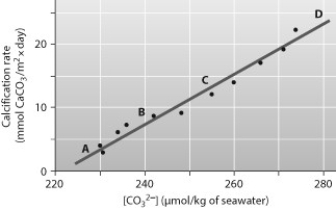
(Multiple Choice)
4.9/5 (67)
(67) 
Filters
- Essay(0)
- Multiple Choice(0)
- Short Answer(0)
- True False(0)
- Matching(0)