



 Chat with AI
Exam 21: Nutrition and Digestion

Exam 1: Biology: Exploring Life47 Questions
Exam 2: The Chemical Basis of Life73 Questions
Exam 3: The Molecules of Cells89 Questions
Exam 4: A Tour of the Cell93 Questions
Exam 5: The Working Cell81 Questions
Exam 6: How Cells Harvest Chemical Energy82 Questions
Exam 7: Photosynthesis: Using Light to Make Food83 Questions
Exam 8: The Cellular Basis of Reproduction and Inheritance81 Questions
Exam 9: Patterns of Inheritance76 Questions
Exam 10: Molecular Biology of the Gene85 Questions
Exam 11: How Genes Are Controlled84 Questions
Exam 12: DNA Technology and Genomics80 Questions
Exam 13: How Populations Evolve67 Questions
Exam 14: The Origin of Species59 Questions
Exam 15: Tracing Evolutionary History88 Questions
Exam 16: Microbial Life: Prokaryotes and Protists80 Questions
Exam 17: The Evolution of Plant and Fungal Diversity85 Questions
Exam 18: The Evolution of Invertebrate Diversity81 Questions
Exam 19: The Evolution of Vertebrate Diversity77 Questions
Exam 20: Unifying Concepts of Animal Structure and Function68 Questions
Exam 21: Nutrition and Digestion96 Questions
Exam 22: Gas Exchange68 Questions
Exam 23: Circulation81 Questions
Exam 24: The Immune System76 Questions
Exam 25: Control of Body Temperature and Water Balance67 Questions
Exam 26: Hormones and the Endocrine System66 Questions
Exam 27: Reproduction and Embryonic Development88 Questions
Exam 28: Nervous Systems75 Questions
Exam 29: The Senses62 Questions
Exam 30: How Animals Move72 Questions
Exam 31: Plant Structure, Growth, and Reproduction81 Questions
Exam 32: Plant Nutrition and Transport69 Questions
Exam 33: Control Systems in Plants61 Questions
Exam 34: The Biosphere: an Introduction to Earths Diverse Environments61 Questions
Exam 35: Behavioral Adaptations to the Environment54 Questions
Exam 36: Population Ecology57 Questions
Exam 37: Communities and Ecosystems62 Questions
Exam 38: Conservation Biology61 Questions
Select questions type


In the digestive system, most nutrient absorption occurs in the
(Multiple Choice)
4.9/5  (82)
(82)  -A person who is 5' 7" and weighs 170 pounds would be considered
 (Multiple Choice)
4.8/5 (75)
(75) What happens to nutrient macromolecules in an animal's digestive tract?
(Multiple Choice)
4.9/5 (73)
(73) Organisms suffering from malnutrition may have a diet deficient in
(Multiple Choice)
4.8/5 (74)
(74) If a person on a fad diet experiences muscle cramps, a physician would suspect that this individual is likely suffering from a deficiency of
(Multiple Choice)
5.0/5 (94)
(94) When browsing the Internet you will often come across "miracle weight-loss" products that guarantee that you will lose weight if you use them. Which of the following would be the best controlled experiment to test this assertion?
(Multiple Choice)
4.8/5 (69)
(69) Which of the following correctly lists the order of the parts of the human digestive system, from first to last contact with food matter?
(Multiple Choice)
4.9/5 (75)
(75) Which enzyme breaks large polypeptides into smaller polypeptides?
(Multiple Choice)
4.8/5 (86)
(86) H. pylori is a bacterium that causes stomach ulcers. What can you conclude from the data shown below which indicates bacteria found in the stomach of people with and without an H. pylori infection? 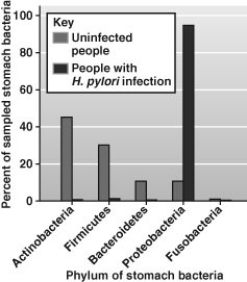
(Multiple Choice)
4.8/5 (83)
(83) Fred explained to his family how the doctor's advice would help prevent cardiovascular disease, but he made a mistake in his explanation. Which of the following statements is false?
(Multiple Choice)
4.9/5 (75)
(75) The function of the sphincter between the stomach and small intestine is to
(Multiple Choice)
4.8/5 (80)
(80) Human saliva performs all of the following functions except
(Multiple Choice)
4.8/5 (79)
(79) The minimal amount of nutrients needed every day by healthy people to prevent nutrient deficiencies is called the
(Multiple Choice)
4.9/5 (70)
(70) Lions are not always successful hunters and may go days between meals. What evolutionary adaptation helps the lion survive periods of famine?
(Multiple Choice)
4.9/5 (80)
(80) Since the fall of 2012, public schools have had to meet new nutrition standards (which included offering more fruits and vegetables) for their lunches. In 2013, the USDA (United States Department of Agriculture) reviewed data from the 2005 School Nutrition and Dietary Assessment to investigate whether students in schools that were already following the new standards (school group A) ate more fruits and vegetables than students in schools that were not following the new standards (school group B).
You will be presented with some of the overall findings of the review and will then be asked questions related to these conclusions.
-Finding #3: Of all of the schools surveyed in 2005, 75% offered lunches that met new weekly standards for amounts of dark, green leafy vegetables.
85% offered lunches that met new weekly standards for amounts for red/orange vegetables.
21% offered lunches that met new weekly standards for legumes (such as beans).
97% offered lunches that met new weekly standards for amounts for "other" vegetables.
This suggests that
(Multiple Choice)
4.8/5 (87)
(87) Most herbivorous animals do not have the ability to digest the cellulose in plants. What mechanism has evolved in the absence of this ability that allows them to survive despite eating only plant matter?
(Multiple Choice)
4.9/5 (99)
(99) 
Filters
- Essay(0)
- Multiple Choice(0)
- Short Answer(0)
- True False(0)
- Matching(0)