



 Chat with AI
Exam 24: The Immune System

Exam 1: Biology: Exploring Life47 Questions
Exam 2: The Chemical Basis of Life73 Questions
Exam 3: The Molecules of Cells89 Questions
Exam 4: A Tour of the Cell93 Questions
Exam 5: The Working Cell81 Questions
Exam 6: How Cells Harvest Chemical Energy82 Questions
Exam 7: Photosynthesis: Using Light to Make Food83 Questions
Exam 8: The Cellular Basis of Reproduction and Inheritance81 Questions
Exam 9: Patterns of Inheritance76 Questions
Exam 10: Molecular Biology of the Gene85 Questions
Exam 11: How Genes Are Controlled84 Questions
Exam 12: DNA Technology and Genomics80 Questions
Exam 13: How Populations Evolve67 Questions
Exam 14: The Origin of Species59 Questions
Exam 15: Tracing Evolutionary History88 Questions
Exam 16: Microbial Life: Prokaryotes and Protists80 Questions
Exam 17: The Evolution of Plant and Fungal Diversity85 Questions
Exam 18: The Evolution of Invertebrate Diversity81 Questions
Exam 19: The Evolution of Vertebrate Diversity77 Questions
Exam 20: Unifying Concepts of Animal Structure and Function68 Questions
Exam 21: Nutrition and Digestion96 Questions
Exam 22: Gas Exchange68 Questions
Exam 23: Circulation81 Questions
Exam 24: The Immune System76 Questions
Exam 25: Control of Body Temperature and Water Balance67 Questions
Exam 26: Hormones and the Endocrine System66 Questions
Exam 27: Reproduction and Embryonic Development88 Questions
Exam 28: Nervous Systems75 Questions
Exam 29: The Senses62 Questions
Exam 30: How Animals Move72 Questions
Exam 31: Plant Structure, Growth, and Reproduction81 Questions
Exam 32: Plant Nutrition and Transport69 Questions
Exam 33: Control Systems in Plants61 Questions
Exam 34: The Biosphere: an Introduction to Earths Diverse Environments61 Questions
Exam 35: Behavioral Adaptations to the Environment54 Questions
Exam 36: Population Ecology57 Questions
Exam 37: Communities and Ecosystems62 Questions
Exam 38: Conservation Biology61 Questions
Select questions type



Which of the following are examples of innate immunity? 1. stomach pH
2) natural killer cells
3) B lymphocytes
4) fever
(Multiple Choice)
4.9/5  (89)
(89) ________ are a component of the immune system that are able to destroy cancer cells by deploying toxins into infected cells as a means of killing them. In this role they are cytotoxic-that is, "cell killing."
(Multiple Choice)
4.8/5 (80)
(80) Virus-infected cells produce ________, proteins that help neighboring cells fight further viral infections.
(Multiple Choice)
4.9/5 (83)
(83) In May 2013, a drug-resistant strain of H7N9 bird flu was discovered in China. The implication of a drug-resistant virus strain is that it
(Multiple Choice)
4.9/5 (60)
(60) A molecule that can elicit an adaptive immune response is called a(n)
(Multiple Choice)
4.8/5 (86)
(86) While playing soccer in your backyard, you disrupt a small fire ant mound. The fire ants emerge and bite your feet. Your feet begin to show swollen, raised areas around the bites. What is happening?
(Multiple Choice)
4.8/5 (74)
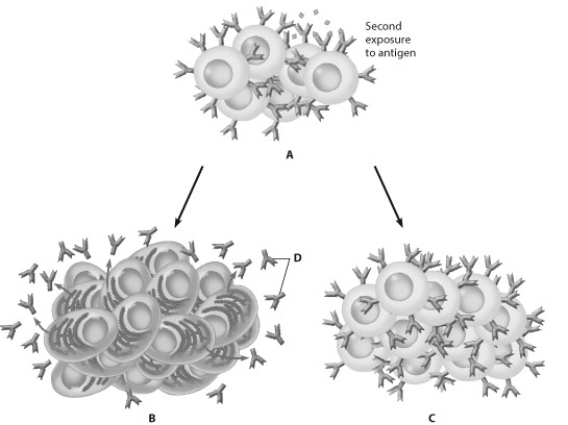
(74) The secondary immune response occurs when memory cells are activated by a second exposure to
(Multiple Choice)
4.8/5 (79)
(79) Spring has arrived, and you notice your neighbors are cutting their grass. When you walk outside to check if your mail has arrived, your eyes begin to water and feel itchy. You are more than likely experiencing
(Multiple Choice)
4.8/5 (80)
(80) Suppose that a person has a mutation in a gene that encodes an enzyme responsible for the production of histamine. In this person, mast cells cannot produce and secrete histamine. Which of the following outcomes is most likely to happen if an injury occurs?
(Multiple Choice)
4.8/5 (83)
(83) What type of immune response is always disadvantageous to a person?
(Multiple Choice)
4.9/5 (84)
(84) The human lymphatic system consists of all of the following structures except the
(Multiple Choice)
4.7/5 (73)
(73) Which of the following cell types is responsible for the humoral immune response?
(Multiple Choice)
4.9/5 (88)
(88) 
Scientists measured whether individuals who had been vaccinated with anti-HPV vaccines (Gardasil and Cervarix) had detectable levels of anti-HPV antibodies in their blood many years after receiving the vaccines. The data are shown here. Based only on these data, which of the following policy recommendations would you make to the United States Center for Disease Control and Prevention (the agency that sets vaccination schedules) regarding anti-HPV vaccines? 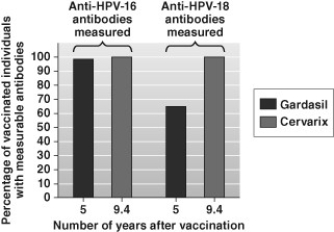
(Multiple Choice)
4.9/5 (82)
(82) Suppose you design a study to test this hypothesis. Your study participants are adults between the ages of 25 and 40 (mean age = 32). You work with an oncologist to determine if the study participants have an HPV-related cancer, and you also measure the concentration of anti-HPV antibodies in their blood. Answer the following questions regarding this study.After reading the paragraph below, answer the questions that follow.
HPV is an infection that is normally fought by the human immune system, but it can lead to cancer in some individuals. While we already know that HPV vaccines help prevent HPV-related cancer, researchers are unsure as to what level of antibody concentration a person needs in order to be protected from HPV-related cancers. Scientists hypothesize that higher anti-HPV antibody levels may provide greater protection from HPV-related cancers compared to lower levels. However, strong evidence does not yet exist to support this hypothesis.
-From the following choices, select the groups of individuals who would make the best participants for the control group in your study.
(Multiple Choice)
4.7/5 (81)
(81) 
Filters
- Essay(0)
- Multiple Choice(0)
- Short Answer(0)
- True False(0)
- Matching(0)