



 Chat with AI
Exam 30: How Animals Move

Exam 1: Biology: Exploring Life47 Questions
Exam 2: The Chemical Basis of Life73 Questions
Exam 3: The Molecules of Cells89 Questions
Exam 4: A Tour of the Cell93 Questions
Exam 5: The Working Cell81 Questions
Exam 6: How Cells Harvest Chemical Energy82 Questions
Exam 7: Photosynthesis: Using Light to Make Food83 Questions
Exam 8: The Cellular Basis of Reproduction and Inheritance81 Questions
Exam 9: Patterns of Inheritance76 Questions
Exam 10: Molecular Biology of the Gene85 Questions
Exam 11: How Genes Are Controlled84 Questions
Exam 12: DNA Technology and Genomics80 Questions
Exam 13: How Populations Evolve67 Questions
Exam 14: The Origin of Species59 Questions
Exam 15: Tracing Evolutionary History88 Questions
Exam 16: Microbial Life: Prokaryotes and Protists80 Questions
Exam 17: The Evolution of Plant and Fungal Diversity85 Questions
Exam 18: The Evolution of Invertebrate Diversity81 Questions
Exam 19: The Evolution of Vertebrate Diversity77 Questions
Exam 20: Unifying Concepts of Animal Structure and Function68 Questions
Exam 21: Nutrition and Digestion96 Questions
Exam 22: Gas Exchange68 Questions
Exam 23: Circulation81 Questions
Exam 24: The Immune System76 Questions
Exam 25: Control of Body Temperature and Water Balance67 Questions
Exam 26: Hormones and the Endocrine System66 Questions
Exam 27: Reproduction and Embryonic Development88 Questions
Exam 28: Nervous Systems75 Questions
Exam 29: The Senses62 Questions
Exam 30: How Animals Move72 Questions
Exam 31: Plant Structure, Growth, and Reproduction81 Questions
Exam 32: Plant Nutrition and Transport69 Questions
Exam 33: Control Systems in Plants61 Questions
Exam 34: The Biosphere: an Introduction to Earths Diverse Environments61 Questions
Exam 35: Behavioral Adaptations to the Environment54 Questions
Exam 36: Population Ecology57 Questions
Exam 37: Communities and Ecosystems62 Questions
Exam 38: Conservation Biology61 Questions
Select questions type


Vertebrae are differentiated during embryonic development by the
(Multiple Choice)
4.9/5  (85)
(85) The sequence of events that cause a sarcomere to contract can be summed up in the correct order as
(Multiple Choice)
4.9/5 (68)
(68) The "Ironman" is a version of the triathlon, a race that includes three events: swimming, bicycling, and running. In an Ironman, an athlete must swim 2.4 miles, bike 112 miles, and run 26.2 miles, in that order, without a break. The annual Ironman World Championship is held in Hawaii every year. The men's course record was set in 2011 by Australia's Craig Alexander with a time of 8 hours, 18 minutes, and 37 seconds, and the women's course record was set in 2009 by England's Chrissie Wellington with a time of 8 hours, 54 minutes, and 2 seconds.
-What type of muscle fibers would likely be found in the legs of athletes who attempt to complete this race?
(Multiple Choice)
4.9/5 (86)
(86) Acetylcholine (ACh) is released by motor neurons and binds to receptors on muscle cells to initiate action potentials. Some snake venom contains specific toxins that bind irreversibly to these receptors and block acetylcholine's ability to bind. If an animal is bitten by a snake with these toxins in its venom, what do you predict would happen?
(Multiple Choice)
4.9/5 (76)
(76) If you lay your forearm along a table, you can rotate it so that your hand changes from a palm-down to a palm-up position. This is possible because your radius and ulna join at a
(Multiple Choice)
4.8/5 (91)
(91) You are cleaning out an old lab freezer and find a tube that contains the ground-up remains of an unknown animal. Your research advisor suggests that you perform chemical assays to determine what molecules made up the animal. After analyzing the data, you determine that the animal contained a large amount of chitin. What type of animal was in the tube?
(Multiple Choice)
4.8/5 (83)
(83) Your friend is complaining of back pain. She also says that she hurts the most near her neck. What part of her back may have been injured?
(Multiple Choice)
4.8/5 (78)
(78) An airfoil provides lift because air moving over a wing must travel
(Multiple Choice)
4.9/5 (84)
(84) A tennis player serving the ball uses fast muscle fibers. The ATP needed to accomplish this comes from
(Multiple Choice)
4.8/5 (70)
(70) 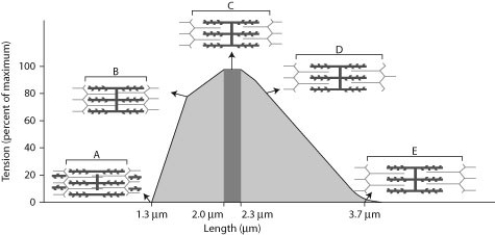 When sarcomeres contract, they generate force (tension). However, the amount of force generated depends on the sarcomere length and the amount of thick and thin filament overlap. Below is a figure that details the force-generating properties of a single sarcomere. This figure was modified from a scientific paper by Al Gordon and colleagues from 1966 and is a classic illustration of the relationship between sarcomere length and force.
-Mammalian muscles can shorten approximately 35% of their resting length when all sarcomeres contract. If a sarcomere passes through maximal tension generation during this 35% contraction, what is the likely starting point for contraction of a sarcomere?
When sarcomeres contract, they generate force (tension). However, the amount of force generated depends on the sarcomere length and the amount of thick and thin filament overlap. Below is a figure that details the force-generating properties of a single sarcomere. This figure was modified from a scientific paper by Al Gordon and colleagues from 1966 and is a classic illustration of the relationship between sarcomere length and force.
-Mammalian muscles can shorten approximately 35% of their resting length when all sarcomeres contract. If a sarcomere passes through maximal tension generation during this 35% contraction, what is the likely starting point for contraction of a sarcomere? (Multiple Choice)
4.8/5 (75)
(75) 
Filters
- Essay(0)
- Multiple Choice(0)
- Short Answer(0)
- True False(0)
- Matching(0)