



 Chat with AI
Exam 30: How Animals Move

Exam 1: Biology: Exploring Life47 Questions
Exam 2: The Chemical Basis of Life73 Questions
Exam 3: The Molecules of Cells89 Questions
Exam 4: A Tour of the Cell93 Questions
Exam 5: The Working Cell81 Questions
Exam 6: How Cells Harvest Chemical Energy82 Questions
Exam 7: Photosynthesis: Using Light to Make Food83 Questions
Exam 8: The Cellular Basis of Reproduction and Inheritance81 Questions
Exam 9: Patterns of Inheritance76 Questions
Exam 10: Molecular Biology of the Gene85 Questions
Exam 11: How Genes Are Controlled84 Questions
Exam 12: DNA Technology and Genomics80 Questions
Exam 13: How Populations Evolve67 Questions
Exam 14: The Origin of Species59 Questions
Exam 15: Tracing Evolutionary History88 Questions
Exam 16: Microbial Life: Prokaryotes and Protists80 Questions
Exam 17: The Evolution of Plant and Fungal Diversity85 Questions
Exam 18: The Evolution of Invertebrate Diversity81 Questions
Exam 19: The Evolution of Vertebrate Diversity77 Questions
Exam 20: Unifying Concepts of Animal Structure and Function68 Questions
Exam 21: Nutrition and Digestion96 Questions
Exam 22: Gas Exchange68 Questions
Exam 23: Circulation81 Questions
Exam 24: The Immune System76 Questions
Exam 25: Control of Body Temperature and Water Balance67 Questions
Exam 26: Hormones and the Endocrine System66 Questions
Exam 27: Reproduction and Embryonic Development88 Questions
Exam 28: Nervous Systems75 Questions
Exam 29: The Senses62 Questions
Exam 30: How Animals Move72 Questions
Exam 31: Plant Structure, Growth, and Reproduction81 Questions
Exam 32: Plant Nutrition and Transport69 Questions
Exam 33: Control Systems in Plants61 Questions
Exam 34: The Biosphere: an Introduction to Earths Diverse Environments61 Questions
Exam 35: Behavioral Adaptations to the Environment54 Questions
Exam 36: Population Ecology57 Questions
Exam 37: Communities and Ecosystems62 Questions
Exam 38: Conservation Biology61 Questions
Select questions type


Which treatment could possibly help to transform the bone on the right to the bone on the left? 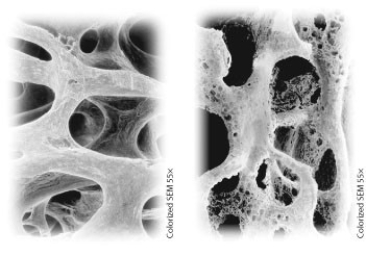
(Multiple Choice)
5.0/5  (83)
(83) Which part of this figure depicting a bone shows spongy bone tissue? 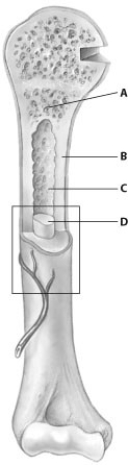
(Multiple Choice)
4.7/5 (69)
(69) Osteoporosis has long been recognized as a problem for women after menopause, but it is also emerging as a health concern for
(Multiple Choice)
4.8/5 (83)
(83)  When sarcomeres contract, they generate force (tension). However, the amount of force generated depends on the sarcomere length and the amount of thick and thin filament overlap. Below is a figure that details the force-generating properties of a single sarcomere. This figure was modified from a scientific paper by Al Gordon and colleagues from 1966 and is a classic illustration of the relationship between sarcomere length and force.
-At what point on the graph are thick and thin filaments most overlapped?
When sarcomeres contract, they generate force (tension). However, the amount of force generated depends on the sarcomere length and the amount of thick and thin filament overlap. Below is a figure that details the force-generating properties of a single sarcomere. This figure was modified from a scientific paper by Al Gordon and colleagues from 1966 and is a classic illustration of the relationship between sarcomere length and force.
-At what point on the graph are thick and thin filaments most overlapped? (Multiple Choice)
4.8/5 (95)
(95) The calcium that triggers muscle contraction is stored in the
(Multiple Choice)
4.9/5 (75)
(75) An animal's locomotor (relates to locomotion) muscle was dissected and the percentages of fast and slow fibers were determined and plotted in the accompanying figure. Which muscle is the likely source for this data? 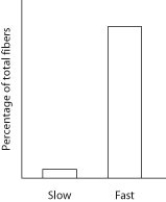
(Multiple Choice)
5.0/5 (80)
(80) Muscles that are constantly active, such as those maintaining our body posture, have a high proportion of
(Multiple Choice)
4.7/5 (61)
(61) The way the tendons in the legs of a kangaroo aid in locomotion is most like
(Multiple Choice)
5.0/5 (80)
(80) Fast muscle fibers contain a high proportion of myofibrils, which allows the fibers to generate high amounts of force. However, this leaves little room in the fibers for other cellular components, including mitochondria. The opposite is true for slow muscle fibers. Does this information support or refute what you know about the fatigue-susceptibility of fast and slow fibers? Why or why not?
(Multiple Choice)
4.9/5 (86)
(86) In the year 2000, it was estimated that the number of new osteoporotic fractures in men and women ages 50 and older was 9.0 million: 1.6 million were at the hip, 1.7 million were at the forearm, and 1.4 million were from the spine and humerus. Consider the following data and answer the questions that follow.
Estimated Number of Fractures (in Thousands) Worldwide at the Sites Shown in Men and Women in the Year 2000
Percentage of Site of Fracture Fractures Men Women Total Hip 18.2 490 1,137 1,627 Forearm 18.5 332 1,328 1,660 Spine 15.8 554 862 1,416 Humerus 7.9 178 528 706 Other sites 39.6 1,909 1,641 3,550 Total 100 3,463 5,496 8,959 Source: Adapted from Johnell, O., & Kanis, J.A. (2006). Osteoporosis International, 17(12): 1726. doi:10.1007/s00198-006-0172-4.
-Compare the percentage of fractures in the hip, forearm, spine, and humerus in men and women combined to the percentage of fractures at other sites in men and women combined. What do you conclude?
(Multiple Choice)
4.7/5 (78)
(78) Mutations in the gene for troponin can result in the production of the troponin protein, which has varying affinities for Ca2+ ions. Suppose that in a muscle cell a mutant troponin is expressed that has such a high affinity for Ca2+ ions that once they bind to troponin they cannot unbind. What will likely happen in this muscle cell?
(Multiple Choice)
4.9/5 (87)
(87) If you inflate a balloon and then let it go, the air rushing out moves the balloon in a way that is similar to the way that a ________ moves.
(Multiple Choice)
4.8/5 (69)
(69) When sarcomeres contract, they generate force (tension). However, the amount of force generated depends on the sarcomere length and the amount of thick and thin filament overlap. Below is a figure that details the force-generating properties of a single sarcomere. This figure was modified from a scientific paper by Al Gordon and colleagues from 1966 and is a classic illustration of the relationship between sarcomere length and force.
-At what point on the graph is the most tension generated?
When sarcomeres contract, they generate force (tension). However, the amount of force generated depends on the sarcomere length and the amount of thick and thin filament overlap. Below is a figure that details the force-generating properties of a single sarcomere. This figure was modified from a scientific paper by Al Gordon and colleagues from 1966 and is a classic illustration of the relationship between sarcomere length and force.
-At what point on the graph is the most tension generated? (Multiple Choice)
4.9/5 (84)
(84) 
Filters
- Essay(0)
- Multiple Choice(0)
- Short Answer(0)
- True False(0)
- Matching(0)