



 Chat with AI
Exam 31: Plant Structure, Growth, and Reproduction

Exam 1: Biology: Exploring Life47 Questions
Exam 2: The Chemical Basis of Life73 Questions
Exam 3: The Molecules of Cells89 Questions
Exam 4: A Tour of the Cell93 Questions
Exam 5: The Working Cell81 Questions
Exam 6: How Cells Harvest Chemical Energy82 Questions
Exam 7: Photosynthesis: Using Light to Make Food83 Questions
Exam 8: The Cellular Basis of Reproduction and Inheritance81 Questions
Exam 9: Patterns of Inheritance76 Questions
Exam 10: Molecular Biology of the Gene85 Questions
Exam 11: How Genes Are Controlled84 Questions
Exam 12: DNA Technology and Genomics80 Questions
Exam 13: How Populations Evolve67 Questions
Exam 14: The Origin of Species59 Questions
Exam 15: Tracing Evolutionary History88 Questions
Exam 16: Microbial Life: Prokaryotes and Protists80 Questions
Exam 17: The Evolution of Plant and Fungal Diversity85 Questions
Exam 18: The Evolution of Invertebrate Diversity81 Questions
Exam 19: The Evolution of Vertebrate Diversity77 Questions
Exam 20: Unifying Concepts of Animal Structure and Function68 Questions
Exam 21: Nutrition and Digestion96 Questions
Exam 22: Gas Exchange68 Questions
Exam 23: Circulation81 Questions
Exam 24: The Immune System76 Questions
Exam 25: Control of Body Temperature and Water Balance67 Questions
Exam 26: Hormones and the Endocrine System66 Questions
Exam 27: Reproduction and Embryonic Development88 Questions
Exam 28: Nervous Systems75 Questions
Exam 29: The Senses62 Questions
Exam 30: How Animals Move72 Questions
Exam 31: Plant Structure, Growth, and Reproduction81 Questions
Exam 32: Plant Nutrition and Transport69 Questions
Exam 33: Control Systems in Plants61 Questions
Exam 34: The Biosphere: an Introduction to Earths Diverse Environments61 Questions
Exam 35: Behavioral Adaptations to the Environment54 Questions
Exam 36: Population Ecology57 Questions
Exam 37: Communities and Ecosystems62 Questions
Exam 38: Conservation Biology61 Questions
Select questions type


The increase in girth associated with production of wood and bark in trees occurs as a consequence of
(Multiple Choice)
4.9/5  (83)
(83) What is an advantage of cloning horticultural crops rather than using sexual propagation to grow them?
(Multiple Choice)
4.9/5 (83)
(83)  -Which structures ensure that too much water does not leave the leaf?
 (Multiple Choice)
4.8/5 (98)
(98) This image represents monocots and eudicots. Which labeled row shows traits that are incorrectly categorized? 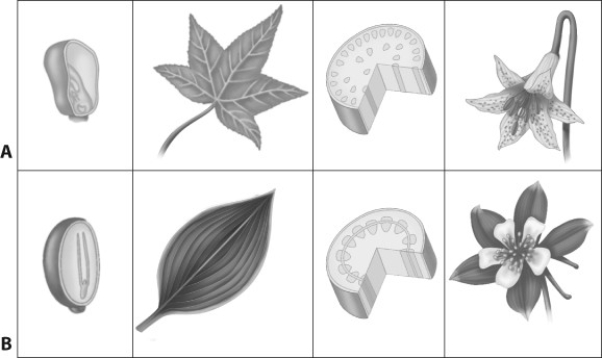
(Multiple Choice)
4.8/5 (73)
(73) A number of studies have found that for many plants there is an increase in seed production under conditions of elevated carbon dioxide levels. What is a likely explanation for this phenomenon?
(Multiple Choice)
4.7/5 (80)
(80) The genetically identical organisms that result from asexual reproduction are called
(Multiple Choice)
4.7/5 (74)
(74)
-Which structure allows exchange of gases between photosynthetic cells and the surrounding air?
-Which structure allows exchange of gases between photosynthetic cells and the surrounding air? (Multiple Choice)
4.9/5 (80)
(80) What is a disadvantage of cloning as a propagation technique?
(Multiple Choice)
4.7/5 (80)
(80) Which structure is the first to emerge from the germinating seed of a eudicot such as the garden bean?
(Multiple Choice)
5.0/5 (106)
(106) In which situation would plant reproduction most likely be pollinator-limited?
(Multiple Choice)
4.8/5 (74)
(74) How many chromosomes are there in a maize (corn) embryo cell nucleus as compared to a maize (corn) endosperm cell nucleus?
(Multiple Choice)
4.7/5 (80)
(80) Before it opens up into full blossom, the outer green layer of a rosebud consists of the leaflike
(Multiple Choice)
4.9/5 (99)
(99) 
Filters
- Essay(0)
- Multiple Choice(0)
- Short Answer(0)
- True False(0)
- Matching(0)