



 Chat with AI
Exam 31: Plant Structure, Growth, and Reproduction

Exam 1: Biology: Exploring Life47 Questions
Exam 2: The Chemical Basis of Life73 Questions
Exam 3: The Molecules of Cells89 Questions
Exam 4: A Tour of the Cell93 Questions
Exam 5: The Working Cell81 Questions
Exam 6: How Cells Harvest Chemical Energy82 Questions
Exam 7: Photosynthesis: Using Light to Make Food83 Questions
Exam 8: The Cellular Basis of Reproduction and Inheritance81 Questions
Exam 9: Patterns of Inheritance76 Questions
Exam 10: Molecular Biology of the Gene85 Questions
Exam 11: How Genes Are Controlled84 Questions
Exam 12: DNA Technology and Genomics80 Questions
Exam 13: How Populations Evolve67 Questions
Exam 14: The Origin of Species59 Questions
Exam 15: Tracing Evolutionary History88 Questions
Exam 16: Microbial Life: Prokaryotes and Protists80 Questions
Exam 17: The Evolution of Plant and Fungal Diversity85 Questions
Exam 18: The Evolution of Invertebrate Diversity81 Questions
Exam 19: The Evolution of Vertebrate Diversity77 Questions
Exam 20: Unifying Concepts of Animal Structure and Function68 Questions
Exam 21: Nutrition and Digestion96 Questions
Exam 22: Gas Exchange68 Questions
Exam 23: Circulation81 Questions
Exam 24: The Immune System76 Questions
Exam 25: Control of Body Temperature and Water Balance67 Questions
Exam 26: Hormones and the Endocrine System66 Questions
Exam 27: Reproduction and Embryonic Development88 Questions
Exam 28: Nervous Systems75 Questions
Exam 29: The Senses62 Questions
Exam 30: How Animals Move72 Questions
Exam 31: Plant Structure, Growth, and Reproduction81 Questions
Exam 32: Plant Nutrition and Transport69 Questions
Exam 33: Control Systems in Plants61 Questions
Exam 34: The Biosphere: an Introduction to Earths Diverse Environments61 Questions
Exam 35: Behavioral Adaptations to the Environment54 Questions
Exam 36: Population Ecology57 Questions
Exam 37: Communities and Ecosystems62 Questions
Exam 38: Conservation Biology61 Questions
Select questions type


What is the difference between the heartwood and sapwood of a tree?
(Multiple Choice)
4.9/5  (72)
(72) Most trees and shrubs continue to grow year after year. Such plants are known as
(Multiple Choice)
4.9/5 (80)
(80)  -If the leaf is like a solar panel receiving light energy and converting it to another form of energy, structure A is like what part of the solar panel?
 (Multiple Choice)
4.9/5 (74)
(74) In angiosperms, the process of ________ ensures that the endosperm will develop only in ovules containing a fertilized egg.
(Multiple Choice)
4.9/5 (80)
(80) Which plant parts commonly contribute to asexual reproduction?
(Multiple Choice)
4.9/5 (85)
(85) One assumption about plant reproduction is that because it requires so much matter and energy, reproductive output is resource-limited. Which statement provides evidence that this assumption may be incorrect?
(Multiple Choice)
4.8/5 (73)
(73) How many layers of vascular cambium will there be in the trunk of a 10-year-old tree?
(Multiple Choice)
4.8/5 (75)
(75) A mature ovary, specialized as a vessel that houses and protects seeds, is a
(Multiple Choice)
5.0/5 (76)
(76) The redwood groves in Northern California are one of America's greatest natural resources. Redwoods can live more than 2,000 years and grow taller than 350 feet. When tourism became popular in the late 1800s, large tunnels were cut through the center of several of these giant trees to allow wagons to pass through (and to attract tourists to the location). Even today, visitors wait in line to be photographed driving their cars through a tunnel. When the groves were converted into national parks, the tunneling was discontinued, but several tunneled trees are still alive.
-What is the correct sequence of tissues a car would pass as it drives through the tree tunnel (starting from the outer surface of the tree and passing through the central core)?
(Multiple Choice)
4.8/5 (72)
(72) A florist assembles a bouquet of flowers from the following: 1. lilies, which have long leaves with parallel veins
2) Queen Anne's lace, also known as wild carrot because of its large taproot
3) buttercups, with their five lovely yellow petals
4) new shoots of daisies with two small cotyledons
This bunch of flowers contains
(Multiple Choice)
4.9/5 (71)
(71) The cells that store starch in dicot roots are located between the
(Multiple Choice)
4.9/5 (70)
(70) In a showy flower such as a magnolia or rose, the flower parts that play the main role in attracting the notice of animal pollinators are the
(Multiple Choice)
4.7/5 (76)
(76) Which part of this seed contains stored food that allows the seedling to grow until it can perform photosynthesis? 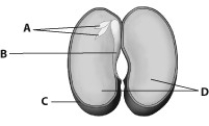
(Multiple Choice)
4.7/5 (72)
(72) 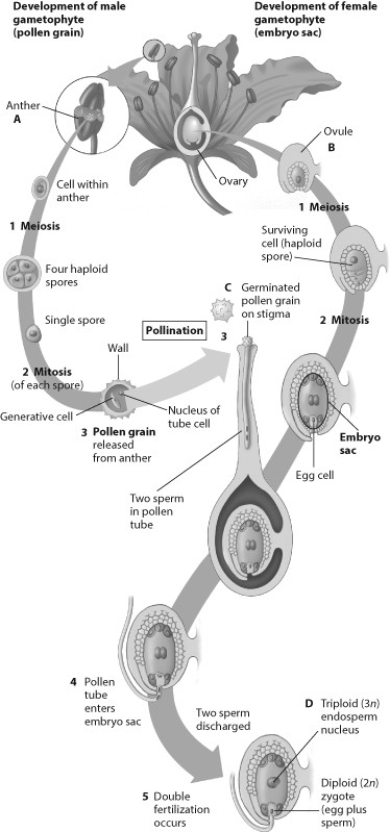 -Which structure in the image has a different number of chromosomes than the others?
 (Multiple Choice)
4.9/5 (75)
(75) This figure compares corn yield (how much corn is produced) in relation to the area of land from which the corn was harvested, for the United States and globally. Which statement, according to this figure, is true? 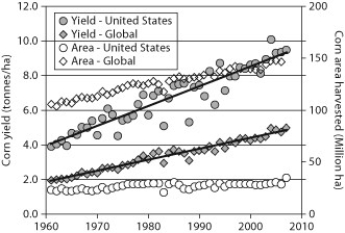
(Multiple Choice)
4.8/5 (72)
(72) Which type of vascular tissue cell in a plant is dead at maturity?
(Multiple Choice)
4.8/5 (72)
(72) 
Filters
- Essay(0)
- Multiple Choice(0)
- Short Answer(0)
- True False(0)
- Matching(0)