



 Chat with AI
Exam 31: Plant Structure, Growth, and Reproduction

Exam 1: Biology: Exploring Life47 Questions
Exam 2: The Chemical Basis of Life73 Questions
Exam 3: The Molecules of Cells89 Questions
Exam 4: A Tour of the Cell93 Questions
Exam 5: The Working Cell81 Questions
Exam 6: How Cells Harvest Chemical Energy82 Questions
Exam 7: Photosynthesis: Using Light to Make Food83 Questions
Exam 8: The Cellular Basis of Reproduction and Inheritance81 Questions
Exam 9: Patterns of Inheritance76 Questions
Exam 10: Molecular Biology of the Gene85 Questions
Exam 11: How Genes Are Controlled84 Questions
Exam 12: DNA Technology and Genomics80 Questions
Exam 13: How Populations Evolve67 Questions
Exam 14: The Origin of Species59 Questions
Exam 15: Tracing Evolutionary History88 Questions
Exam 16: Microbial Life: Prokaryotes and Protists80 Questions
Exam 17: The Evolution of Plant and Fungal Diversity85 Questions
Exam 18: The Evolution of Invertebrate Diversity81 Questions
Exam 19: The Evolution of Vertebrate Diversity77 Questions
Exam 20: Unifying Concepts of Animal Structure and Function68 Questions
Exam 21: Nutrition and Digestion96 Questions
Exam 22: Gas Exchange68 Questions
Exam 23: Circulation81 Questions
Exam 24: The Immune System76 Questions
Exam 25: Control of Body Temperature and Water Balance67 Questions
Exam 26: Hormones and the Endocrine System66 Questions
Exam 27: Reproduction and Embryonic Development88 Questions
Exam 28: Nervous Systems75 Questions
Exam 29: The Senses62 Questions
Exam 30: How Animals Move72 Questions
Exam 31: Plant Structure, Growth, and Reproduction81 Questions
Exam 32: Plant Nutrition and Transport69 Questions
Exam 33: Control Systems in Plants61 Questions
Exam 34: The Biosphere: an Introduction to Earths Diverse Environments61 Questions
Exam 35: Behavioral Adaptations to the Environment54 Questions
Exam 36: Population Ecology57 Questions
Exam 37: Communities and Ecosystems62 Questions
Exam 38: Conservation Biology61 Questions
Select questions type


Plants differ from many animals because they undergo indeterminate (continual) growth. Indeterminate growth is common in clonal plants because a single clone can continually produce new clones without undergoing sexual reproduction, even if the plant is capable of doing so.
Senescence, an inability to undergo cell division as an organism ages, also occurs in many plants and animals. However, scientists have had a difficult time establishing the occurrence of senescence in cloning plants because of their indeterminate growth patterns. Mutations in somatic cells are common during asexual growth, and these mutations lead to a decrease in sexual fitness. Scientists hypothesize that over time, as these mutations accumulate, they may contribute to senescence in clonal plants. To test this theory, scientists studied a naturally growing population of trembling aspen (Populus tremuloides), a tree species that grows clones from its root system but is capable of sexual reproduction. To determine if trembling aspens senesce, they compared genetic data of estimated tree age with the variable of "diminishing fertility": the amount of pollen released by male aspen trees. Here are the results for this part of the study:
 Source: Adapted from Ally, D., Ritland, K., & Otto, S. P. (2010). Aging in a long-lived clonal tree. PLoS Biol, 8(8): e1000454. doi:10.1371/journal.pbio.1000454.
-What can the scientists conclude from the data?
Source: Adapted from Ally, D., Ritland, K., & Otto, S. P. (2010). Aging in a long-lived clonal tree. PLoS Biol, 8(8): e1000454. doi:10.1371/journal.pbio.1000454.
-What can the scientists conclude from the data? (Multiple Choice)
4.8/5  (62)
(62) In a flowering plant, the cells that give rise to sperm undergo meiosis in the
(Multiple Choice)
4.8/5 (87)
(87) Foreign genes can be inserted into a single plant cell that is then cultured to produce
(Multiple Choice)
4.9/5 (78)
(78) 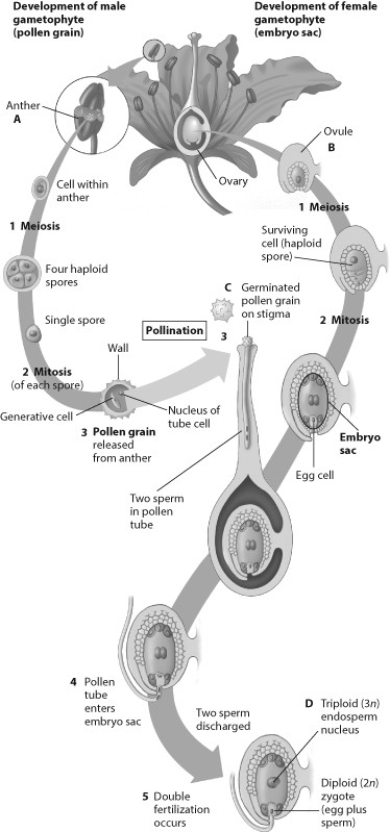 -Which structure is the result of a generative cell with a thick wall around it?
 (Multiple Choice)
4.8/5 (68)
(68)  -Which structure allows sufficient water to enter the leaf?
 (Multiple Choice)
4.8/5 (84)
(84) Flowers bear seeds that develop from ovules housed in protective chambers called
(Multiple Choice)
4.9/5 (99)
(99) In Utah there is a clone of aspen trees that covers over 100 acres. Such clones can be considered to be a single plant with many stems. It appears that the first stem of this clone originated over 80,000 years ago, even before there were humans in North America. What likely contributes most to the long-term survival (long life span) of aspens?
(Multiple Choice)
4.9/5 (91)
(91) Sieve-tube elements are food-conducting plant cells that are part of the
(Multiple Choice)
4.8/5 (87)
(87) A woody plant lives through 5 years of drought, followed by 5 years of good growing conditions. The ring of xylem cells formed during the 5 good years will
(Multiple Choice)
4.8/5 (90)
(90) Which cells provide flexible support to the growing parts of plants?
(Multiple Choice)
4.9/5 (77)
(77) Rhizomes that end in enlarged structures that are specialized for storage are called
(Multiple Choice)
5.0/5 (77)
(77) New growth that increases stem length on a plant arises mainly from
(Multiple Choice)
4.9/5 (80)
(80) What is the evolutionary advantage of the very long life span of some plants?
(Multiple Choice)
4.8/5 (73)
(73) The three tissue systems of a mature plant root complete their development in the root zone of
(Multiple Choice)
4.8/5 (83)
(83) Removing the terminal bud of a plant that shows apical dominance will cause
(Multiple Choice)
4.9/5 (81)
(81) A vascular cambium cell divides to produce an inner and an outer daughter cell. Which outcome represents the probable fate of these cells?
(Multiple Choice)
4.8/5 (68)
(68) 
Filters
- Essay(0)
- Multiple Choice(0)
- Short Answer(0)
- True False(0)
- Matching(0)