



 Chat with AI
Exam 3: Bioenergetics, Enzymes, and Metabolism

Exam 1: Introduction to the Study of Cell and Molecular Biology67 Questions
Exam 2: The Chemical Basis of Life69 Questions
Exam 3: Bioenergetics, Enzymes, and Metabolism48 Questions
Exam 4: The Structure and Function of the Plasma Membrane114 Questions
Exam 5: Aerobic Respiration and the Mitochondrion95 Questions
Exam 6: Photosynthesis and the Chloroplast95 Questions
Exam 7: Interactions Between Cells and Their Environment99 Questions
Exam 8: Cytoplasmic Membrane Systems: Structure, Function, and Membrane Trafficking209 Questions
Exam 9: The Cytoskeleton and Cell Motility100 Questions
Exam 10: The Nature of the Gene and the Genome95 Questions
Exam 11: Gene Expression: From Transcription to Translation108 Questions
Exam 12: Control of Gene Expression88 Questions
Exam 13: Dna Replication and Repair92 Questions
Exam 14: Cellular Reproduction98 Questions
Exam 15: Cell Signaling and Signal Transduction: Communication Between Cells105 Questions
Exam 16: Cancer74 Questions
Exam 17: The Immune Response88 Questions
Exam 18: Techniques in Cell and Molecular Biology136 Questions
Select questions type


An enzyme has a KM of 20 µM and a Vmax of 50 mmoles of product/minute/µg of enzyme.After exposure to an inhibitor and analysis on a Lineweaver - Burk plot the following values are obtained: -1/ KM = - 0.05 liters/µmole and 1/ Vmax = 0.04 (mmoles of product/minute/µg of enzyme)-1.What kind of inhibitor was used in the experiment?
(Essay)
4.8/5  (78)
(78) The development of bacterial resistance to antibiotics is an example of what engine of evolution?
(Essay)
4.7/5 (74)
(74) How are new compounds typically screened for their effectiveness as antibiotics?
(Essay)
4.8/5 (80)
(80) Do the equations below represent coupled reactions? If not,why not?
A + B <-> C + D ( G = +5.4 kcal/mole)
D + F <-> G + H ( G = -4.4 kcal/mole)
(Essay)
4.8/5 (65)
(65) Which antibiotic inhibits the enzyme DNA gyrase,which is required for bacterial DNA replication?
(Essay)
4.9/5 (85)
(85) You are studying metabolic pathways and discover that two pathways intersect so that the enzyme basinase participates in both of the intersecting pathways,in one case using substrate K and in the other using substrate M.When presented with substrate K in amounts significantly larger than M,basinase converts K to L which leads eventually to the production of the end product R.The activity of the second pathway is depressed simultaneously.In the presence of large amounts of substrate M and lower amounts of substrate K,the second pathway is activated and culminates in the production of that pathway's end product Y.The activity of the first pathway is depressed simultaneously.What are the alternative substrates K and M acting like?
(Essay)
4.7/5 (90)
(90) A reaction involving the gain of one or more electrons is a(n)_________ reaction.
(Multiple Choice)
4.8/5 (69)
(69) Below is a segment of a cell's collection of biochemical pathways.M is a product of one series of these reactions.It is also a regulatory molecule.Look at the pathway below and indicate the position(s)at which M is most likely to act as a feedback inhibitor when its concentration gets too high. 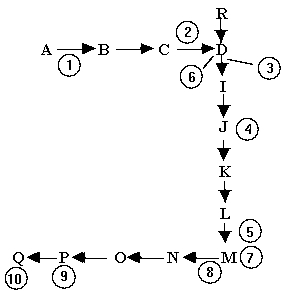
(Essay)
4.8/5 (85)
(85) 
Filters
- Essay(0)
- Multiple Choice(0)
- Short Answer(0)
- True False(0)
- Matching(0)