



 Chat with AI
Exam 5: Adaptation and Natural Selection

Exam 1: The Nature of Ecology57 Questions
Exam 2: Climate72 Questions
Exam 3: The Aquatic Environment71 Questions
Exam 4: The Terrestrial Environment93 Questions
Exam 5: Adaptation and Natural Selection76 Questions
Exam 6: Plant Adaptations to the Environment90 Questions
Exam 7: Animal Adaptations to the Environment80 Questions
Exam 8: Properties of Populations64 Questions
Exam 9: Population Growth63 Questions
Exam 10: Life History66 Questions
Exam 11: Intraspecific Population Regulation70 Questions
Exam 12: Species Interactions, population Dynamics, and Natural Selection55 Questions
Exam 13: Interspecific Competition65 Questions
Exam 14: Predation81 Questions
Exam 15: Parasitism and Mutualism81 Questions
Exam 16: Community Structure70 Questions
Exam 17: Factors Influencing the Structure of Communities62 Questions
Exam 18: Community Dynamics64 Questions
Exam 19: Landscape Dynamics62 Questions
Exam 20: Ecosystem Energetics67 Questions
Exam 21: Decomposition and Nutrient Cycling64 Questions
Exam 22: Biogeochemical Cycles81 Questions
Exam 23: Terrestrial Ecosystems68 Questions
Exam 24: Aquatic Ecosystems78 Questions
Exam 25: Coastal and Wetland Ecosystems66 Questions
Exam 26: Large-Scale Patterns of Biological Diversity59 Questions
Exam 27: The Ecology of Climate Change55 Questions
Select questions type


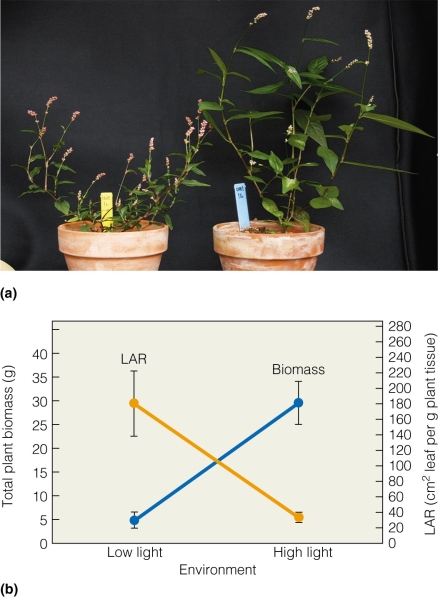 Plants grown under a medium light condition would exhibit how much biomass?
 (Multiple Choice)
4.8/5  (89)
(89) Squirrels tend to have larger body sizes at higher latitudes.This could be an example of
(Multiple Choice)
4.9/5 (77)
(77) Researchers Rosemary and Peter Grant have discovered that beak size frequency of Galápagos Island medium ground finch populations varies with all the following,except
(Multiple Choice)
4.9/5 (68)
(68) The tongue length of an animal is controlled by two alternative alleles at a single locus,L (long)and l (short).If an individual has parents that are both homozygous dominant,it will be
(Multiple Choice)
4.8/5 (84)
(84) Individual beak size of individual finches of the Galápagos Islands
(Multiple Choice)
4.7/5 (76)
(76) According to the Hardy-Weinberg principle,which of the following must be true for gene frequencies in a population to remain the same?
(Multiple Choice)
4.9/5 (75)
(75) The simplest response an individual organism can make to a change in environmental conditions is to
(Multiple Choice)
4.8/5 (90)
(90) A population of a species that is distinguishable from other populations by one or more characteristics is referred to as a(n)________.
(Short Answer)
4.7/5 (70)
(70) The specific traits of a particular organism enabling it to survive,grow,and reproduce within a given environment are called
(Multiple Choice)
4.9/5 (85)
(85) If birds with larger beaks are favored by the environment,it is likely that ________ selection will occur.
(Multiple Choice)
4.7/5 (86)
(86) What is the allele frequency of q in a population with genotypic frequencies of P = 0.3,H = 0.4,and Q = 0.3?
(Multiple Choice)
4.8/5 (82)
(82) The phenotypic trait that selection acts upon directly is referred to as the ________ of selection.
(Short Answer)
4.8/5 (90)
(90) The expression of different phenotypic traits for a given genotype under different environmental conditions is referred to as
(Multiple Choice)
4.8/5 (75)
(75) The position occupied by a gene on the chromosome is called the locus.
(True/False)
4.8/5 (91)
(91) ________ is the differential success of individuals in a population in response to environmental conditions.
(Short Answer)
4.9/5 (71)
(71) Gene flow is restricted between subspecies because of some extrinsic barrier,such as rivers or mountain ridges.
(True/False)
4.8/5 (89)
(89) A(n)________ is a population that has adapted to its unique local environmental conditions.
(Short Answer)
4.8/5 (81)
(81) 
Filters
- Essay(0)
- Multiple Choice(0)
- Short Answer(0)
- True False(0)
- Matching(0)