



 Chat with AI
Exam 11: Intraspecific Population Regulation

Exam 1: The Nature of Ecology57 Questions
Exam 2: Climate72 Questions
Exam 3: The Aquatic Environment71 Questions
Exam 4: The Terrestrial Environment93 Questions
Exam 5: Adaptation and Natural Selection76 Questions
Exam 6: Plant Adaptations to the Environment90 Questions
Exam 7: Animal Adaptations to the Environment80 Questions
Exam 8: Properties of Populations64 Questions
Exam 9: Population Growth63 Questions
Exam 10: Life History66 Questions
Exam 11: Intraspecific Population Regulation70 Questions
Exam 12: Species Interactions, population Dynamics, and Natural Selection55 Questions
Exam 13: Interspecific Competition65 Questions
Exam 14: Predation81 Questions
Exam 15: Parasitism and Mutualism81 Questions
Exam 16: Community Structure70 Questions
Exam 17: Factors Influencing the Structure of Communities62 Questions
Exam 18: Community Dynamics64 Questions
Exam 19: Landscape Dynamics62 Questions
Exam 20: Ecosystem Energetics67 Questions
Exam 21: Decomposition and Nutrient Cycling64 Questions
Exam 22: Biogeochemical Cycles81 Questions
Exam 23: Terrestrial Ecosystems68 Questions
Exam 24: Aquatic Ecosystems78 Questions
Exam 25: Coastal and Wetland Ecosystems66 Questions
Exam 26: Large-Scale Patterns of Biological Diversity59 Questions
Exam 27: The Ecology of Climate Change55 Questions
Select questions type


By organizing socially into a group,individual animals may benefit by
(Multiple Choice)
4.9/5  (78)
(78) The fewest number of individuals necessary to ensure the long term survival of a population is known as the
(Multiple Choice)
4.9/5 (89)
(89) Which of the following organisms would be most likely to present evidence of self-thinning?
(Multiple Choice)
4.7/5 (80)
(80) What might be an unforeseen outcome of planting soybean plants at high densities in a field?
(Multiple Choice)
4.7/5 (87)
(87) Fire is an example of a density-independent factor that affects the size of a population.
(True/False)
4.7/5 (69)
(69) The progressive decline in density and increase in biomass of remaining individuals in a population is known as ________-thinning.
(Short Answer)
4.9/5 (72)
(72) Increasing density does not affect the body mass of individual organisms.
(True/False)
5.0/5 (72)
(72) Instead of coping with stress,some animals ________ by leaving the population to seek vacant habitats.
(Short Answer)
4.7/5 (85)
(85) The form of competition in which growth and reproduction are depressed equally across individuals in a population as the intensity of competition increases is called
(Multiple Choice)
4.8/5 (85)
(85) A small population size of flowers can pose problems for the plant as a result of
(Multiple Choice)
5.0/5 (71)
(71) Competition among individuals of the same species is referred to as ________ competition.
(Short Answer)
4.8/5 (87)
(87) When experimental plants (e.g.,Atriplex prostrata)were grown at high densities,
(Multiple Choice)
4.9/5 (79)
(79) As intraspecific competition increases,growth and development are affected first,followed by individual survival and reproduction.
(True/False)
4.7/5 (80)
(80) 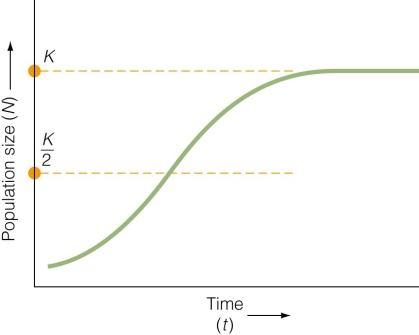 The figure depicts which type of population growth?
Which of the following represents an example of density-independent growth?
(Multiple Choice)
4.8/5 (88)
(88) 
Filters
- Essay(0)
- Multiple Choice(0)
- Short Answer(0)
- True False(0)
- Matching(0)