



 Chat with AI
Exam 12: Species Interactions, population Dynamics, and Natural Selection

Exam 1: The Nature of Ecology57 Questions
Exam 2: Climate72 Questions
Exam 3: The Aquatic Environment71 Questions
Exam 4: The Terrestrial Environment93 Questions
Exam 5: Adaptation and Natural Selection76 Questions
Exam 6: Plant Adaptations to the Environment90 Questions
Exam 7: Animal Adaptations to the Environment80 Questions
Exam 8: Properties of Populations64 Questions
Exam 9: Population Growth63 Questions
Exam 10: Life History66 Questions
Exam 11: Intraspecific Population Regulation70 Questions
Exam 12: Species Interactions, population Dynamics, and Natural Selection55 Questions
Exam 13: Interspecific Competition65 Questions
Exam 14: Predation81 Questions
Exam 15: Parasitism and Mutualism81 Questions
Exam 16: Community Structure70 Questions
Exam 17: Factors Influencing the Structure of Communities62 Questions
Exam 18: Community Dynamics64 Questions
Exam 19: Landscape Dynamics62 Questions
Exam 20: Ecosystem Energetics67 Questions
Exam 21: Decomposition and Nutrient Cycling64 Questions
Exam 22: Biogeochemical Cycles81 Questions
Exam 23: Terrestrial Ecosystems68 Questions
Exam 24: Aquatic Ecosystems78 Questions
Exam 25: Coastal and Wetland Ecosystems66 Questions
Exam 26: Large-Scale Patterns of Biological Diversity59 Questions
Exam 27: The Ecology of Climate Change55 Questions
Select questions type


In an area with high soil nutrient availability,mycorrhizal fungi are
(Multiple Choice)
5.0/5  (81)
(81) When one species feeds on another prey species,typically killing it,the relationship between the two interacting species is referred to as ________.
(Short Answer)
4.8/5 (87)
(87) The relationship between nectar-producing flowers and nectar-feeding birds is a mutually beneficial interaction.
(True/False)
4.8/5 (86)
(86) 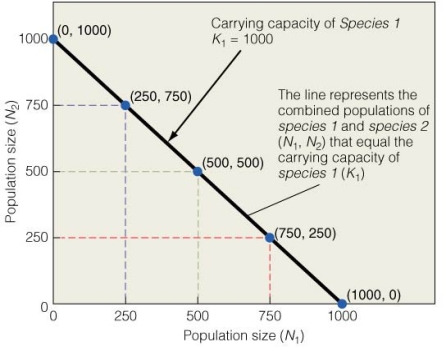 Which of the following has the strongest impact on species 1 population size? N₂ =
 (Multiple Choice)
4.9/5 (85)
(85) In comparison to desert habitats,urban landscapes on average have a
(Multiple Choice)
5.0/5 (75)
(75) When the relationship between two interacting species is detrimental to the populations of both species,the interaction is referred to as
(Multiple Choice)
4.9/5 (94)
(94) When each of two species benefits from their interaction,the relationship is referred to as ________.
(Short Answer)
4.7/5 (84)
(84) In a parasitic relationship between two species,the host species usually dies.
(True/False)
4.9/5 (81)
(81) An organism's realized niche is always smaller than its fundamental niche.
(True/False)
4.8/5 (68)
(68) 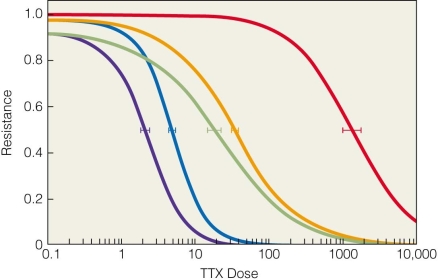 The red line in the figure (the furthest to the right)represents
 (Multiple Choice)
4.9/5 (88)
(88) The length of a butterfly tongue perfectly matches the nectar tube of a flower it pollinates.This is an example of
(Multiple Choice)
4.9/5 (80)
(80) The process whereby one species gives rise to several others that exploit different features of the environment is known as
(Multiple Choice)
4.7/5 (83)
(83) The interaction between two species usually influences all individuals within the respective populations equally.
(True/False)
4.8/5 (87)
(87) When a species of bird preys upon the seeds of a plant and favors the smallest seeds,
(Multiple Choice)
4.9/5 (86)
(86) When the population size of a prey species increases,the birthrate of a predator species should also increase.
(True/False)
4.9/5 (86)
(86) What might happen over time if two bird species competed for the same seed resource and one preferred larger seeds while the other species preferred smaller ones?
(Multiple Choice)
4.8/5 (76)
(76) On a dare,a student challenges another student to lick a California newt (Taricha torosa).From which population of newts should the student grab an individual to reduce his or her risk of a toxic dose?
(Multiple Choice)
4.8/5 (68)
(68) 
Filters
- Essay(0)
- Multiple Choice(0)
- Short Answer(0)
- True False(0)
- Matching(0)