



 Chat with AI
Exam 13: Interspecific Competition

Exam 1: The Nature of Ecology57 Questions
Exam 2: Climate72 Questions
Exam 3: The Aquatic Environment71 Questions
Exam 4: The Terrestrial Environment93 Questions
Exam 5: Adaptation and Natural Selection76 Questions
Exam 6: Plant Adaptations to the Environment90 Questions
Exam 7: Animal Adaptations to the Environment80 Questions
Exam 8: Properties of Populations64 Questions
Exam 9: Population Growth63 Questions
Exam 10: Life History66 Questions
Exam 11: Intraspecific Population Regulation70 Questions
Exam 12: Species Interactions, population Dynamics, and Natural Selection55 Questions
Exam 13: Interspecific Competition65 Questions
Exam 14: Predation81 Questions
Exam 15: Parasitism and Mutualism81 Questions
Exam 16: Community Structure70 Questions
Exam 17: Factors Influencing the Structure of Communities62 Questions
Exam 18: Community Dynamics64 Questions
Exam 19: Landscape Dynamics62 Questions
Exam 20: Ecosystem Energetics67 Questions
Exam 21: Decomposition and Nutrient Cycling64 Questions
Exam 22: Biogeochemical Cycles81 Questions
Exam 23: Terrestrial Ecosystems68 Questions
Exam 24: Aquatic Ecosystems78 Questions
Exam 25: Coastal and Wetland Ecosystems66 Questions
Exam 26: Large-Scale Patterns of Biological Diversity59 Questions
Exam 27: The Ecology of Climate Change55 Questions
Select questions type


________ competition results when nonterritorial behavioral interactions between two species result in negative effects on both species.
(Short Answer)
4.8/5  (75)
(75) Coexisting species of wild cats differ in the size of their canine teeth,which corresponds to differences in their preferred species of prey.This outcome is most likely the result of
(Multiple Choice)
4.8/5 (79)
(79) Removing individuals during a competition experiment may have direct and indirect effects on the environment that are not intended or understood by the investigators and that can influence the response of the remaining species.
(True/False)
4.9/5 (76)
(76) Which of the following is a nonresource (or nonconsumable resource)that can influence the outcome of competition among plant species?
(Multiple Choice)
4.9/5 (96)
(96) Interspecific competition involves individuals of two or more species vying for the same limited ________.
(Short Answer)
4.9/5 (89)
(89) The coexistence of competitors due to differences in the range of resources used or environmental tolerances is referred to as niche ________.
(Short Answer)
4.9/5 (83)
(83) Laboratory studies have confirmed that two different species can coexist while using the same resource.
(True/False)
4.9/5 (83)
(83) Climatic variation can function as a density-independent limitation on population density.
(True/False)
4.7/5 (87)
(87) The Lotka-Volterra equations predict the outcomes of ________ competition under different conditions.
(Short Answer)
4.9/5 (66)
(66) According to the Lotka-Volterra equations,which of the following is not an expected outcome of competitive interactions between two species?
(Multiple Choice)
5.0/5 (76)
(76) 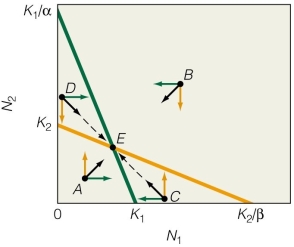 If the carrying capacity of species 2 was actually 50,what would the competitive outcome be?
 (Multiple Choice)
4.8/5 (77)
(77) The Russian biologist G.F.Gause was one of the first to support the Lotka-Volterra equations by studying the competitive interactions of ________ species.
(Short Answer)
4.9/5 (85)
(85) In Tilman's experiments with diatoms,what was the outcome when the two species competed for silica?
(Multiple Choice)
4.8/5 (86)
(86) A relationship that affects the populations of two or more species adversely is referred to as ________ competition.
(Short Answer)
4.8/5 (69)
(69) Differences among species may relate to adaptation for the ability to exploit a certain environment or range of resources independent of competition.
(True/False)
4.9/5 (73)
(73) According to the competitive exclusion principle,the populations of two species that live in the same place and have exactly the same ecological requirements
(Multiple Choice)
4.9/5 (70)
(70) 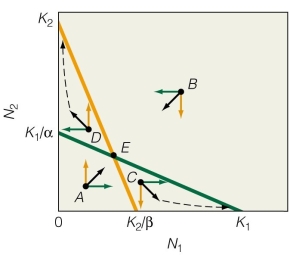 What is the outcome of these isoclines?
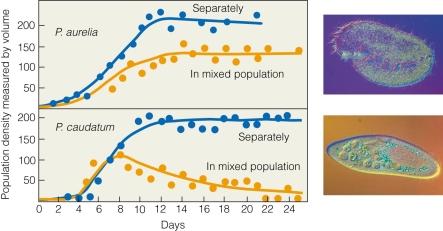 According to the figure,when these two species are combined in a culture,what will the outcome be?
 (Multiple Choice)
5.0/5 (95)
(95) 
Filters
- Essay(0)
- Multiple Choice(0)
- Short Answer(0)
- True False(0)
- Matching(0)