



 Chat with AI
Exam 19: Landscape Dynamics

Exam 1: The Nature of Ecology57 Questions
Exam 2: Climate72 Questions
Exam 3: The Aquatic Environment71 Questions
Exam 4: The Terrestrial Environment93 Questions
Exam 5: Adaptation and Natural Selection76 Questions
Exam 6: Plant Adaptations to the Environment90 Questions
Exam 7: Animal Adaptations to the Environment80 Questions
Exam 8: Properties of Populations64 Questions
Exam 9: Population Growth63 Questions
Exam 10: Life History66 Questions
Exam 11: Intraspecific Population Regulation70 Questions
Exam 12: Species Interactions, population Dynamics, and Natural Selection55 Questions
Exam 13: Interspecific Competition65 Questions
Exam 14: Predation81 Questions
Exam 15: Parasitism and Mutualism81 Questions
Exam 16: Community Structure70 Questions
Exam 17: Factors Influencing the Structure of Communities62 Questions
Exam 18: Community Dynamics64 Questions
Exam 19: Landscape Dynamics62 Questions
Exam 20: Ecosystem Energetics67 Questions
Exam 21: Decomposition and Nutrient Cycling64 Questions
Exam 22: Biogeochemical Cycles81 Questions
Exam 23: Terrestrial Ecosystems68 Questions
Exam 24: Aquatic Ecosystems78 Questions
Exam 25: Coastal and Wetland Ecosystems66 Questions
Exam 26: Large-Scale Patterns of Biological Diversity59 Questions
Exam 27: The Ecology of Climate Change55 Questions
Select questions type


The landscape can be thought of as a shifting mosaic of habitat patches,each in a phase of successional development.
(True/False)
4.9/5  (82)
(82) 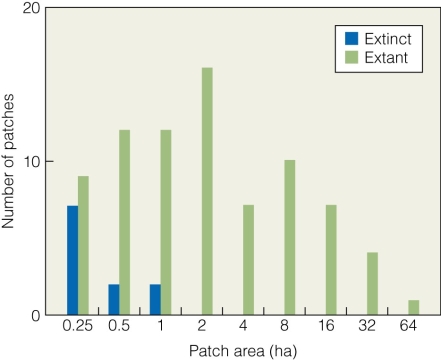 What does this figure suggest?
Patch size is generally more important for plant populations than for animal populations.
(True/False)
4.8/5 (77)
(77) The ________ effect refers to the rich diversity of life that occurs along the border between adjacent habitat patches,represented by species from both adjacent patches and species adapted to edge habitats.
(Short Answer)
4.8/5 (84)
(84) The theory of island biogeography predicts that large islands have more species than smaller islands.
(True/False)
4.7/5 (75)
(75) Habitat fragmentation is harmful because no species are adapted to living along habitat edges.
(True/False)
4.8/5 (83)
(83) The theory of island biogeography was developed for islands and cannot be applied to habitat patches within a larger landscape.
(True/False)
4.9/5 (70)
(70) Subpopulations within a metapopulation are isolated from one another with no movement of individuals between subpopulations.
(True/False)
4.8/5 (78)
(78) A(n)________ species lives within the borders of a habitat patch,avoiding edges where habitat change is abrupt.
(Short Answer)
4.9/5 (78)
(78) The patchwork of different types of land cover is called a(n)________.
(Short Answer)
4.8/5 (82)
(82) Island biogeography theory predicts that a 10-fold increase in area results in
(Multiple Choice)
4.9/5 (81)
(81) When a forest gradually merges into a grassland over a wide area,the border between the two landscape patches is referred to as a(n)
(Multiple Choice)
4.8/5 (77)
(77) Animal species inhabiting edges of habitat patches usually require two or more habitat types within their home range or territory.
(True/False)
4.9/5 (79)
(79) 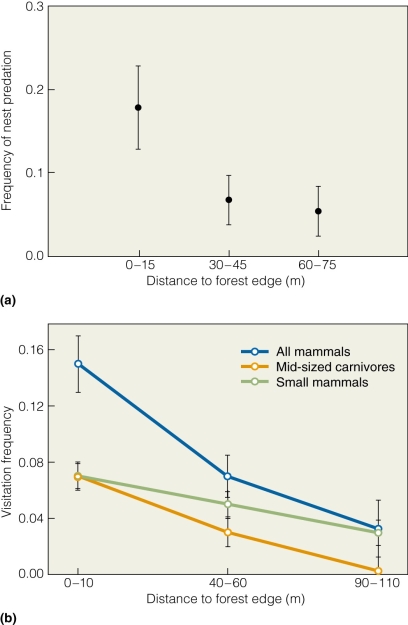 What do these data suggest?
Borders between patches that result from natural disturbances typically change over time.
(True/False)
4.9/5 (70)
(70) 
Filters
- Essay(0)
- Multiple Choice(0)
- Short Answer(0)
- True False(0)
- Matching(0)