



 Chat with AI
Exam 21: Decomposition and Nutrient Cycling

Exam 1: The Nature of Ecology57 Questions
Exam 2: Climate72 Questions
Exam 3: The Aquatic Environment71 Questions
Exam 4: The Terrestrial Environment93 Questions
Exam 5: Adaptation and Natural Selection76 Questions
Exam 6: Plant Adaptations to the Environment90 Questions
Exam 7: Animal Adaptations to the Environment80 Questions
Exam 8: Properties of Populations64 Questions
Exam 9: Population Growth63 Questions
Exam 10: Life History66 Questions
Exam 11: Intraspecific Population Regulation70 Questions
Exam 12: Species Interactions, population Dynamics, and Natural Selection55 Questions
Exam 13: Interspecific Competition65 Questions
Exam 14: Predation81 Questions
Exam 15: Parasitism and Mutualism81 Questions
Exam 16: Community Structure70 Questions
Exam 17: Factors Influencing the Structure of Communities62 Questions
Exam 18: Community Dynamics64 Questions
Exam 19: Landscape Dynamics62 Questions
Exam 20: Ecosystem Energetics67 Questions
Exam 21: Decomposition and Nutrient Cycling64 Questions
Exam 22: Biogeochemical Cycles81 Questions
Exam 23: Terrestrial Ecosystems68 Questions
Exam 24: Aquatic Ecosystems78 Questions
Exam 25: Coastal and Wetland Ecosystems66 Questions
Exam 26: Large-Scale Patterns of Biological Diversity59 Questions
Exam 27: The Ecology of Climate Change55 Questions
Select questions type


Which of the following are considered decomposer mesofauna?
(Multiple Choice)
4.9/5  (78)
(78) In an estuary,the zone of maximum vertical difference in density of water layers is called the
(Multiple Choice)
4.9/5 (70)
(70) Why do areas with high NPP typically have a high rate of nutrient cycling?
(Multiple Choice)
4.9/5 (79)
(79) 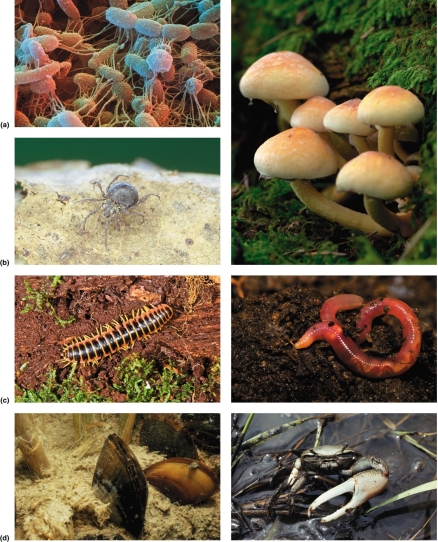 Which of the following are decomposers?
The breakdown of chemical bonds that were formed during the construction of plant and animal tissues is called ________.
(Short Answer)
4.9/5 (79)
(79) In salt marshes,only a small portion of primary production is consumed by herbivores.
(True/False)
4.9/5 (81)
(81) Litter degrades into a dark brown or black homogeneous organic matter known as ________.
(Short Answer)
4.8/5 (82)
(82) In an estuary,the zone of maximum vertical difference in density is called a(n)________.
(Short Answer)
4.9/5 (91)
(91) The process of conversion of nutrients from an organic form into an inorganic form that plants can use is called
(Multiple Choice)
5.0/5 (82)
(82) The rate of net primary productivity can be limited directly by the availability of
(Multiple Choice)
4.7/5 (72)
(72) 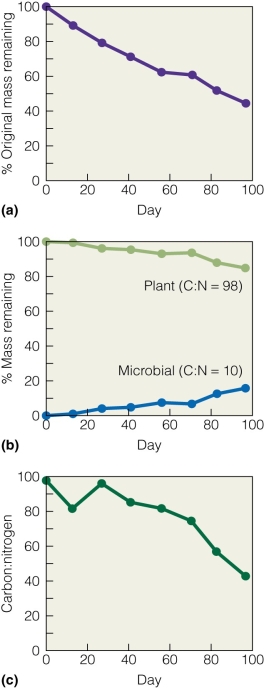 Why does the C/N ratio decline over time?
Which of the following variables is the coefficient that estimates decomposition rate?
(Multiple Choice)
4.7/5 (88)
(88) Estuaries receive nutrients both from tides and from streams and rivers.
(True/False)
4.9/5 (93)
(93) In open-water ecosystems,turnover prevents the movement of nutrients between the bottom and surface layers.
(True/False)
4.9/5 (67)
(67) 
Filters
- Essay(0)
- Multiple Choice(0)
- Short Answer(0)
- True False(0)
- Matching(0)