



 Chat with AI
Exam 23: Terrestrial Ecosystems

Exam 1: The Nature of Ecology57 Questions
Exam 2: Climate72 Questions
Exam 3: The Aquatic Environment71 Questions
Exam 4: The Terrestrial Environment93 Questions
Exam 5: Adaptation and Natural Selection76 Questions
Exam 6: Plant Adaptations to the Environment90 Questions
Exam 7: Animal Adaptations to the Environment80 Questions
Exam 8: Properties of Populations64 Questions
Exam 9: Population Growth63 Questions
Exam 10: Life History66 Questions
Exam 11: Intraspecific Population Regulation70 Questions
Exam 12: Species Interactions, population Dynamics, and Natural Selection55 Questions
Exam 13: Interspecific Competition65 Questions
Exam 14: Predation81 Questions
Exam 15: Parasitism and Mutualism81 Questions
Exam 16: Community Structure70 Questions
Exam 17: Factors Influencing the Structure of Communities62 Questions
Exam 18: Community Dynamics64 Questions
Exam 19: Landscape Dynamics62 Questions
Exam 20: Ecosystem Energetics67 Questions
Exam 21: Decomposition and Nutrient Cycling64 Questions
Exam 22: Biogeochemical Cycles81 Questions
Exam 23: Terrestrial Ecosystems68 Questions
Exam 24: Aquatic Ecosystems78 Questions
Exam 25: Coastal and Wetland Ecosystems66 Questions
Exam 26: Large-Scale Patterns of Biological Diversity59 Questions
Exam 27: The Ecology of Climate Change55 Questions
Select questions type


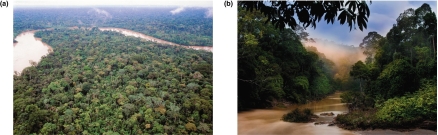 Which type of biome is depicted here?

________ is the perennially frozen subsurface that develops in boreal and arctic systems where the ground temperatures remain below 0°C for extended periods of time.
(Short Answer)
4.8/5  (92)
(92) Rainfall is greater in temperate deciduous forests than in temperate shrublands and grasslands.
(True/False)
4.8/5 (75)
(75) Increases in elevation are accompanied by decreases in temperature.The rate at which temperature drops as elevation increases is referred to as the dry adiabatic lapse rate,which gives a drop in temperature of rising unsaturated air of about 10°C for every 1000 meters.If the temperature is 25°C at the base of the mountain,what temperatures do organisms experience 3000 meters upslope?
(Multiple Choice)
4.8/5 (74)
(74) Tropical rain forests are restricted primarily to the ________ zone between latitudes 10° N and 10° S.
(Short Answer)
4.9/5 (85)
(85) Similar climates produce similar vegetation structure around the world.
(True/False)
4.7/5 (89)
(89) Which of the following is the predominant leaf form of environments where the growing season is very short or where nutrient availability severely constrains photosynthesis and plant growth?
(Multiple Choice)
4.9/5 (73)
(73) 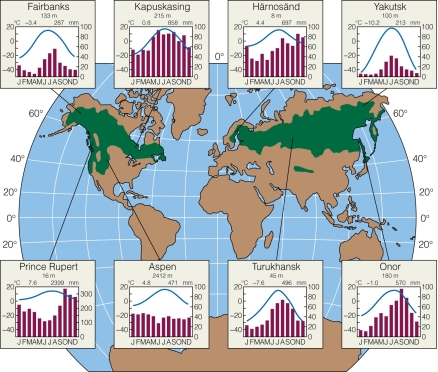 Which biome is represented by the map and climate diagrams?
 (Multiple Choice)
4.9/5 (82)
(82) Which of the following is not a type of temperate grassland?
(Multiple Choice)
4.9/5 (82)
(82) The largest and most continuous region of tropical rain forest in the world is in South America.
(True/False)
4.7/5 (75)
(75) What is the primary difference between savannas and tropical forests?
(Multiple Choice)
5.0/5 (94)
(94) Leaves that live for only a single year or growing season are classified as ________.
(Short Answer)
4.9/5 (79)
(79) A(n)________ climate is characterized by hot,dry summers and cool,moist winters.
(Short Answer)
4.7/5 (96)
(96) 
Filters
- Essay(0)
- Multiple Choice(0)
- Short Answer(0)
- True False(0)
- Matching(0)