



 Chat with AI
Exam 10: Infinite Series

Exam 1: Preliminaries101 Questions
Exam 2: Limits and Continuity105 Questions
Exam 3: Differentiation116 Questions
Exam 4: Applications of the Derivative118 Questions
Exam 5: Integration129 Questions
Exam 6: Applications of the Definite Integral85 Questions
Exam 7: Exponentials, Logarithms and Other Transcendental Functions66 Questions
Exam 8: Integration Techniques123 Questions
Exam 9: First-Order Differential Equations72 Questions
Exam 10: Infinite Series111 Questions
Exam 11: Parametric Equations and Polar Coordinates129 Questions
Exam 12: Vectors and the Geometry of Space107 Questions
Exam 13: Vector-Valued Functions103 Questions
Exam 14: Functions of Several Variables and Partial Differentiation112 Questions
Exam 15: Multiple Integrals92 Questions
Exam 16: Vector Calculus67 Questions
Exam 17: Second Order Differential Equations38 Questions
Select questions type


Determine whether the series is absolutely convergent, conditionally convergent, or divergent. 
(Multiple Choice)
4.8/5  (90)
(90) Imagine a ball dropped from a height of 40 meters. Each time it strikes the ground, it bounces 0.68 times as high as the previous bounce. Find the total distance the ball will travel if it is allowed to bounce indefinitely.
(Multiple Choice)
4.8/5 (70)
(70) Use the even/odd properties of  to predict (don't compute) whether the Fourier Series will contain only cosine terms, only sine terms or both.
 (Multiple Choice)
4.9/5 (83)
(83) Determine if  is absolutely convergent, conditionally convergent or divergent.
 (Multiple Choice)
4.8/5 (85)
(85) Find the power series representation (about c = 0), the radius of convergence, and the interval of convergence. 
(Multiple Choice)
5.0/5 (86)
(86) 
 converges or diverges. Show your work.
Determine whether the series is absolutely convergent, conditionally convergent, or divergent. 
(Multiple Choice)
4.8/5 (95)
(95) Determine if  is absolutely convergent, conditionally convergent or divergent.
 (Multiple Choice)
5.0/5 (83)
(83) Use a known Taylor series to find the Taylor series about c = 0 for  , and find its radius of convergence.
 (Multiple Choice)
4.8/5 (81)
(81) Find a power series representation and radius of convergence for  by integrating or differentiating a series.
 (Multiple Choice)
4.9/5 (76)
(76) Use a Taylor polynomial for of degree 3 for the function  to approximate
 about c = 1.
to approximate about c = 1. (Multiple Choice)
4.9/5 (76)
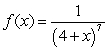
(76) 


Use the even/odd properties of  to predict (don't compute) whether the Fourier Series will contain only cosine terms, only sine terms or both.
 (Multiple Choice)
4.8/5 (75)
(75) Use graphical and numerical evidence to conjecture whether the series  converges or diverges. .


converges or diverges. . (Multiple Choice)
4.9/5 (78)
(78) 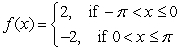 on the interval
 .
Find the Taylor series about c = 5 and its interval of convergence. 
(Multiple Choice)
4.8/5 (98)
(98)  on the interval
 .

Filters
- Essay(0)
- Multiple Choice(0)
- Short Answer(0)
- True False(0)
- Matching(0)