



 Chat with AI
Exam 8: Saving, Investment, and the Financial System

Exam 1: Ten Principles of Economics439 Questions
Exam 2: Thinking Like an Economist615 Questions
Exam 3: Interdependence and the Gains From Trade527 Questions
Exam 4: The Market Forces of Supply and Demand697 Questions
Exam 5: Measuring a Nations Income518 Questions
Exam 6: Measuring the Cost of Living543 Questions
Exam 7: Production and Growth507 Questions
Exam 8: Saving, Investment, and the Financial System565 Questions
Exam 9: The Basic Tools of Finance510 Questions
Exam 10: Unemployment and Its Natural Rate698 Questions
Exam 11: The Monetary System517 Questions
Exam 12: Money Growth and Inflation484 Questions
Exam 13: Open-Economy Macroeconomics: Basic Concepts520 Questions
Exam 14: A Macroeconomic Theory of the Open Economy478 Questions
Exam 15: Aggregate Demand and Aggregate Supply563 Questions
Exam 16: The Influence of Monetary and Fiscal Policy on Aggregate Demand510 Questions
Exam 17: The Short-Run Tradeoff Between Inflation and Unemployment516 Questions
Exam 18: Six Debates Over Macroeconomic Policy372 Questions
Select questions type


Which of the following restrictions implies that investment exceeds private saving for a closed economy?
(Multiple Choice)
5.0/5  (80)
(80) Which government policy raises the interest rate and raises investment spending?
(Short Answer)
4.8/5 (85)
(85) Figure 26-5. Figure 26-5 shows the loanable funds market for a closed economy. 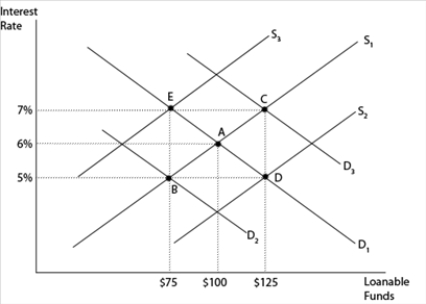 -Refer to Figure 26-5. Starting at point A, a reduction in government spending would cause
 (Multiple Choice)
4.9/5 (76)
(76) A government may use deficit financing to smooth tax rates over time.
(True/False)
4.7/5 (75)
(75) Explain why the demand for loanable funds slopes downward and why the supply of loanable funds slopes upward.
(Essay)
4.9/5 (83)
(83) A is a certificate of indebtedness and a is a claim to partial ownership in a firm.
(Short Answer)
4.9/5 (80)
(80) Use the following table to answer the following questions.
Table 26-2
 -Refer to Table 26-2. For which stocks) isare) the P/E ratio less than what is historically typical?
 (Multiple Choice)
4.8/5 (77)
(77) Suppose the Congress and president decreased the maximum annual contributions limits to retirement accounts and at the same time reduced the budget deficit. What would happen to the interest rate?
(Multiple Choice)
4.9/5 (83)
(83) Suppose the market for loanable funds is in equilibrium. What would happen in the market for loanable funds, other things the same, if the Congress and President increased the maximum contribution limits to 401k) and 403b) tax- deferred retirement accounts?
(Multiple Choice)
4.9/5 (89)
(89) When the government increases its borrowing, the budget _____ increases and government debt _____. The resulting change in investment due to this increased government borrowing is called _____.
(Short Answer)
4.8/5 (73)
(73) Use the following table to answer the following questions.
Table 26-2
-Refer to Table 26-2. Which company had the lowest earnings per share?
-Refer to Table 26-2. Which company had the lowest earnings per share? (Multiple Choice)
4.9/5 (86)
(86) When tax code changes reduce investment incentives, the _____ for loanable funds curve shifts to the _____. This results in an) _____ in the interest rate and an) _____ in investment.
(Short Answer)
4.8/5 (77)
(77) What variable adjusts to balance demand and supply in the market for loanable funds?
(Short Answer)
4.8/5 (78)
(78) Scenario 26-1. Assume the following information for an imaginary, closed economy.
GDP = $100,000; taxes = $22,000; government purchases = $25,000; national saving = $15,000.
-Refer to Scenario 26-1. For this economy, investment amounts to
(Multiple Choice)
4.9/5 (76)
(76) Suppose that Congress were to institute an investment tax credit. What would happen in the market for loanable funds?
(Multiple Choice)
4.8/5 (76)
(76) Scenario 26-3. Assume the following information for an imaginary, open economy.
Consumption = $1,000; investment = $200; net exports = -$50; taxes = $230; private saving = $225; and national saving = $150.
-Refer to Scenario 26-3. For this economy, GDP equals
(Multiple Choice)
4.8/5 (70)
(70) Larry buys stock in A to Z Express Company. Curly Corporation builds a new factory. Whose transaction would be an act of investment in the language of macroeconomics?
(Multiple Choice)
4.9/5 (74)
(74) Scenario 26-2. Assume the following information for an imaginary, closed economy.
GDP = $5 trillion; consumption = $3.1 trillion; government purchases = $0.7 trillion; and taxes = $0.9 trillion.
-Refer to Scenario 26-2. For this economy, investment amounts to
(Multiple Choice)
4.9/5 (76)
(76) 
Filters
- Essay(0)
- Multiple Choice(0)
- Short Answer(0)
- True False(0)
- Matching(0)