



 Chat with AI
Exam 8: Saving, Investment, and the Financial System

Exam 1: Ten Principles of Economics439 Questions
Exam 2: Thinking Like an Economist615 Questions
Exam 3: Interdependence and the Gains From Trade527 Questions
Exam 4: The Market Forces of Supply and Demand697 Questions
Exam 5: Measuring a Nations Income518 Questions
Exam 6: Measuring the Cost of Living543 Questions
Exam 7: Production and Growth507 Questions
Exam 8: Saving, Investment, and the Financial System565 Questions
Exam 9: The Basic Tools of Finance510 Questions
Exam 10: Unemployment and Its Natural Rate698 Questions
Exam 11: The Monetary System517 Questions
Exam 12: Money Growth and Inflation484 Questions
Exam 13: Open-Economy Macroeconomics: Basic Concepts520 Questions
Exam 14: A Macroeconomic Theory of the Open Economy478 Questions
Exam 15: Aggregate Demand and Aggregate Supply563 Questions
Exam 16: The Influence of Monetary and Fiscal Policy on Aggregate Demand510 Questions
Exam 17: The Short-Run Tradeoff Between Inflation and Unemployment516 Questions
Exam 18: Six Debates Over Macroeconomic Policy372 Questions
Select questions type


Suppose the Move It! exercise chain has revenues of $45 million, accounting costs of $15 million, and currently has issued 10 million shares of stocks selling at $90 each. Compute the price-earning ratio. Show your work. Is this ratio relatively high or low? What might an increase in the price-earnings ratio indicate?
(Essay)
4.8/5  (80)
(80) Bond A and Bond B have identical characteristics except that Bond A has a higher interest rate. Which bond has a higher credit risk?
(Short Answer)
4.8/5 (78)
(78) When someone borrows to purchase capital goods, he is using someone else's to fund his .
(Short Answer)
4.9/5 (81)
(81) If the nominal interest rate is 2.5 percent and the inflation rate is 2 percent, what is the real interest rate?
(Multiple Choice)
4.9/5 (72)
(72) A change in the tax laws that increases the supply of loanable funds will have a smaller effect on investment when
(Multiple Choice)
4.9/5 (74)
(74) Suppose the economy is closed with national saving of $3 trillion, consumption of $10 trillion, and government purchases of $4 trillion. What is GDP?
(Multiple Choice)
4.9/5 (69)
(69) If in a closed economy Y = $11 trillion, which of the following combinations would be consistent with national saving of $3 trillion?
(Multiple Choice)
4.9/5 (87)
(87) Figure 26-1. The figure depicts a demand-for-loanable-funds curve and two supply-of-loanable-funds curves. 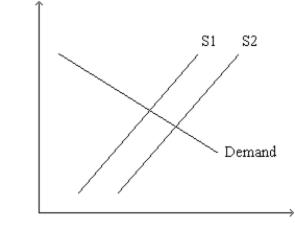 -Refer to Figure 26-1. What is measured along the vertical axis of the graph?
 (Multiple Choice)
4.7/5 (81)
(81) Mallard Corporation had a price-earnings ratio of 15, paid a dividend of $3, and retained earnings of $1 a share. What was the price of a share of Mallard stock?
(Multiple Choice)
4.9/5 (76)
(76) Which of the following would be included as investment in the GDP accounts?
(Multiple Choice)
4.9/5 (71)
(71) Which of the following is an example of financial intermediation?
(Multiple Choice)
4.7/5 (70)
(70) An increase in the government budget deficit causes national saving to _____, the interest rate to _____, and investment to _____.
(Short Answer)
4.8/5 (75)
(75) When an economy's government goes from running a budget deficit to running a budget surplus, the economy's long-run growth prospects are improved.
(True/False)
4.9/5 (76)
(76) When the government increases spending holding taxes constant), the budget balance _____. This causes the interest rate in the market for loanable funds to _____ and investment to _____.
(Short Answer)
4.9/5 (75)
(75) Scenario 26-2. Assume the following information for an imaginary, closed economy.
GDP = $5 trillion; consumption = $3.1 trillion; government purchases = $0.7 trillion; and taxes = $0.9 trillion.
-Refer to Scenario 26-2. For this economy, private saving is equal to
(Multiple Choice)
4.9/5 (84)
(84) In a closed economy, if Y and T remained the same, but G rose and C fell but by less than the rise in G, what would happen to public and national saving?
(Multiple Choice)
4.7/5 (81)
(81) On which of these bonds is the prospect of default most likely?
(Multiple Choice)
4.9/5 (95)
(95) As chief financial officer you sell newly issued bonds on behalf of your firm. Your firm is
(Multiple Choice)
4.7/5 (94)
(94) Suppose the U.S. offered a tax credit for firms that built new factories in the U.S. Then
(Multiple Choice)
4.8/5 (71)
(71) 
Filters
- Essay(0)
- Multiple Choice(0)
- Short Answer(0)
- True False(0)
- Matching(0)