



 Chat with AI
Exam 8: Saving, Investment, and the Financial System

Exam 1: Ten Principles of Economics439 Questions
Exam 2: Thinking Like an Economist615 Questions
Exam 3: Interdependence and the Gains From Trade527 Questions
Exam 4: The Market Forces of Supply and Demand697 Questions
Exam 5: Measuring a Nations Income518 Questions
Exam 6: Measuring the Cost of Living543 Questions
Exam 7: Production and Growth507 Questions
Exam 8: Saving, Investment, and the Financial System565 Questions
Exam 9: The Basic Tools of Finance510 Questions
Exam 10: Unemployment and Its Natural Rate698 Questions
Exam 11: The Monetary System517 Questions
Exam 12: Money Growth and Inflation484 Questions
Exam 13: Open-Economy Macroeconomics: Basic Concepts520 Questions
Exam 14: A Macroeconomic Theory of the Open Economy478 Questions
Exam 15: Aggregate Demand and Aggregate Supply563 Questions
Exam 16: The Influence of Monetary and Fiscal Policy on Aggregate Demand510 Questions
Exam 17: The Short-Run Tradeoff Between Inflation and Unemployment516 Questions
Exam 18: Six Debates Over Macroeconomic Policy372 Questions
Select questions type


The model of the market for loanable funds shows that an investment tax credit will cause interest rates to rise and investment to rise. Yet we also suppose that higher interest rates lead to lower investment. How can these two conclusions be reconciled?
(Essay)
4.9/5  (79)
(79) Suppose the government were to replace the income tax with a consumption tax so that interest on savings was not taxed. The result would be that the interest rate
(Multiple Choice)
4.9/5 (88)
(88) Figure 26-5. Figure 26-5 shows the loanable funds market for a closed economy. 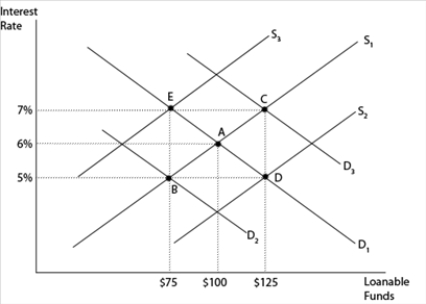 -Refer to Figure 26-5. Starting at point A, a change in tax laws that encouraged households to save more would likely cause
 (Multiple Choice)
5.0/5 (79)
(79) Bountiful Tractors has a share price of $60, retained earnings of $2 per share, and a dividend yield of 2 percent. What is Bountiful Tractor's priceearnings ratio?
(Multiple Choice)
4.9/5 (74)
(74) Scenario 26-2. Assume the following information for an imaginary, closed economy.
GDP = $5 trillion; consumption = $3.1 trillion; government purchases = $0.7 trillion; and taxes = $0.9 trillion.
-Refer to Scenario 26-2. For this economy, public saving is equal to
(Multiple Choice)
4.8/5 (75)
(75) Suppose a government that taxed all interest income changed its tax law so that the first $5,000 of a taxpayer's interest income was tax free. This would shift the
(Multiple Choice)
4.9/5 (79)
(79) If there is a shortage in the market for loanable funds, what happens to desired saving and desired investment as the interest rate moves to its equilibrium value?
(Multiple Choice)
4.8/5 (75)
(75) Suppose government expenditures on goods and services and net taxes both decrease, and expenditures fall by more than net taxes. The effects of these changes on the budget deficit cause
(Multiple Choice)
4.7/5 (74)
(74) Compared to short-term bonds, other things the same, long-term bonds generally have
(Multiple Choice)
4.7/5 (87)
(87) When the government budget deficit rises, national saving is reduced, interest rates rise, and investment falls.
(True/False)
4.9/5 (80)
(80) Bolivia had a smaller budget deficit in 2003 than in 2002. Other things the same, we would expect this reduction in the budget deficit to have
(Multiple Choice)
4.8/5 (85)
(85) Which of the following could explain an increase in the interest rate and the equilibrium quantity of loanable funds?
(Multiple Choice)
4.7/5 (86)
(86) 
Filters
- Essay(0)
- Multiple Choice(0)
- Short Answer(0)
- True False(0)
- Matching(0)