



 Chat with AI
Exam 8: Saving, Investment, and the Financial System

Exam 1: Ten Principles of Economics439 Questions
Exam 2: Thinking Like an Economist615 Questions
Exam 3: Interdependence and the Gains From Trade527 Questions
Exam 4: The Market Forces of Supply and Demand697 Questions
Exam 5: Measuring a Nations Income518 Questions
Exam 6: Measuring the Cost of Living543 Questions
Exam 7: Production and Growth507 Questions
Exam 8: Saving, Investment, and the Financial System565 Questions
Exam 9: The Basic Tools of Finance510 Questions
Exam 10: Unemployment and Its Natural Rate698 Questions
Exam 11: The Monetary System517 Questions
Exam 12: Money Growth and Inflation484 Questions
Exam 13: Open-Economy Macroeconomics: Basic Concepts520 Questions
Exam 14: A Macroeconomic Theory of the Open Economy478 Questions
Exam 15: Aggregate Demand and Aggregate Supply563 Questions
Exam 16: The Influence of Monetary and Fiscal Policy on Aggregate Demand510 Questions
Exam 17: The Short-Run Tradeoff Between Inflation and Unemployment516 Questions
Exam 18: Six Debates Over Macroeconomic Policy372 Questions
Select questions type


In which of the following cases would it necessarily be true that national saving and private saving are equal for a closed economy?
(Multiple Choice)
4.7/5  (82)
(82) Figure 26-3. The figure shows two demand-for-loanable-funds curves and two supply-of-loanable-funds curves.  -Refer to Figure 26-3. What, specifically, does the label on the vertical axis, i, represent?
 (Multiple Choice)
4.9/5 (86)
(86) On a graph that depicts the market for loanable funds, the nominal interest rate is measured along the vertical axis.
(True/False)
4.8/5 (81)
(81) Suppose the issuer of a bond fails to pay some of the interest or principal that was promised to the bondholders. This failure is referred to as a
(Multiple Choice)
4.7/5 (70)
(70) What happens to desired investment spending if the interest rate rises? Is this response relevant to the supply of loanable funds curve or the demand for loanable funds curve?
(Essay)
4.8/5 (63)
(63) Consider three different closed economies with the following national income statistics. Country A has taxes of $40 billion, transfers of $20 billion, and government expenditures on goods and services of $30 billion. County B has private savings of $60 billion, and investment expenditures of $40 billion. Country C has GDP of $300 billion, investment of $90, consumption of $180 billion, taxes of $60 billion and transfers of $20 billion. From this information, we know that
(Multiple Choice)
4.9/5 (69)
(69) Which of the following is not always correct for a closed economy?
(Multiple Choice)
4.9/5 (75)
(75) If in the past Congress had taken additional actions to make saving more rewarding, then today it is likely that the equilibrium interest rate
(Multiple Choice)
4.8/5 (76)
(76) Table 26-3. The following table presents information about a closed economy whose market for loanable funds is in equilibrium.
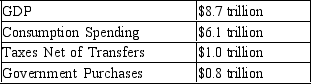 -Refer to Table 26-3. Determine the quantity of loanable funds demanded.
 (Multiple Choice)
4.8/5 (84)
(84) The slope of the supply of loanable funds is based on the logic that an increase in interest rates
(Multiple Choice)
4.8/5 (81)
(81) The sale of either stocks or bonds to raise money is known as equity finance.
(True/False)
4.8/5 (63)
(63) If the demand for loanable funds shifts to the right, then the equilibrium interest rate
(Multiple Choice)
4.9/5 (80)
(80) 
Filters
- Essay(0)
- Multiple Choice(0)
- Short Answer(0)
- True False(0)
- Matching(0)