



 Chat with AI
Exam 10: General Survey

Exam 1: Health Assessment29 Questions
Exam 2: Human Development Across the Lifespan29 Questions
Exam 3: Wellness and Health Promotion29 Questions
Exam 4: Cultural Considerations29 Questions
Exam 5: Psychosocial Assessment29 Questions
Exam 6: Assessment of Vulnerable Populations30 Questions
Exam 7: Interviewing and Communication Techniques30 Questions
Exam 8: The Health History28 Questions
Exam 9: Techniques and Equipment29 Questions
Exam 10: General Survey32 Questions
Exam 11: Pain Assessment29 Questions
Exam 12: Nutritional Assessment31 Questions
Exam 13: Skin, Hair, Nails29 Questions
Exam 14: Head, Neck, and Related Lymphatics34 Questions
Exam 15: Eye34 Questions
Exam 16: Ears, Nose, Mouth, and Throat34 Questions
Exam 17: Respiratory System31 Questions
Exam 18: Breasts and Axillae31 Questions
Exam 19: Cardiovascular System28 Questions
Exam 20: Peripheral Vascular System28 Questions
Exam 21: Abdomen29 Questions
Exam 22: Urinary System33 Questions
Exam 23: Male Reproduction System29 Questions
Exam 24: Female Reproduction System30 Questions
Exam 25: Musculoskeletal System32 Questions
Exam 26: Neurologic System34 Questions
Exam 27: Pregnant Females26 Questions
Exam 28: Hospitalized Patient25 Questions
Exam 29: Complete Health Assessment26 Questions
Select questions type


A young adult client notes height as "5 feet 11 inches" and weight as "200 lbs." Upon assessment, the client is found to be 5 feet 9 inches tall with a weight of 225 lbs. Which is the most likely cause of this discrepancy?
(Multiple Choice)
4.8/5  (70)
(70) The nurse is assessing a client who has suffered a cerebral vascular accident (CVA or stroke) and has difficulty with verbal expression, but no other deficits. What approach should the nurse use to assess this client's level of pain?
(Multiple Choice)
4.8/5 (72)
(72) During a physical assessment the client asks the nurse repeatedly, "Is everything ok?" The nurse concludes which for this client?
(Multiple Choice)
4.8/5 (88)
(88) The nurse is assessing a toddler when the child's mother states that the child has had a fever for the past two days. When the nurse asks the mother what the temperature has been, the mother replies that she hasn't actually taken it but the child's skin has felt very warm. Which response by the nurse is appropriate in this situation?
(Multiple Choice)
4.9/5 (89)
(89) A nurse has been asked to present a program on blood pressure for a group of adults at a community center. Which statement is appropriate for the nurse to include in the program?
(Multiple Choice)
4.9/5 (84)
(84) During the evening assessment of a febrile client admitted to the nursing unit with abdominal pain, the nurse assesses a lower than normal blood pressure and a rapid pulse. What is the most likely cause of these findings?
(Multiple Choice)
4.8/5 (80)
(80) The unlicensed assistive personnel (UAP) brings the nurse the following vital signs for an older adult client: Temperature 97.4ºF (oral), BP 165/70, pulse rate 84/min., and respirations 28. After reviewing the vital signs, which action by the nurse is the most appropriate?
(Multiple Choice)
4.9/5 (90)
(90) The nurse is assessing a client's left brachial pulse. Which area will the nurse palpate to assess this pulse? 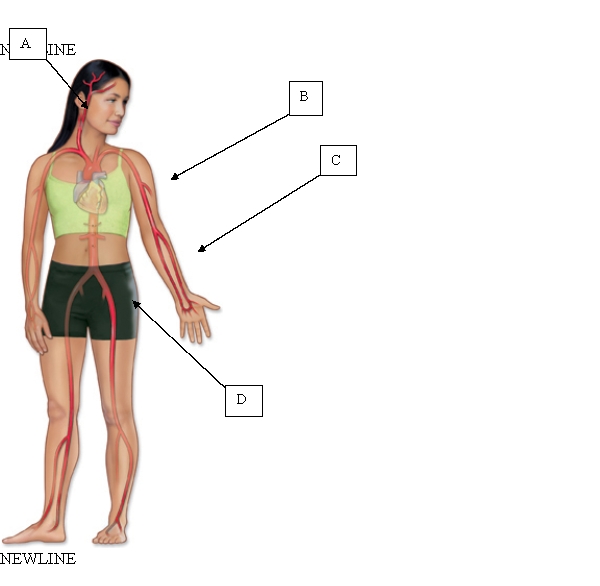
(Multiple Choice)
4.9/5 (70)
(70) The nurse is assessing an older adult client with arteriosclerosis and obtains a blood pressure reading of 172/98 mmHg. Which factors may be applicable in this situation?
(Multiple Choice)
4.8/5 (88)
(88) The nurse is conducting a class on hypertension, when a client asks what the numbers in the blood pressure mean. Which statements would the nurse correctly use to answer the client's question?
(Multiple Choice)
4.8/5 (82)
(82) While interviewing a client, the nurse observes that the client is changing position frequently, wringing hands, and laughing at inappropriate times. Which would be appropriate for the nurse to include in the assessment based on this information?
(Multiple Choice)
4.9/5 (67)
(67) The night nurse is reviewing the vital signs of a client in an extended care facility. The nurse notes the client's oral temperature at 6 a.m. was 98.0°F, but that evening, the client's oral temperature was 99.2°F. What is this variation indicative of?
(Multiple Choice)
4.8/5 (77)
(77) 
Filters
- Essay(0)
- Multiple Choice(0)
- Short Answer(0)
- True False(0)
- Matching(0)